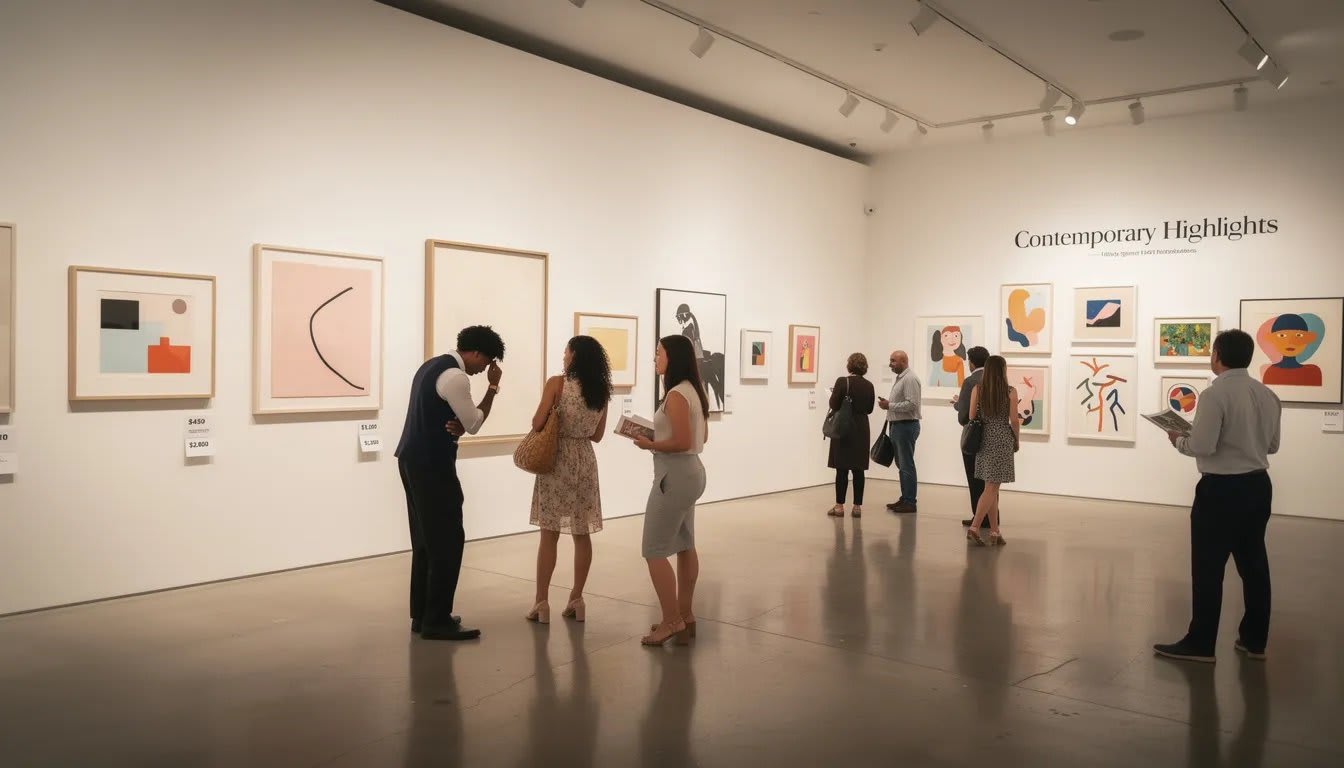
In 2026, a remarkable trend is emerging in the contemporary art market: accessible works priced between €5,000 and €50,000 are not just gaining traction; they are redefining value and opportunity for discerning collectors.
Introduction: The Market Data That's Changing Everything
Something remarkable is occurring within the contemporary art market, and it is unfolding in a territory that has often gone unnoticed. While headlines fixate on record-breaking sales of blue-chip masterworks, the true narrative of 2026 is emerging from a very different segment: accessible contemporary art, art priced between €5,000 and €50,000.
According to recent research from the prestigious art market newsletter Puck, which scrutinized the November 2025 New York auctions, this lower-priced segment achieved a striking hammer ratio of 1.57—indicating that works sold for an average of 157% of their estimated values. Such dramatic outperformance, validated by the latest Art Basel and UBS Global Art Market Report, signifies a paradigm shift in collector behavior and market dynamics.
At LLB Auction, we have witnessed this transformation firsthand, as evidenced by our sales results throughout 2025 and into early 2026. Works by emerging and mid-career contemporary artists—pieces embodying genuine quality and artistic vision at accessible price points—are consistently exceeding estimates, attracting competitive bidding, and fostering sustained collector followings.
The accessible art revolution transcends mere pricing. It articulates a sophisticated redefinition of value, risk, and opportunity within contemporary collecting.
Understanding the Data: What the Numbers Actually Mean
The remarkable hammer ratio of 1.57 for lower-priced works presents a statistically significant finding that commands attention. For context, blue-chip works at the same auctions attained hammer ratios closer to 1.0, implying that they sold roughly at their estimated values. Some ultra-high-value lots even struggled to secure buyers.
This performance gap uncovers several pivotal market realities. First, demand at accessible price points is robust and expanding. Second, estimates for emerging and mid-career artists are conservatively set, thereby providing opportunities for buyers to acquire work below its true market value. Third, the buyer demographic for accessible contemporary art is broadening at a pace faster than supply, generating competitive pressure that escalates prices upwards.
The Art Basel and UBS report amplifies these insights, providing additional context: while the overall value of the global art market contracted in 2024, transaction volumes increased. More collectors are engaging with art, but at lower average price points. This phenomenon is not indicative of a market weakness—it reflects a process of democratization.
For collectors, the implications are clear. The lower-price segment offers superior price discovery, stronger performance relative to estimates, and access to artists whose careers are actively evolving rather than having reached a state of established equilibrium.
Why Accessible Contemporary Art is Outperforming
Several structural and psychological factors clarify why accessible works are currently outperforming their blue-chip counterparts.
Economic Uncertainty and Risk Distribution: In times of economic volatility—such as those characterizing much of 2024 and early 2025—collectors instinctively seek to distribute risk. Rather than investing €500,000 in a singular blue-chip acquisition, astute buyers are curating diversified collections comprising five to ten works within the €30,000–€100,000 range. This approach not only provides exposure across an array of artists, periods, and styles, but also mitigates downside risks associated with any single acquisition.
The Emerging Artist Premium: Works by emerging and mid-career artists embody genuine upside potential that established blue-chip artists cannot rival. A painting by Richard Prince (b. 1994), whose sun-drenched compositions are garnering escalating international acclaim, or Eva Santer, whose surrealist creations entered the competitive international market through strategic auction placements, signify the promise of substantial appreciation as these artists' reputations flourish. On the other hand, blue-chip works by long-established artists offer stability but lack significant growth potential.
Generational Shift in Collector Demographics: Younger collectors, typically in their 30s and 40s, are entering the market and driving transaction volume growth at accessible price points. They prioritize discovery, personal connection, and long-term potential over immediate status signaling. This generation adopts different shopping habits, engages in independent research, and values authenticity over mere brand recognition.
Quality at Every Price Point: Most importantly, accessible does not mean amateur. Artists like Mira Langston, whose vibrant abstract creations meld emotional depth with sophisticated technical execution, or Antonia Beauvoir, whose baroque canvases exhibit extraordinary painterly mastery, are creating museum-quality work priced in alignment with their emerging rather than established status. Collectors are keenly aware that exceptional quality exists throughout the price spectrum.
The Artists Driving the Accessible Segment: LLB Auction's Perspective
The accessible art revolution manifests not just as a concept, but through the practices and market performances of specific artists whose works blend exceptional quality with strategic pricing.
Richard Prince (b. 1994): Architectural Vision at Accessible Entry Points
Contemporary artist Richard Prince (b. 1994) crafts idealized landscapes inspired by modern architecture, tropical environments, and contemporary leisure spaces. His figurative paintings—vivid depictions of sun-drenched swimming pools, coastal cities, lush gardens, and winding roads—form a visual universe that is both escapist and contemporary.
Prince's art occupies a strategic position in the market. Priced sufficiently to attract first-time serious collectors, his paintings simultaneously demonstrate the technical quality and conceptual depth necessary to support long-term value appreciation. As his international exhibition history expands and institutional recognition grows, early collectors who acquire his work now stand to benefit before broader market acknowledgment drives prices higher.
This trajectory—accessible entry point, demonstrated quality, and growing recognition—epitomizes the optimal scenario for emerging artist collecting. It is precisely the dynamic propelling outperformance in the lower-price segment.
Mira Langston: Established Vision, Accessible Opportunity
American artist Mira Langston (b. 1971) offers a different yet equally captivating opportunity within the accessible segment. With decades of artistic practice behind her and an established aesthetic vocabulary focused on abstract explorations of nature, light, and emotional resonance, Langston delivers quality and maturity typically reserved for higher price points.
Her acclaimed series Harmony in Motion—organic abstractions that evoke water, movement, and natural rhythms—demonstrates an advanced understanding of color, composition, and materiality. Since commencing sales through LLB Auction in 2024, her work has consistently met or exceeded estimates, underscoring collector appetite for mature artistic visions offered at accessible prices.
Langston's market position reinforces a crucial principle: price does not always align flawlessly with quality or an artist's career stage. Artists whose work has yet to achieve widespread institutional recognition or secondary market depth can provide exceptional value to discerning collectors willing to look beyond names alone.
Antonia Beauvoir: Baroque Mastery Without Blue-Chip Premium
French artist Antonia Beauvoir creates technically accomplished paintings that would command considerably higher prices if attributed to an artist with a more extensive institutional exhibition history. Her baroque and romantic canvases—portraying female figures veiled in flora and fabrics—delve into explorations of fragility, identity, and life cycles, showcasing painterly mastery that rivals those priced multiples above her current market position.
Beauvoir's oeuvre has been exhibited in France and across international venues, establishing the kind of provenance and critical acknowledgment that typically heralds significant price appreciation. Collectors acquiring her work at present position themselves ahead of the curve—gaining access to museum-quality paintings at emerging artist rates.
This notion encapsulates the opportunity fueling performance in the accessible segment: identifying artists whose quality surpasses their prevailing market recognition, thereby acquiring work before the gap diminishes.
Eva Santer: Surrealist Precision for Informed Collectors
Belgian artist Eva Santer (b. 1988) made her debut on the international art scene through a sale at LLB Auction in 2023, and her trajectory since affirms the merit of strategic acquisition in the accessible segment. Her surrealist paintings, executed with remarkable photographic precision and conceptual depth inspired by René Magritte, grant collectors entry into an established artistic lineage at accessible price points.
Santer represents the type of artist that astute collectors actively seek: genuine technical mastery, a clear art historical foundation, conceptual intelligence, and a market position that has yet to fully reflect her caliber. As her exhibition history expands and critical recognition deepens, early collectors benefit from having identified and acquired her work before broader consensus drives prices higher.
Strategic Collecting in the Accessible Segment
For collectors striving to approach the accessible contemporary art market strategically, several principles merit consideration.
Research is Non-Negotiable: At accessible price points, brand recognition offers less clarity. Collectors must cultivate independent judgment regarding quality, potential, and worth. This entails attending exhibitions, studying auction results, understanding an artist's training and influences, and forging relationships with specialists capable of providing informed insights.
Diversification Creates Opportunity: Instead of concentrating resources into a solitary acquisition, building a diverse collection comprising five to ten works by varied artists allows exposure to multiple potential trajectories. Some works will appreciate significantly, while others may plateau, yet a portfolio approach manages risk while preserving upward potential.
Quality Over Bargains: The accessible segment encompasses genuine opportunities alongside works that are merely economically priced due to a lack of quality or originality. Distinguishing between these subsets necessitates discernment. A €30,000 piece from an artist with demonstrated skill, coherent vision, and growing recognition represents a far superior acquisition than a €10,000 creation from an artist devoid of these attributes.
Timing Matters: The accessible segment evolves more rapidly than blue-chip markets. An artist currently priced at €15,000 today may very well command €40,000 in three years should their career trajectory unfold favorably. Collectors who can pinpoint quality early and secure acquisitions prior to broader acknowledgment reap disproportionate benefits.
The Role of Auction Houses in the Accessible Segment
Auction houses like LLB Auction occupy a crucial role within the accessible contemporary art ecosystem. We provide market validation, price discovery, and access to works that may otherwise remain visible solely through individual galleries with limited reach.
For emerging and mid-career artists, auction placement facilitates exposure to international collectors, documented pricing history, and the credibility associated with institutional endorsement. Conversely, for collectors, auctions offer transparent pricing information, competitive bidding ensuring fair market value, and access to works by artists they may not encounter through gallery avenues alone.
Our 20% buyer's premium, along with comprehensive services—such as professional photography, detailed condition reports, expert cataloguing, and international marketing—enhances LLB Auction's appeal to the accessible segment, where cost efficiency is paramount, and collectors demand transparency.
Market Outlook: Is This Sustainable?
The pressing question is whether the accessible segment's outperformance signifies a lasting shift or merely a temporal anomaly. The evidence suggests durability.
The demographic trajectories propelling demand for accessible art—namely, younger collectors, diversification strategies, and digital natives who are comfortable with autonomous research—are unlikely to reverse course. The economic considerations favoring distributed risk over concentrated investments remain relevant amid an uncertain global landscape. Furthermore, the imbalance between supply and demand—characterized by a growing collector base and limited availability of quality work at accessible prices—indicates a structural foundation for sustained vitality.
Nonetheless, not every piece of accessible contemporary art is destined for appreciation, and the segment inherently carries risk. Artists whose careers fail to flourish, works that prove less durable than anticipated, and acquisitions made without sufficient due diligence can underperform. The accessible segment rewards informed collecting while punishing speculative purchases motivated by hype rather than substantiated quality.
Conclusion: The Smart Money is Moving
The market data reflected in 2025 and early 2026 illustrate a lucid narrative: the accessible contemporary art segment is where discerning collectors are unearthing the most favorable opportunities. Works priced between €5,000 and €50,000 are consistently outperforming estimates, eliciting competitive bidding and offering real prospects for appreciation that blue-chip works can no longer reliably deliver.
At LLB Auction, we maintain our commitment to serve this evolving market by showcasing exceptional works from artists like Richard Prince (b. 1994), Mira Langston, Antonia Beauvoir, Eva Santer, and others whose practices seamlessly integrate quality, vision, and accessible pricing. These are not mere consolation prizes for collectors unable to acquire blue-chip art; rather, they represent strategic investments by sophisticated buyers who comprehend that value, quality, and opportunity exist across the entire price spectrum.
The accessible art revolution is about more than settling for less; it is about recognizing that the most compelling opportunities in contemporary collecting arise where quality surpasses recognition—and having the audacity to act upon that insight.
Keywords for SEO: accessible contemporary art, affordable art investment, emerging artists 2026, art market trends, lower price segment art, contemporary art under 50k, art investment strategy, LLB Auction, Richard Prince 1994, Mira Langston, Antonia Beauvoir, Eva Santer, art collecting tips, auction performance data, Art Basel report 2026
Discover accessible contemporary works by Richard Prince (b. 1994), Mira Langston, Antonia Beauvoir, Eva Santer, and other extraordinary artists at LLB Auction. Contact our specialists to discuss strategic collecting in the accessible segment.
Thank you for being part of the LLB Auction community.
The LLB Auction Team