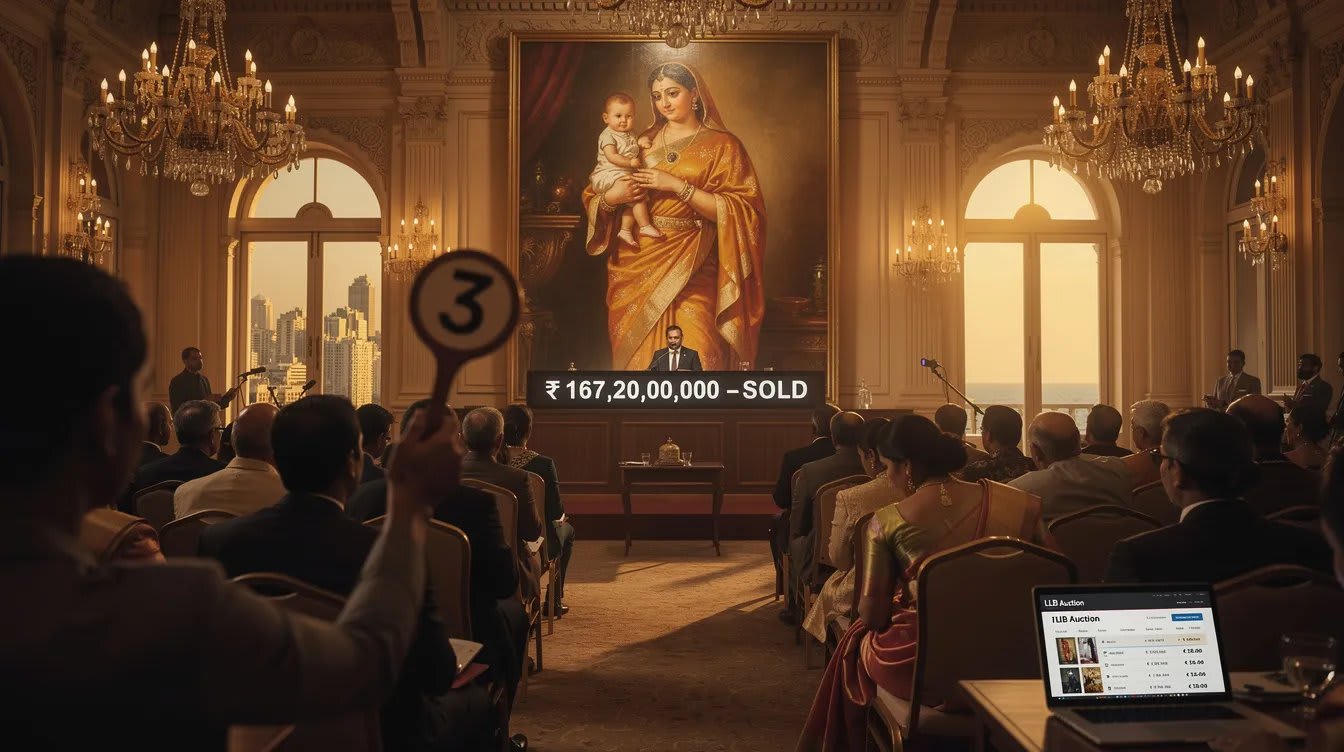
April 2026 marks a pivotal moment in the art world as Raja Ravi Varma's 'Yashoda and Krishna' shatters records, heralding a new era for Indian art in the global marketplace.
Published by LLB Auction — Luxembourg's Contemporary Art Auction House | Friday 3 April 2026
On 1 April 2026— a date that might elicit laughter but instead delivered pivotal news— a remarkable painting by acclaimed artist Raja Ravi Varma was sold at Saffronart's Spring Live Auction in Mumbai for ₹167.2 crore: $17.9 million.
The exquisite piece, Yashoda and Krishna, painted during the 1890s at the zenith of Varma's career, depicts the infant deity Krishna alongside his devoted foster mother. This intimate tableau of domesticity shines through Varma's signature synthesis of European academic realism and Indian mythological themes. Notably, this artwork's pre-sale estimate ranged from ₹80 to 120 crore, yet the final sale price astonishingly surpassed the lower estimate, achieving more than double its anticipated value.
The buyer, Cyrus Poonawalla—founder of the Serum Institute of India, one of the globe's leading vaccine manufacturers, and recognized as India's fourth richest family in 2026—proclaimed the artwork to be "a national treasure," vowing to ensure its availability for periodic public viewing.
This sale obliterated the previous record for Indian art at auction, previously held by MF Husain's Gram Yatra, which had grossed $13.7 million in 2025, exceeding it by over 30%. The bidding was fiercely competitive, leading to a historic result that represents one of the most significant developments within the global art market this week.
Why This Record Changes the Conversation
The Indian art market is currently experiencing what experts term a "bull run"— a sustained phase characterized by soaring prices, heightened collector engagement, and expanding international interest in art once regarded as solely domestic.
While this phenomenon is not entirely newfound, the recent Raja Ravi Varma result adds a new level of significance.
Ashish Anand, CEO of DAG gallery, emphasized that the monumental price reflects a maturing market alongside a burgeoning global enthusiasm for traditional Indian artistic forms. Minal Vazirani, co-founder of Saffronart, articulated that the sale serves as "a reminder of the enduring cultural and emotional resonance of Indian art."
Beyond individual acclaim, the underlying signal reveals a structural transformation. Unlike Husain, whose international market has been meticulously cultivated over decades, Varma has traditionally appealed to a domestic audience, resonating within the public consciousness of India. As one commentator noted, Varma represents, "an artist for the masses, with works deeply embedded in Indian cultural and visual heritage." The fact that Varma now holds the title of the most expensive Indian painting sold at auction signifies that price ceilings are dictated not by international validation but by the heartfelt conviction of Indian collectors.
Moreover, experts assert that scarcity plays a crucial role in escalating prices. Many iconic pieces from revered artists like Varma, Amrita Sher-Gil, and VS Gaitonde are typically found in private collections or infrequently surface at auction. This limited availability, coupled with a growing demand from India's increasing base of ultra-high-net-worth individuals, propels valuations to unprecedented heights.
The trajectory is evident. The $13.7 million record held by Husain lasted less than a year before it was eclipsed. The $17.9 million record for Varma may face a similar fate before 2026's conclusion.
The Global Pattern: Four Markets, One Signal
The Raja Ravi Varma sale is not an isolated occurrence. It is part of a global trend that has become increasingly obvious over the past month.
In London in early March, Sotheby's reported a staggering 110% increase, while Christie's saw a rise of 52%. The auction houses achieved near-perfect sell-through rates, with Henry Moore's record-setting piece fetching £26.3 million.
In Hong Kong at Art Basel and concurrent auctions, Christie's recorded a 100% sell-through on 37 lots, with a combined auction total of $160 million across three auction houses. Notably, Sanyu more than doubled its estimate, and Joan Mitchell set a new record as the most expensive artwork by a female artist sold in Asia.
In Mumbai just yesterday, Raja Ravi Varma's work claimed the title of the most expensive Indian painting ever sold at auction, achieving a record more than double its initial low estimate.
This pattern unifying three continents over four weeks underscores a consistent theme: works of quality, genuine scarcity, and remarkable provenance are being eagerly acquired by conviction-driven collectors at prices that defy expectations. The speculative market of 2020-2022 penalized fleeting buyers. In contrast, the disciplined market of 2026 rewards long-term holders and sincere collectors.
This is the market that LLB Auction was destined to serve, a moment in time where the guiding principles on which we operate are validated across various price levels and geographies.
The Indian Market Signal for European Collectors
The ascent of the Indian art market bears direct implications for European collectors that extend beyond mere academic curiosity.
India is now home to one of the globe's fastest-growing populations of ultra-high-net-worth individuals. Significant cultural institutions, such as the Guggenheim Abu Dhabi, are set to launch in June 2026. Art Basel Qatar inaugurated its first edition in February, while Frieze Abu Dhabi is set to debut in November. The Gulf and South Asia are rapidly being assimilated into the global art market framework, a development that will redefine price discovery for an expansive array of artists and artworks.
For European collectors engaging with LLB Auction, two distinct opportunities arise:
- First: prominent artists of the Indian Modern tradition—Husain, Gaitonde, Sher-Gil, Tyeb Mehta—show a secondary market presence at price ranges accessible to European auction platforms. Works on paper, prints, and smaller canvases by these artists are available in the €5,000 to €50,000 range. The validation provided by high-profile results in Mumbai strengthens these secondary market positions, making them increasingly transparent.
- Second: the structural dynamics driving the recent Indian record—characterized by scarcity, provenance, and conviction-driven collecting—parallels trends observed in London, Hong Kong, and other major markets this spring. Collectors who comprehend these dynamics and effectively apply them at accessible price points—through platforms featuring low fees, transparent costs, and stringent authentication—find themselves ideally positioned in a market rewarding sound investment behavior.
What LLB Auction Offers in This Moment
The art market as of April 2026 is thriving across every major geography. With signals aligned in London, Hong Kong, and Mumbai, the lessons are consistently affirmed:
- Quality prevails.
- Provenance matters.
- Scarcity drives interest.
- Long-term conviction pays off.
LLB Auction provides European collectors with access to this unique moment at price levels positioned to be both accessible and economically sensible. The buyer's premium stands at 20%, in contrast to Sotheby's 28% and Christie's 27%, both of which have recently seen increases. Shipping within Europe through DHL costs between €150 to €450, inclusive of full insurance and professional packaging. Our expert team authenticates every lot before the initial bid is placed.
The artists featured in LLB's collection embody the principles that drove the remarkable $17.9 million achievement for Raja Ravi Varma in Mumbai: genuine scarcity, comprehensive documentation, and practices designed for the long-term collector's confidence.
Richard Prince (1994)—whose work is grounded in contemporary cultural discourse, conceptually engaging and available at entry points poised for future appreciation.
Antonia Beauvoir—notable for singular figurative paintings, each with provenance traceable from inception, ideal for collectors seeking works that transition seamlessly from gallery to personal collection over decades.
Ansou Niabaly—a painter exuding visceral energy, bridging geographic narratives that resonate with a global audience looking for artists addressing larger cultural dialogues.
Yun Sé—characterized by deliberate production limits, establishing an Eastern-Western dialogue through formal rigor. This scarcity is inherently woven into the fabric of the artist’s practice.
Léa Véris and Eva Santer—both artists demonstrate material intelligence and psychological precision, establishing long-term practices rooted in an acute understanding of their crafts.
Each of these artists is now available, positioned within price ranges that promote acquisition, holding, and rational resale potential. They exemplify the principles that materialized the unprecedented $17.9 million record in Mumbai.
The Week in Summary: March Closes, April Opens
As the first full week of April 2026 dawns, the overview from March has come to completion.
In London, record results emerged with near-perfect sell-through rates, demonstrating sustained confidence across all price levels.
This year's Art Basel Hong Kong attracted 91,500 visitors and generated $160 million in auction results, showcasing demand across a wide spectrum from $6,300 to $3.8 million.
The result in Mumbai—the most expensive Indian painting in auction history—was achieved by a committed long-term collector exceeding its estimate by more than double.
Three markets. Three continents. One unified signal.
The art market is not uniformly healthy, as the speculative hype of 2021 and 2022 has been methodically eradicated. Works that fail to meet estimates demonstrate valuable lessons, just as those that surpass them. However, for collectors who approach the market with discipline, a focus on quality, and a long-term perspective, April 2026 presents one of the most promising entry points in recent memory.
At LLB Auction, this opportunity is at your fingertips today—spanning the €5,000 to €50,000 range, accompanied by a 20% buyer's premium, transparent logistics, and rigorous authentication designed to elevate a purchase into a well-documented collection.
The frontier is not a distant reality. It is already here.
LLB Auction is a Luxembourg-based online auction house specializing in contemporary art priced between €5,000 and €50,000. Buyer's premium: 20%. Shipping via DHL with full insurance: €150–€450 within Europe. Expert authentication is conducted on every lot. Browse current lots and upcoming sales at llb-auction.com.
Tags: India art market 2026, Raja Ravi Varma auction record, Cyrus Poonawalla Saffronart, Indian painting record $17.9 million, global art market April 2026, LLB Auction Luxembourg, buy contemporary art online Europe, 20% buyer's premium auction, art market recovery 2026, scarcity provenance art, Richard Prince 1994, Antonia Beauvoir, Ansou Niabaly, Yun Sé, Léa Véris, Eva Santer, online art auction Luxembourg, contemporary art €5000 €50000, South Asian art market 2026
Thank you for being part of the LLB Auction community.
The LLB Auction Team