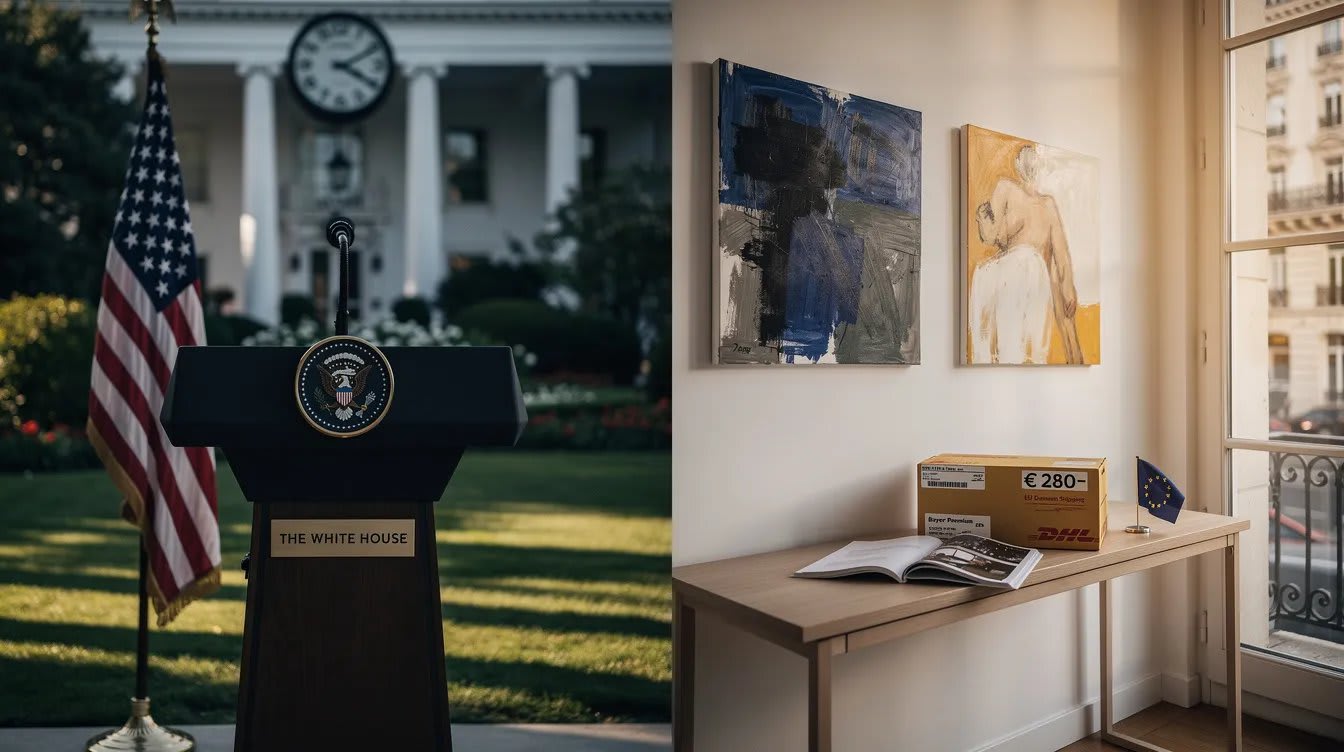
The repercussions of liberation resonate profoundly for European art collectors, as the chaos of a trade war unveils a new era of opportunity and clarity in the art market.
Published by LLB Auction — Luxembourg's Contemporary Art Auction House | Thursday, 2 April 2026
One year ago today, on 2 April 2025, Donald Trump delivered a historic announcement in the White House Rose Garden, declaring what he perceived as "one of the most important days in American history." He signed Executive Order 14257, which imposed extensive "reciprocal tariffs" on imports from virtually every nation, introducing a universal 10% baseline that escalated for major trading partners. This date was subsequently dubbed Liberation Day.
Immediately following this announcement, the US stock market plummeted by 12.4%, marking its most significant decline since the COVID-19 pandemic. A resultant sell-off of US Treasury securities triggered the most substantial three-day increase in the 30-year Treasury rate since 1982, with the term "chaos" appearing in nearly every major financial publication within hours.
Art advisors labored through the night, desperately attempting to decipher the implications for their clients. One advisor, quoted by Artnet News during that tumultuous time, encapsulated the sentiment:
"I was like, what am I doing, sitting here trying to be a tax law expert? Then I realized that the whole world is doing this. It's chaos."
Fast forward one year, and while the chaos has somewhat abated — especially after the Supreme Court struck down the International Emergency Economic Powers Act (IEEPA) tariff authority in February 2026 — the structural shifts catalyzed by these tariffs are enduring. Astonishingly, for European collectors utilizing a Luxembourg-based auction platform, these shifts have unlocked a monumental opportunity in the marketplace that has not been present for a generation.
What Actually Happened to Art Under the Tariffs
It is crucial to maintain precision in understanding the repercussions of these tariffs.
Original artworks — encompassing paintings, sculptures, drawings, and original prints in limited editions — are classified under Heading 9701 of the Harmonized Tariff Schedule and remain protected by the "Berman Amendment" exemption, which is codified at 50 USC 1702(b). Instituted in 1988, this exemption guarantees the free flow of informational and cultural materials and particularly extends to artworks. Remarkably, throughout the tariff tumult of 2025, this exemption remained intact, albeit with important caveats.
The caveats indeed posed real challenges. US Customs and Border Protection officers wielded discretion in classification; artworks featuring functional elements, such as design objects, mixed-media compositions, and artistic furniture, faced ambiguity regarding their exempt status. Additionally, art supplies, crating materials, lumber for stretcher bars, and shipping packaging sourced from China were subject to tariffs, leaving transaction participants grappling with the uncertainty that these exemptions could be revoked at any moment.
As of February 2026, following the Supreme Court's nullification of the broader IEEPA tariff framework, a new 10% baseline tariff was established under separate Section 122 authority. Yet, troubling uncertainties regarding the status of art transactions persisted.
The practical outcome one year post-Liberation Day is crystal clear: facilitating the purchasing and selling of art within the European Union — from a Luxembourg auction house to collectors in cities such as Paris, Brussels, Amsterdam, or Frankfurt — is free from such complications. There are no tariffs, no customs friction, no classification ambiguity, and no risk of abrupt rule changes from the moment the auction hammer falls until the artwork arrives at your doorstep.
The Structural Shift: What "Liberation Day" Did to the Global Art Market
The art market is particularly vulnerable to trade friction, largely not due to tariffs directly on the artworks, but because of the complexities and elevated costs associated with surrounding logistics.
Experts predicted a bleak outlook for the year ahead, suggesting that tariffs would escalate confusion and operational costs, alter buyer behavior, and inflict the most harm on smaller galleries due to their limited resources.
This prediction proved prescient. International galleries began to reconsider their involvement in US fairs. Cross-Atlantic shipping expenses surged as tariffs cumulated on packing materials, lumber for crating, and essential logistics supplies. Documentation requirements doubled, and art advisors, having invested years cultivating international collector relationships, found themselves entangled in a maze comprising customs codes, classification regulations, and shifting exemption lists.
Consequently, a partial, yet significant, withdrawal of the US art market transitioned into domestic circulation, strengthening intra-European and intra-Asian market dynamics. The February 2026 auction data vividly illustrates this trend: the three houses based in Hong Kong generated an impressive $160 million in just one week, with Christie's achieving a remarkable 100% sell-through rate on 37 lots. Additionally, London's March auctions surged a staggering 52% and 110% year-on-year, while Paris continues to bolster its status as a central hub for discerning European collectors.
Remarkably, the art market did not succumb to tariff pressure; rather, it reorganized itself. This reorganization systematically favored two environments: intra-Asian collecting and intra-European collecting. Both landscapes thrive due to regulatory clarity, established logistics networks, and the absence of uncertainty that still clouds transatlantic transactions.
Why Luxembourg Is Precisely the Right Hub for This Moment
The European single market, with Luxembourg positioned at its geographic and regulatory nucleus, has become exponentially more valuable to art collectors than at almost any previous juncture since the inception of the EU.
Within the EU, artworks traverse freely — there are no tariffs, no customs declarations for intra-EU shipments, and no classification uncertainties. Value-added tax (VAT) on artworks in Luxembourg is applicable at a reduced rate of 8%, solidifying its status as one of the most collector-friendly jurisdictions in Europe. The regulatory landscape here is stable, multilingual, and meticulously designed for the international circulation of cultural assets.
LLB Auction is headquartered in Luxembourg precisely because these structural advantages resonate profoundly with the collectors we serve. A German collector acquiring artwork through LLB engages in a fully EU-regulated, VAT-compliant, tariff-free transaction. The same holds true for collectors from France, Belgium, or the Netherlands. Artworks are shipped using DHL, accompanied by professional packaging and insurance, costing between €150 to €450 within Europe. There are no crating surcharges, no logistics margins, and no surprise invoices post-sale.
In stark contrast, a US-based collector attempting to acquire a piece from a European gallery is confronted with a 10% baseline tariff on imports, risks of reclassification should the artwork possess any functional attributes, dramatically expanded documentation requirements, and inflated shipping costs emblematic of the new complexities governing transatlantic logistics. The story of a US collector who "procrastinated" and missed the window prior to Liberation Day serves as a cautionary tale indicative of a shifting reality.
The advantages inherent in collecting within Europe through a transparent EU-regulated platform have never been more substantial or quantifiable.
The Fee Advantage That Compounds the Structural One
While the tariff implications are undeniably structural, they are further compounded by a significant fee advantage.
LLB Auction's buyer's premium stands at 20%.
In comparison, Sotheby's charges 28%, and Christie's charges 27%, both of which have recently increased for lower-value lots, affecting the segment where most European collectors generally operate.
To illustrate, consider a €25,000 acquisition:
At Sotheby's London or Christie's (including transatlantic logistics if the buyer is US-based):
- Hammer Price: €25,000
- Premium (28%): €7,000
- Shipping to Europe: €3,000+
- Total: €35,000+ (representing a 40% increase above the hammer price)
At LLB Auction:
- Hammer Price: €25,000
- Premium (20%): €5,000
- DHL Shipping: €300
- Total: €30,300 (a 21% increase above the hammer price)
The net difference amounts to €4,700 per transaction. Over a collection of ten artworks acquired over five years, that equates to roughly €47,000 — or nearly two additional acquisitions at the same price point.
Remarkably, there are no tariff complications, no customs uncertainties, no duplication in documentation, and no unexpected logistic surprises.
The Artists That Make the Argument Concrete
The European collecting landscape extends beyond mere structure; it embodies tangible substance. The artworks featured through LLB Auction epitomize the quality, scarcity, and enduring conviction that the market has consistently rewarded over the past year.
Richard Prince (1994) — a collector on the cutting edge of conceptual rigor and cultural finesse, whose works operate independently of the speculative trends that Liberation Day harshly penalized. His pieces, showcased through LLB, effortlessly navigate between European collections without hiccups.
Antonia Beauvoir — distinctive figurative paintings, singular in their availability, complete with impeccable provenance from inception. This is the very kind of work identified by The Art Newspaper's analysis of the London March sales as the strongest performer: defined by quality, rarity, and fresh-to-market availability.
Ansou Niabaly — a dynamic practice characterized by painterly vigor and a geographic breadth that situates his work at the crossroads of European and global collecting trends. Artworks acquired in Luxembourg come complete with documentation from the first transaction, permanently insulated from the increasing friction inherent in transatlantic purchases.
Yun Sé, Léa Véris, Eva Santer — each cultivating artistic practices characterized by depth and formal cohesion that uphold long-term collector conviction. All are accessible through an EU-regulated, low-premium, transparent platform that the past year has rendered strategically more valuable than at any prior moment.
Liberation Day, One Year On: The Verdict for European Collectors
Trump heralded April 2, 2025, as "one of the most important days in American history." However, for the European art collector, it stands as one of the most enlightening days in contemporary market history—not solely for its disruptive effects, but for the clarifications it ushered in.
It became clear that the art market's critical structural variable is not which artists have ascended in popularity or which auction house boasts the finest specialists, but rather where collectors are purchasing artwork from and which platform they engage for their acquisitions.
The European collector, who operates seamlessly within the EU single market through a Luxembourg-based auction platform featuring a 20% buyer's premium, with shipping by DHL capped at €450 and full expert authentication on every lot, enjoys a structurally superior position over any collector navigating the complexities of transatlantic transactions today. Interestingly, this advantageous position has been notably fortified, rather than weakened, by a year of trade conflict.
Liberation Day indeed liberated something substantial. However, it was not the outcome that Trump had envisioned.
It emancipated the European collector from the belief that only prominent London or New York auction houses presented viable options. It decisively made the case—substantiated by hard numbers and regulatory realities—for a different paradigm, one grounded in transparency, minimal friction, and the structural benefits inherent in the world's largest integrated single market.
At LLB Auction, such an approach has long been our hallmark. Now, a year after Liberation Day, the market has at last awakened to this crucial argument.
LLB Auction is a Luxembourg-based online auction house specializing in contemporary art priced between €5,000 and €50,000. Buyer’s premium: 20%. Shipping via DHL with full insurance: €150 to €450 within Europe. Experience seamless transactions free from tariff complexities and customs friction, complemented by expert authentication on every lot. Discover current offerings and upcoming sales at llb-auction.com.
Tags: Liberation Day tariffs art market, Trump tariffs art 2026, art tariffs Europe exempt, LLB Auction Luxembourg, buy contemporary art EU, European art collector 2026, art market tariffs 2026, 20% buyer's premium auction, intra-EU art collecting, Richard Prince 1994, Antonia Beauvoir, Ansou Niabaly, Yun Sé, Léa Véris, Eva Santer, online art auction Luxembourg, art collecting without tariffs, Luxembourg art hub Europe
Thank you for being part of the LLB Auction community.
The LLB Auction Team