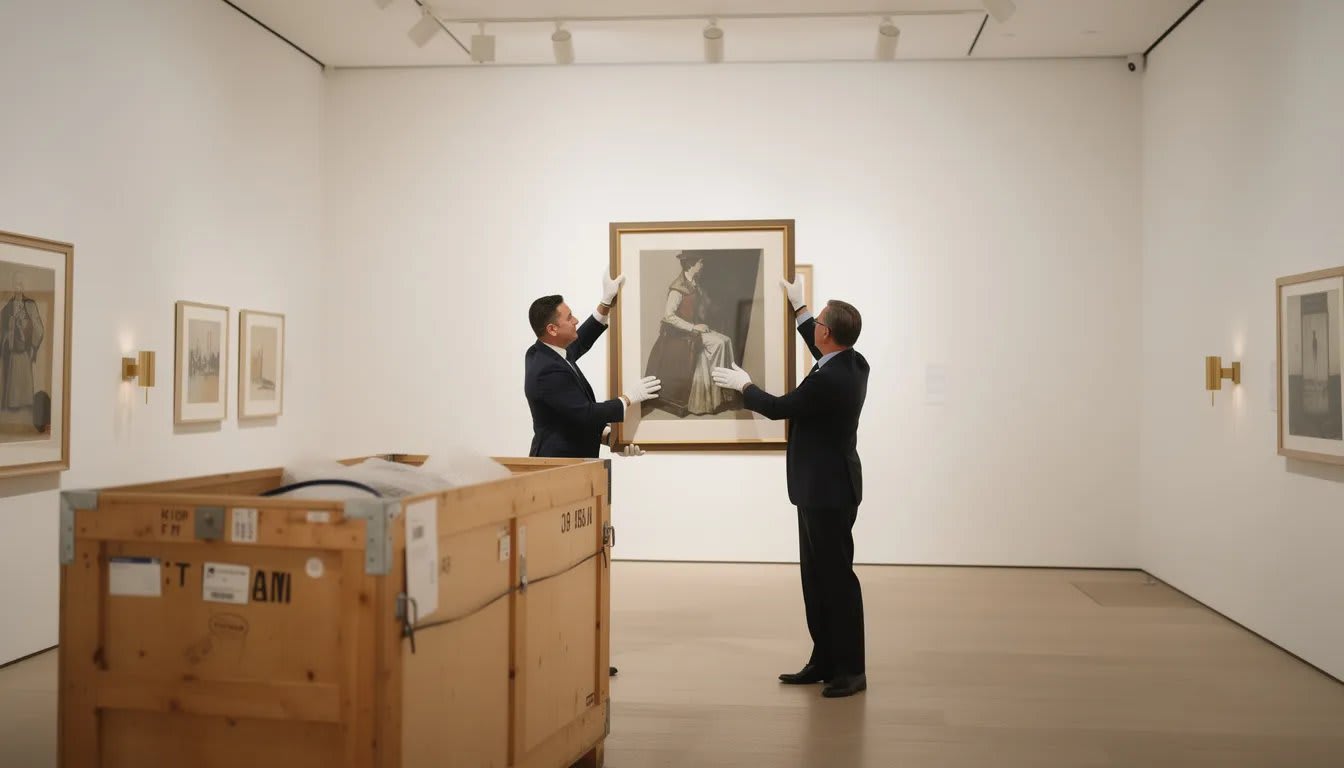
Delve into the intricate journey of contemporary artworks as they transition from the creative sanctuary of the studio to the vibrant energy of the auction house.
Every work that appears in an auction sale has a story. Not simply the story of its creation — characterized by the artist's choices of color, form, and material — but also the narrative that unfolds in the periods following its inception. The journey from an artist's workspace to the auction room is longer, more complex, and far more fascinating than most collectors ever imagine. Understanding this odyssey transforms the way you experience a sale and deepens your appreciation for every piece that arrives at the moment of the hammer.
Step One: The Studio — Where Everything Begins
Every auction lot begins with an act of creation. Whether it is Jean-Michel Basquiat layering frenetic text and imagery onto canvas in his New York studio during the 1980s, Jeff Koons conceiving the monumental engineering required to bring a Balloon Animal sculpture to life, or Richard Prince (b. 1994) constructing one of his sun-drenched compositions of swimming pools and coastal architecture from careful observation and original visual imagination, each work begins as a private dialogue between the artist and their practice.
At this formative stage, the future market value of the work is entirely unknown. What matters is the integrity of the artistic vision and the quality of its execution. These aspects are what specialists will later evaluate when considering a work for auction, and they embody the qualities for which collectors ultimately bid when the hammer falls.
Step Two: First Ownership — Galleries, Private Sales, and Direct Acquisitions
Most works enter the market through a gallery or directly from the artist's studio. This moment of first sale is critically significant for establishing provenance — it sets the foundation of the ownership chain that will follow the work throughout its life. A piece acquired through a reputable gallery carries with it documentation of its origin, a factor that adds measurable value when the work ultimately comes to auction.
Yun Sé's silkscreens and paintings, which investigate minimalist portraits of young women through the aesthetic codes of Japanese pop culture and street art, often enter collections through galleries possessing deep knowledge of his practice and cultural context. That relationship with the gallery — the documentation it generates and the critical framing it provides — becomes a crucial part of the work's narrative and contributes to its auction value years later.
Step Three: Life in a Collection — Exhibitions, Publications, and Growing Recognition
Between the first acquisition and eventual auction, most significant works spend years, sometimes even decades, enriching a private collection. During this time, they may be loaned for museum exhibitions, featured in catalogues and monographs, insured, conserved, and photographed. Each of these moments adds another layer to the work's provenance and, consequently, to its market value.
Ansou Niabaly's multidisciplinary creations — paintings, sculptures, and installations that draw on African cultural traditions to explore themes of identity, migration, and collective memory — have been exhibited in galleries and institutions around the globe. Every exhibition appearance, catalogue entry, and critical review becomes part of a growing record that auction specialists will later utilize to build a compelling case for the work's value. When a collector eventually decides to sell, this accumulated narrative speaks for itself.
Step Four: The Decision to Sell — Approaching an Auction House
The decision to consign a work to auction is rarely taken lightly. Collectors who have lived with a work, observed its artist evolve, and witnessed its growing critical acclaim bring both emotional and financial considerations to this pivotal conversation. The first step involves contacting an auction house, and the quality of that initial dialogue sets the tone for everything that follows.
At LLB Auction, every consignment inquiry is treated as the beginning of a genuine partnership. Our specialists invest time in understanding the work, its history, and the collector's objectives before making any recommendations. This process entails no pressure or predetermined agenda — only expert advice aimed at achieving the best possible outcome.
Step Five: Research, Authentication, and Condition Reporting
Once a work is accepted for consignment, it enters a rigorous process of research and verification. Specialists cross-reference ownership records, verify exhibition history, and consult published literature to assemble the most comprehensive provenance record possible. This meticulous research is particularly paramount for works by artists with complex market histories or those who share their names with multiple practitioners.
The condition of the work is thoroughly assessed by a conservator, who generates a written report detailing any areas of restoration, aging, or vulnerability. This report is shared with prospective buyers during the preview period and becomes part of the permanent record of the piece. For a painting by Antonia Beauvoir — whose baroque and romantic canvases skillfully blend portraiture, symbolism, and surrealism through female figures veiled in flowers and fabrics — the condition of the surface, varnish, and pigment is as crucial to buyer confidence as the aesthetic power of the work itself.
Step Six: Photography, Catalogue, and Marketing
A work inadequately photographed will likely fail to achieve its potential at auction. LLB Auction prioritizes professional photography that captures not only the overall composition but also the surface texture, color fidelity, and physical presence of each masterpiece. These images form the foundation of the auction catalogue — a document that reaches collectors, dealers, and institutions across Europe, Asia, and the Americas prior to the sale.
The catalogue entry for each lot is crafted by a specialist and encompasses a description of the work, its provenance, exhibition history, literature references, and pre-sale estimate. For artists like Jeff Koons or Basquiat, whose market histories are extensively documented, catalogue entries draw upon decades of critical writing and auction records. For emerging talents such as Richard Prince (b. 1994) or Yun Sé, these entries serve an equally vital function: introducing their works to collectors who may be encountering the artist for the first time and clarifying why this moment constitutes a significant acquisition opportunity.
Step Seven: The Preview — Collectors Meet the Work
Before the sale, LLB Auction opens its doors for a public preview during which collectors, dealers, and advisors can physically examine every work. This is a moment of genuine discovery — the juncture at which a work transitions from image to object, from catalogue entry to tangible presence.
For many collectors, the preview is where the bidding decision takes shape. Experiencing the scale of an Ansou Niabaly installation, the surface quality of an Antonia Beauvoir canvas, or the intricate color relationships in a Richard Prince (b. 1994) composition in person can confirm, or occasionally revise, the enthusiasm generated by catalogue images. Our specialists are present throughout the preview to answer questions, provide additional research, and assist collectors in grasping the full context of each work.
Step Eight: The Sale — The Moment Everything Has Been Building Toward
On the day of the sale, every decision made in the preceding weeks and months converges in the auction room. The estimate has been set, the reserve agreed upon, the catalogue distributed, and the preview completed. Now the work must resonate on its own accord — and the room must respond.
The auctioneer opens bidding, marking the culmination of a journey that began in the artist's studio, leading to this public resolution. Whether the hammer falls at estimate, above it, or, in extraordinary circumstances, at multiples of the high estimate, the result reflects the cumulative impact of every step that preceded it: the quality of the work, the care in its preservation, the thoroughness of its documentation, and the expertise of the auction house facilitating its market entrance.
At LLB Auction, we assert that every work merits this level of attention — from the initial conversation with a consignor to the moment the hammer descends.
Thinking of consigning a work? Contact our team at LLB Auction for a confidential consultation. Discover works by Richard Prince (b. 1994), Yun Sé, Ansou Niabaly, Antonia Beauvoir, and many more in our upcoming sales.
Thank you for being part of the LLB Auction community.
The LLB Auction Team