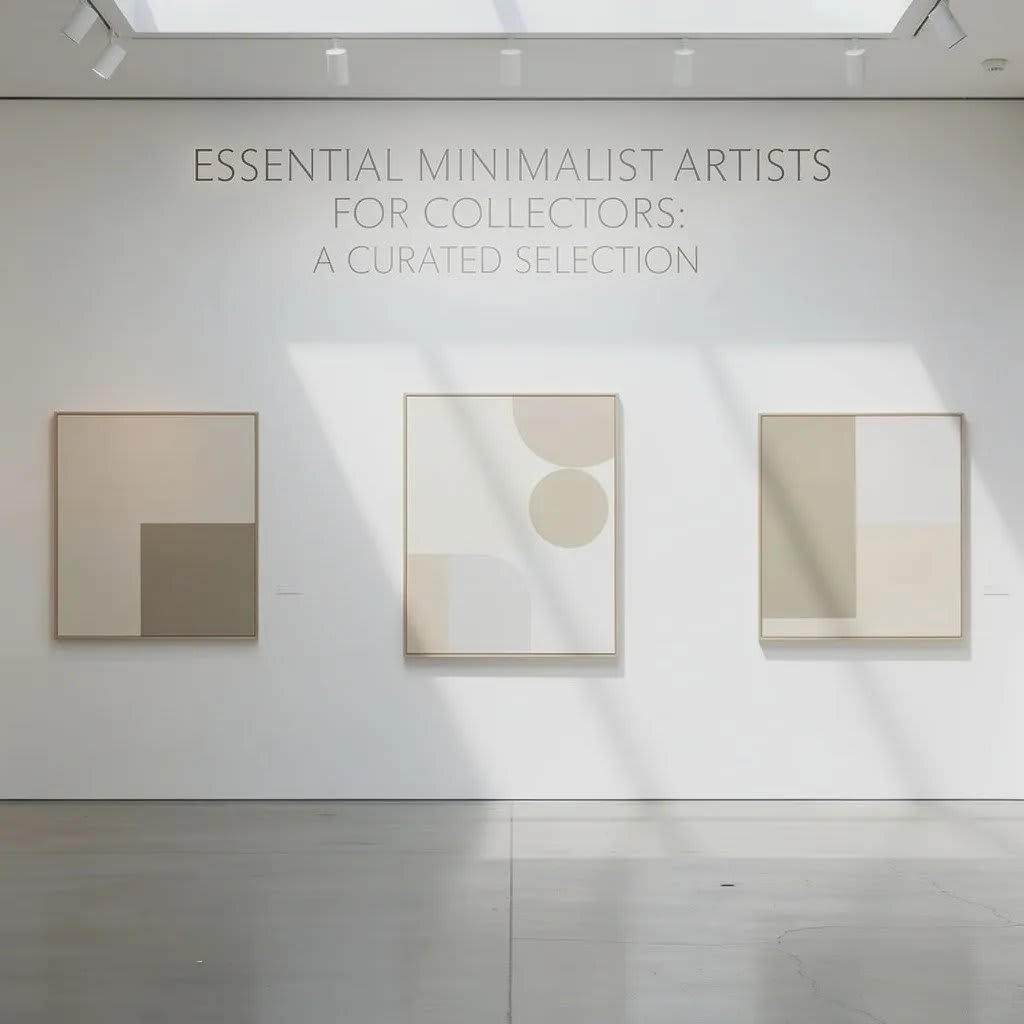
Delve into the world of minimalist art with our curated selection of ten influential artists who resonate through their elegant simplicity and profound impact.
A Selection of Essential Minimalist Artists for Collectors
Minimalism represents much more than an artistic movement defined by a reduction of forms. It embodies a deliberate economy of means, emerging in the United States during the 1960s. With roots in the profound philosophy of architect Mies van der Rohe's principle “Less is more” and the groundbreaking explorations of Kazimir Malevich, minimalism swiftly established itself as a universal visual language. This language transcends time while maintaining its compelling impact.
Today, minimalism remains a pivotal force in the contemporary art market, captivating collectors with its elegance, clarity, and timeless quality. Ranging from historical pioneers to contemporary artists influenced by graphic design, architecture, and popular culture, minimalism continues to evolve and reinvent itself. Below, we present a selection of ten essential artists, each an iconic figure whose works present strong opportunities for discerning collectors.
Frank Stella, the Pioneer of Pure Form
To discuss minimalism is to honor Frank Stella, a monumental figure in American art. He has profoundly influenced the history of abstraction by purging narrative and symbolism from his oeuvre. Stella's works are crafted with rigorous geometric structures and repeated forms that foster a direct relationship between the surface and the viewer. In his world, painting exists solely as itself; what you witness is precisely what is presented. His screen prints and lithographs continue to be highly coveted by collectors.
Cy Twombly, Emotional Minimalism
Located at the intersection of abstraction, writing, and gesture, Cy Twombly occupies a distinctive position within minimalism. His artworks, often characterized by fine lines, marks, and expanses of emptiness, evoke profound emotional resonance. While Twombly's practice extends beyond strict historical minimalism, his deft use of voids, repetition, and graphic restraint positions him as an essential reference for aficionados of poetic minimalism.
Donald Judd, Conceptual Rigor
As a seminal figure in minimalism, Donald Judd revolutionized the movement by eschewing traditional painting for sculptures and installations composed of industrial components featuring simple, repetitive forms. His art interrogates the relationship between object, space, and viewer without establishing hierarchies or illusions. Judd's intellectual and radical approach to minimalism embodies a profound vision, rendering his works highly valued in both institutional and private collections.
Lee Ufan, Dialogue Between Matter and Void
Renowned as a major Korean artist and founding member of the Mono-ha movement, Lee Ufan investigates the interplay between raw materials and the surrounding environment. His works often incorporate simple gestures or stones paired with restrained surfaces, inviting silence and contemplation. Ufan's philosophical minimalism appeals to collectors who are drawn to the spiritual and meditative facets of art.
Julian Opie, Contemporary Figurative Minimalism
Julian Opie stands as one of the most recognizable contemporary artists. By distilling human figures into clean lines, simplified contours, and flat swathes of color, he establishes a visual language heavily influenced by graphic design, digital imagery, and signage. His immediately identifiable figurative minimalism enjoys remarkable success on the market, appealing particularly to new collectors.
Edgar Plans, Narrative Simplicity
Edgar Plans crafts a refined visual universe populated by childlike characters often situated within minimalist frameworks. Behind the apparent simplicity lies a deeper reflection on innocence, freedom, and contemporary society. His work, celebrated for its playful and graphic quality, offers an accessible and emotionally resonant approach to minimalism.
Mike Lee, Matter and Repetition
Contemporary artist Mike Lee delves into the possibilities of minimalist abstraction through repeated gestures and material experimentation. His monochromatic works engage with texture, relief, and subtle surface variations, inviting a more intimate visual experience, where light unveils the richness of detail.
Alex Katz, Reduction in the Service of the Figure
Alex Katz emerges as a pivotal figure within figurative minimalism. His portraits and landscapes are distinguished by simplified forms, bold colors, and direct compositions. Influenced by advertising, cinema, and fashion, Katz offers a refined interpretation of reality that is both contemporary and elegant. His works are widely recognized and sought after within the international art market.
Yu Nagaba, Japanese Graphic Minimalism
Japanese contemporary artist Yu Nagaba has gained acclaim for his drawings characterized by simple yet expressive lines. His minimalist style, akin to illustration, captures the essence of human faces and bodies with remarkable economy. Notably visible on the contemporary scene, Nagaba resonates through the freshness and sincerity of his lines.
Why Collect Minimalism Today?
The enduring appeal of minimalism for collectors lies in its ability to transcend fleeting trends and adapt seamlessly to the evolving contemporary art landscape. Minimalist works, easy to integrate into modern spaces, provide immediate visual clarity while retaining significant conceptual depth. The compelling balance between visual simplicity and artistic rigor renders them suitable for both novice collectors and seasoned enthusiasts alike.
Whether crafted by historical figures who defined art history or by contemporary artists employing refined visual languages, minimalist artworks are timeless pieces capable of resonating across various contexts. They not only represent aesthetic value but also hold the promise of long-term appreciation potential.
Looking to elevate your collecting journey?
Discover upcoming LLB Auction sales and explore a curated selection of expertly authenticated works, backed by clear and transparent guarantees—empowering you to collect with confidence.
Thank you for being part of the LLB Auction community.
The LLB Auction Team