In this article
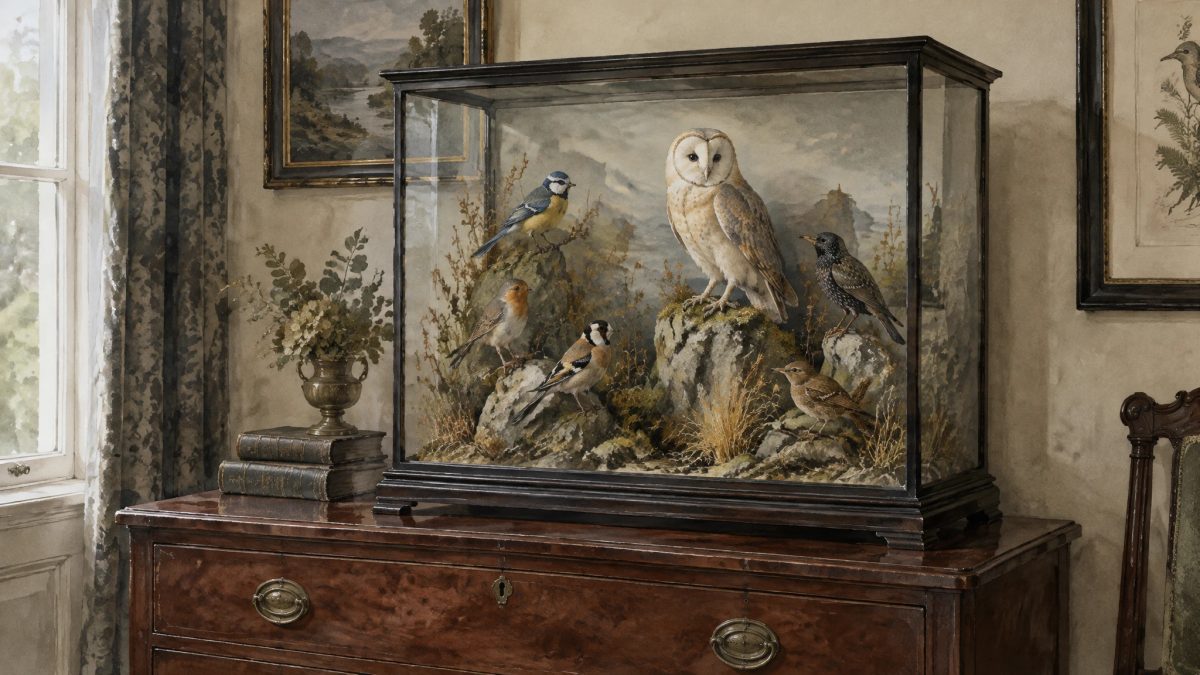
On 26 November 2026 a mounted thylacine head that a London family had kept under a bed for years sold at £170,000 hammer in Bath, after seven and a half minutes of bidding against an estimate of £30,000 to £50,000. Three months earlier the same saleroom had offered another head as a fox at £30 to £50, and it made £62,600 with fees. Those two results raise the question every heir with a glass case of birds or a mounted trophy now asks: what sets antique taxidermy value, and can the object be sold at all? The answer turns on four factors (species, maker, case and condition) and on one legal date. Inside the European Union, a mount finished before 3 March 1947 can qualify as a worked specimen and change hands without a commercial certificate, provided the owner can prove its age.
Key points:
- A mounted thylacine head made £170,000 hammer in Bath on 26 November 2026, an auction record and the second head the same house had sold in under four months.
- A cased pair of extinct New Zealand huia made £220,000 plus premium at Tennants in 2023, thought to be the world auction record for a piece of taxidermy.
- EU law treats taxidermy finished before 3 March 1947 as a worked specimen exempt from the Article 10 certificate, under Article 62(3) of Regulation (EC) No 865/2006.
- A mount renovated after 1947, or a bird of prey without documentary proof of age, needs evidence accepted by the national Management Authority before any sale.
Taxidermy auction records in Bath: what the two thylacine heads show
The two thylacine heads that passed through Auctioneum in 2026 show, in a single season, how far antique taxidermy value can move once a species is correctly identified. The thylacine (also called the Tasmanian tiger) is a Tasmanian marsupial whose last known individual died in captivity in Hobart on 7 September 1936. Taxidermy is the craft of preparing, stuffing and mounting an animal skin over a form so that it keeps the appearance of the living animal.
The first head went on sale in August 2026 catalogued as a fox, with an estimate of £30 to £50. Two bidders recognised it, and the Essex curiosity dealer James Cranfield bought it for £62,600 including fees. He spotted the species from the teeth. His verdict on the find: "it is the holy grail of natural history collecting."
The second head, nicknamed Trevor, came from a London family who had kept it out of sight under a bed. Its history places the shot in Sheffield, in north-west Tasmania, in the early 1900s, and its arrival in the United Kingdom in 1905. It passed through several owners; one ear came loose decades ago and stayed with the mount. Auctioneum estimated it at £30,000 to £50,000. On 26 November 2026 it was hammered at £170,000 after a bidding contest of seven and a half minutes, an auction record. Its auctioneer, Andrew Stowe, described its preparation in these terms: "It's the only one to have come up to have been done properly."
Three lessons for an ordinary owner follow from these sales.
- Identification sets the price. The same category of object moved from a £30 estimate to £62,600 once the species was named.
- Proof of species is physical. Radiographs (X-ray images) of both heads confirmed the skull inside the mount, and the second head showed part of the cranium missing where the animal was shot.
- Registration adds weight. Trevor was entered in the International Thylacine Specimen Database (ITSD), the reference register of surviving thylacine material; about 815 thylacine specimens are recorded worldwide, from tissue slides to full mounts, and only three mounted heads are known.
Most inherited taxidermy will never approach these sums. The thylacine is an extreme case, and the records belong to a species that no longer exists. The method behind the result applies to every cased bird and every mounted head, and it is how antique taxidermy value is established at any price level: name the species, date the work, document the history, then read the law.
Free valuation from a photo
Send a photo. Lyna Brahami replies within 48 working hours, free and without commitment.
Drop your photos here
or
Prefer WhatsApp?
Send the photos on WhatsAppWrite to +352 661 225 970. The reply comes in the conversation.
What drives antique taxidermy value: species, maker, case and condition
Antique taxidermy value rests on four variables, and each can be checked from photographs before a specialist sees the object. A Victorian cased bird of a common species by an unknown hand and a signed diorama by a leading London firm belong to different markets, even when they look alike on a mantelpiece.
Species and its legal status
The species decides both the scarcity of a mount and whether it can be sold freely. Extinct species with documented specimens carry the highest prices: the cased pair of huia (Heteralocha acutirostris, an extinct New Zealand bird) prepared by James E. Whiting in the late nineteenth century sold at Tennants for £220,000 plus buyer's premium in 2023. Exotic big game and anthropomorphic tableaux follow. Common British birds, deer heads and fish occupy the lower end of the market, where antique taxidermy value rests mostly on the case and the decorative effect. The legal status of the species, examined further down, can remove a mount from the open market altogether.
The maker's label
A trade label identifies the workshop, and the workshop dates the mount. The leading Victorian and Edwardian firms put their name on a paper label fixed to the case or the base: Rowland Ward and John Cooper in England, Peter Spicer & Sons, and the Indian firm Van Ingen & Van Ingen of Mysore. Results at Tennants show the premium a named maker carries: an anthropomorphic cased pair of boxing badger cubs by Peter Spicer & Sons sold for £14,000, and a Bengal tiger by Van Ingen & Van Ingen, dated 24 January 1930, sold for £16,500.
The original case
An original case protects the mount and carries its history. Glazed cases with painted backgrounds, grasses and rockwork were part of the Victorian taxidermist's work, and a sealed case keeps out dust, dirt and air pollutants. A monumental diorama of Australian marsupials, birds and reptiles of about 1892 sold at Tennants for £25,000, and a diorama of Indian birds and reptiles of about 1872 by Henry Shaw for £9,000. A mount removed from its case loses part of its antique taxidermy value and part of its evidence of age.
Condition and antique taxidermy value
Condition can halve or erase antique taxidermy value, and the faults are visible. Sagging skin or gaps between skin and form point to a poor original mount. Clumps of fur falling away signal moth or beetle infestation, the most serious threat to a specimen. Ultraviolet light fades feathers and fur, cracked antlers suggest years of temperature swings, and replaced glass eyes or repainted beaks indicate later restoration. Stowe's remark on Trevor ("There is not a googly eye in sight on this one") refers to that last fault.
| Factor | What the owner checks | Recorded result |
|---|---|---|
| Species | Extinct, exotic or common; legal annex | Huia pair, late 19th century: £220,000 plus premium (2023) |
| Maker | Printed label, address, signature on the base | Peter Spicer & Sons badger cubs: £14,000 |
| Case | Original glazed case, painted ground, seal | Australian diorama, about 1892: £25,000 |
| Condition | Fur loss, fading, splits, replaced eyes | Thylacine head with skull intact: £170,000 hammer (2026) |
| Tableau | Anthropomorphic or narrative scene | Walter Potter, Kittens' Tea and Croquet Party: $169,000 (2016) |
The last line of that table belongs to Walter Potter, the Victorian taxidermist known for staging animals in narrative tableaux; his Kittens' Tea and Croquet Party, made in the late nineteenth century, sold at Tommey & Co. for $169,000 on 6 February 2016.
Dating and identifying a mount before a valuation
Dating a mount is the step that ties antique taxidermy value to the law and to the market, because the legal regime depends on when the specimen was finished. The specialist reads five kinds of evidence, and an owner can gather most of them in an afternoon.
The label comes first. A firm's name and address changed over its history, and a street number or a firm name with "& Sons" narrows the period. The case construction comes next: the glass, the joinery, the paper that seals the joints and the painting of the background carry the traits of their period. The materials inside the mount follow. Nineteenth-century taxidermists attached skins to rudimentary forms stuffed with scraps of cloth or sawdust, while later workshops built solid internal manikins and, today, foam bodies.
Physical examination completes the picture. Radiographs show the internal armature and whether a skull is original; that is how the two thylacine heads were confirmed. For extinct or scarce species, a reference database such as the ITSD records known specimens, their history and their present owners. The family record ends the chain: an inventory, a probate list, a photograph of a room with the case on the wall, a letter or a shipping receipt all date the object independently of its appearance.
Reading antique taxidermy value from the evidence
Each piece of evidence moves antique taxidermy value in a predictable direction. A legible maker's label places the mount in a documented workshop and gives bidders a reference point among past results. An inventory or photograph dated before 1947 supports the legal right to sell an Annex A species, which widens the field of buyers to every bidder in the Union. A radiograph confirming an original skull removes doubt about a composite or a reconstruction, the question that would otherwise cap the price. Each missing element narrows the market. The two thylacine heads illustrate both ends: the first, offered without identification, carried an estimate of £30 to £50; the second, offered with radiographs, a recorded history back to 1905 and an entry in the ITSD, carried an estimate a thousand times higher and sold well above it. The object type was the same in both sales, and the difference in antique taxidermy value came from the file that accompanied each head.
Is it legal to sell taxidermy in the EU? The pre-1947 worked-specimen rule
Inside the European Union, selling taxidermy of a protected species is legal without a commercial certificate when the mount qualifies as a worked specimen finished before 3 March 1947. The rule comes from two texts. Council Regulation (EC) No 338/97 applies the CITES (the Convention on International Trade in Endangered Species of Wild Fauna and Flora) inside the Union and lists protected species in annexes. Its Article 8(1) prohibits the purchase, sale, offer for sale, keeping for sale and display for commercial purposes of any specimen of a species listed in Annex A, the annex of the most endangered species. Its Article 8(3) allows an exemption, case by case, through a certificate issued by the Management Authority (the national body that applies the regulation) of the Member State where the specimen is located. That document is the Article 10 certificate. Article 2(w) defines a worked specimen as one "significantly altered from its natural raw state for jewellery, adornment, art, utility, or musical instruments" more than 50 years before the regulation entered into force, which places the cut-off at 3 March 1947. Article 62(3) of Commission Regulation (EC) No 865/2006 then exempts such worked specimens from the Article 8 prohibition without any certificate.
The European Commission's guidance on worked specimens, published in the Official Journal on 17 May 2017, lists taxidermy specimens among its examples of objects that can qualify. The same guidance sets three conditions that matter to an owner. The specimen must have been worked before 3 March 1947. A specimen worked or reworked after that date falls outside the definition, whatever the age of the skin. And the owner who wants to sell must be able to show the date.
For the heir, the practical consequence is clear. A Victorian cased owl with its original label and a family inventory from 1920 sits inside the exemption. The same owl remounted in a new case in 1975 sits outside it, and a sale requires an Article 10 certificate. The Article 8(1) prohibition targets Annex A species; species in the other annexes follow lighter conditions, so the species must be identified before the paperwork is assessed. Antique taxidermy value therefore depends as much on the documents as on the object.
Birds of prey and renovated mounts: where the evidence gets harder
Birds of prey are the category where owners most often misjudge the rule, because every species of bird of prey is listed in Annex A. The Commission's guidance addresses them directly in paragraph 5.8: "Stuffed animals, especially birds of prey, are difficult to age and it can be difficult to prove that the specimen was in its finished state before 3 March 1947." It adds that renovation "can further compromise the verification process", and that a renovated mount qualifies only when "sufficient evidence of the specimen's original worked acquisition status" reaches the Management Authority.
A recent case in England shows the consequence. In August 2026 Essex Police seized a Eurasian goshawk, cased with a thrush, that a 65-year-old trader had offered for sale on a social media page without an Article 10 certificate. The seller received a community resolution with a condition to study the CITES rules. The investigating officer, PC Dane Wyatt of Essex Police, put it plainly: "I would urge anyone considering buying or selling taxidermied birds and animals to make sure they understand and comply with the relevant licensing requirements. We can, and do, take action."
Great Britain applies its own Wildlife Trade Regulations, built on the same Annex A. There, the Animal and Plant Health Agency (APHA) issues the commercial-use certificates, and commercial use of an Annex A specimen without one carries up to five years in prison or an unlimited fine. In both systems, an owl, a falcon, a hawk or an eagle in an old case is the object that most often needs paper before it can be offered.
For the owner, the antique taxidermy value of a bird of prey is therefore tied to its file. A Victorian owl with a dated label and an inventory reaches every bidder in the Union; the same owl without proof of age reaches none until a certificate is granted. Assembling the evidence costs little compared with that difference, and a set of photographs shows which documents are missing.
Preparing antique taxidermy for a valuation: seven steps
A clear file shortens the valuation, settles the legal question and gives the specialist what is needed to state an antique taxidermy value with confidence. The following steps cover what a specialist asks for first.
- Photograph the whole object. Take the front of the case or mount in daylight, without flash on the glass, then each side.
- Photograph the back and the base. Labels, stamps, pencil inscriptions and old repairs are usually hidden there.
- Record the dimensions. Height, width and depth of the case or the mount, in centimetres.
- Name the species if you can. A common name is enough; the specialist confirms it, and the species decides which annex applies.
- Gather the family papers. Inventories, probate lists, insurance schedules, letters and old photographs showing the object in a room all help date it before 1947.
- Note every intervention. A new case, replaced eyes, re-coloured feathers or a cleaning campaign must be declared; renovation is the point the Commission's guidance singles out.
- Leave the object as it is. Do not open a sealed case, re-glue a loose ear or clean fur before the examination; the condition report records the object as found.
These steps cost nothing and protect antique taxidermy value: a documented mount sells to a wider field of bidders than one whose age rests on family memory alone.
Where a sale stops: Annex A without proof, post-1947 work and export
Three situations block or delay a sale, and each can be identified before consignment, whatever the antique taxidermy value of the object. The first is an Annex A species without documentary proof of age: without evidence of finishing before 3 March 1947, an Article 10 certificate becomes necessary, and the Management Authority decides case by case. The second is any mount made, or reworked, after 3 March 1947: the worked-specimen exemption no longer applies, and the regime of the species governs the sale. The third is export beyond the Union. Article 5(6) of Regulation (EC) No 338/97 waives some conditions for issuing an export permit for worked specimens, but the export document itself remains a separate step, and the rules of the destination country apply on arrival. A buyer outside the Union reads the import rules of their own country before bidding. National rules protecting native wild birds can add their own conditions to a sale, so a cased native bird is checked against them as well as against the annexes.
A worked example: three objects from one family house
Take an heir in Wallonia who finds three objects in an attic in 2026. The first is a cased red fox with a printed maker's label and a 1912 inventory that lists it. The species carries no Annex A restriction, the label and inventory date the mount, and the case can be offered once the specialist confirms both points. The second is a common buzzard mounted in a modern case, which a family member remembers having restored in the 1960s. As a bird of prey it sits in Annex A, and its renovation after 3 March 1947 means the worked-specimen exemption cannot be assumed: the owner needs evidence of the original worked status accepted by the Management Authority, or an Article 10 certificate, before any sale. The third is a roe deer head on a shield, dated 1934 on a brass plate. Its antique taxidermy value depends on condition and decorative appeal more than on paperwork. The heir sends one set of photographs per object, and the valuation reply covers each of the three.
Some materials belong to other legal regimes as well. Ivory follows stricter rules of its own within the Union, covered in our guide to netsuke value and the ivory rules. Archaeological material raises its own questions of lawful provenance, set out in the guide to antiquities at auction and their export licences.
FAQ: antique taxidermy value and sale
What is antique taxidermy value based on?
Antique taxidermy value rests on four factors: the species, the maker, the original case and the condition. Extinct or exotic species with a named Victorian maker reach the highest prices: a cased pair of extinct huia made £220,000 plus premium at Tennants in 2023, and a thylacine head made £170,000 hammer in 2026. Common British birds or deer heads by unknown hands sell for far less. Documented age adds value because it secures the legal right to sell.
Is it legal to sell taxidermy inherited from a grandparent?
Inside the EU, selling taxidermy of an Annex A species is legal without a certificate when the mount is a worked specimen finished before 3 March 1947, under Article 62(3) of Regulation (EC) No 865/2006. The owner must be able to prove that date. Species in the other annexes of Regulation (EC) No 338/97 follow lighter conditions. A mount made or reworked after 1947 needs an Article 10 certificate if the species is listed in Annex A.
Do I need a certificate to sell a stuffed bird of prey?
Every bird of prey is listed in Annex A, so a sale needs either proof that the mount is a worked specimen finished before 3 March 1947 or an Article 10 certificate. The European Commission's 2017 guidance warns that birds of prey are difficult to age and that renovation weakens the evidence. In England, police seized an uncertified goshawk offered online in August 2026. Gather inventories and photographs before offering such a mount.
How do I find out who made my taxidermy case?
Look for a printed paper label on the back of the case, the base or the inside of the door. Firms such as Rowland Ward, John Cooper, Peter Spicer & Sons and Van Ingen & Van Ingen labelled their work, and the wording of the label helps date it. Without a label, the case construction, the background painting and the materials inside the mount guide attribution. Send clear photographs of the back with the valuation request.
Does restoration reduce the value of old taxidermy?
Restoration lowers value when it replaces original parts, and it complicates the legal file. Replaced eyes, re-coloured plumage or a new case change the object, and the European Commission's 2017 guidance states that renovation can compromise verification of a pre-1947 date. A restored mount needs sufficient evidence of its original worked status. Declare every known intervention in the valuation request; the condition report then records it.
How LLB Auction values and sells antique taxidermy
LLB Auction, a full service auction house at 29 rue du Fort Elisabeth in Luxembourg, accepts every category of fine art and collectibles for valuation, antiques included. The owner deals with one house from the first photograph to the payment.
Valuation from photographs. Lyna Brahami, Associate Specialist, answers each valuation request within 48 working hours. The valuation is free, confidential and without commitment. To request an antique taxidermy value, send the photographs, dimensions and papers listed above through the expertise page, or by WhatsApp or phone at +352 661 225 970.
Examination and cataloguing. The specialist examines every object in person before it goes to sale. The house photographs, researches and catalogues the lot under a consignment contract with an agreed reserve and commission.
Sale and settlement. Sales are held online on llb-auction.com and listed on Interenchères. The buyer pays the house, the seller receives a statement, and the result appears on the sale's public results page.
Conclusion
The thylacine heads sold in Bath in 2026 drew attention to an old principle: a mount earns its price once its species, its maker and its date are established. For most owners, the decisive questions are more modest. Is the species listed in Annex A? Was the mount finished before 3 March 1947, and can the family papers show it? Has it been renovated since? An heir who answers those three questions with photographs and documents holds a file that a specialist can value quickly and a house can offer lawfully. Antique taxidermy value starts with that file, and the hub guide to collector cars, instruments and curiosities at auction shows how other categories of curiosity follow the same path. Gathering the evidence before the valuation request is the surest way to establish antique taxidermy value.
Also worth reading:
- Netsuke value: wood or ivory, and what the ivory rules let an owner sell
- Antiquities at auction: provenance papers and export licences
- Collector cars, fine instruments and curiosities at auction
Sources:
- Second Tasmanian tiger head sets auction record in Bath sale : Antiques Trade Gazette, 26 November 2026
- Second thylacine head found in UK has hit auction house : ABC News, Susan Oong, 22 October 2026
- Commission Notice 2017/C 154/06, guidance document on worked specimens : European Commission, Official Journal C 154, 17 May 2017
- Council Regulation (EC) No 338/97 on the protection of species of wild fauna and flora by regulating trade therein : Council of the European Union, 9 December 1996
- Commission Regulation (EC) No 865/2006 laying down detailed rules for the implementation of Regulation (EC) No 338/97 : European Commission, 4 May 2006
- Natural History and Taxidermy department : Tennants Auctioneers, consulted 27 November 2026
- Wildlife crime investigation leads to seizure of illegally-taxidermied goshawk : Essex Police, 21 August 2026
- Police seize taxidermy goshawk over missing sale licence : ShootingUK, 29 August 2026
- Antique Taxidermy: Getting Your Fill : Invaluable, 20 December 2021
Sell or buy with the house
Lyna Brahami values a work from your photos, free, within 48 working hours. The house then catalogues it, offers it in an online sale and settles you with a statement once the buyer has paid.

Associate Specialist