In this article
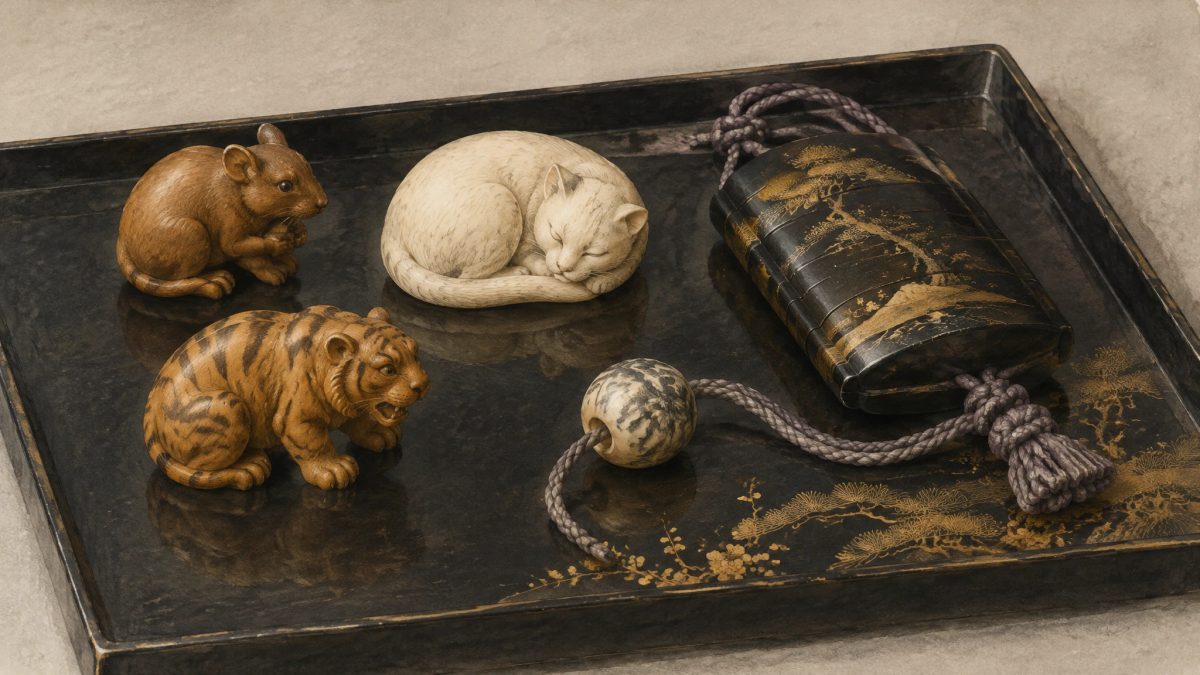
Netsuke value rests on three questions an owner must settle before anything else: what the carving is made of, who made it and when, and whether the law allows it to be sold at all. On 23 November 2026 Bonhams published a collecting guide to Japanese netsuke alongside an online sale of the C.S. Reed collection, with highlighted lots estimated from $2,000 to $20,000. Through 2026, boxwood carvings sold strongly in British salerooms while ivory ones waited for exemption certificates under the Ivory Act. For an heir in Luxembourg, Belgium or eastern France with a few toggles in a family cabinet, a netsuke value printed in a catalogue means little until the material and the legal route to sale are known. This guide covers both.
Key takeaways:
- The netsuke auction record is about €1.3 million, paid in Paris in 2023 for an ivory Monkey King by Matsushita Otoman; the record for a boxwood netsuke is $441,375, set at Bonhams New York in December 2022.
- Since 19 January 2022, an elephant ivory netsuke worked before 3 March 1947 can be sold inside the EU only with an intra-EU certificate issued by the CITES authority of the Member State.
- In the United Kingdom, dealing in ivory has been banned since 6 June 2022 unless the item is registered (£20) or certified as pre-1918 and of outstandingly high value (£250 application).
- Boxwood and other wooden netsuke fall outside the ivory rules and take five-figure estimates: $10,000 to $15,000 for a Kano Tomokazu tiger in November 2026.
Why netsuke value is in the news this season
The netsuke market of late 2026 is a market split by material. On one side, wooden carvings by the great nineteenth-century names circulate freely and draw competition: the C.S. Reed sale, open for online bidding at Bonhams until 15 December 2026, offers a boxwood sparrow by Masanao estimated at $15,000 to $20,000, a recumbent goat by Ikkan at $10,000 to $15,000, and a tiger by Kano Tomokazu at the same level. On the other side, ivory pieces need paperwork before they can be offered, and in the United Kingdom they need a certificate reserved for items of outstandingly high value.
The British case shows the tension. In January 2026, the Norfolk auction house TW Gaze secured permission to sell an Edo period ivory netsuke after the piece received an exemption for outstanding quality under the Ivory Act 2018 (the British law that prohibits dealing in elephant ivory, with five narrow exemptions). In March 2026 a dealer's published letter called the law ridiculous, using a fine netsuke as its example. In the spring a Norfolk sale showed Japanese wooden netsuke still taking large sums under the strict antique ivory rules, and in June 2026 animal carvings by Naito Toyomasa (1773 to 1856) came up for sale in Cologne.
The shift has a measurable trace in results. In June 2023 the Guy de Lasteyrie collection of netsuke and sagemono sold at Bonhams Cornette de Saint Cyr in Paris for more than €1.2 million against a pre-sale estimate of €575,000 to €750,000, with 78 % of lots sold. Its top lot was a boxwood mounted Chinese horseman by Hoshin of Kyoto, late eighteenth century, which made €127,400 against an estimate of €18,000 to €25,000, more than seven times the low figure. Suzanna Yip, Bonhams Director of Japanese Department, said of the collection: "A wonderful collection that thoroughly deserved such wonderful results."
For an owner, netsuke value now depends as much on the legal status of the material as on the quality of the carving. A boxwood rat by a recognised Gifu carver can go to auction next month; an ivory piece of equal quality first needs a certificate, and in some jurisdictions it cannot be sold at all.
Free valuation from a photo
Send a photo. Lyna Brahami replies within 48 working hours, free and without commitment.
Drop your photos here
or
Prefer WhatsApp?
Send the photos on WhatsAppWrite to +352 661 225 970. The reply comes in the conversation.
What a netsuke is, and why Europe has collected them for 150 years
A netsuke is a small carved toggle that held a hanging container on the sash of a Japanese man's kimono, which had no pockets. The containers are called sagemono (hanging things): the inro, a small portable box of wood or lacquer formed of several interlocking compartments, the tobacco pouch or the purse. A silk cord ran from the container, through a sliding bead called the ojime, up behind the obi (the kimono sash) to the netsuke, which rested on top of the sash and stopped the cord from slipping through. The cord passed through two connected holes in the netsuke, the himotoshi, and wear around those holes is still one of the first things a specialist examines.
Men wore inro and netsuke from the seventeenth to the nineteenth century; the custom faded once Western dress became general in Japan. The word breaks into ne (root) and tsuke (to attach), a trace of the first toggles in root wood or bone. From the eighteenth century the cities of Edo (Tokyo), Kyoto, Osaka and Nagoya supported specialist carvers, and the toggle became a small sculpture whose subject signalled the owner's interests and means. The wider field of Japanese lacquer, porcelain and prints is covered in the guide to Chinese and Japanese art at auction.
Katabori, manju and kagamibuta: the forms a collection holds
The katabori is the fully three-dimensional figure, an animal, a deity or a scene from legend, 3 to 8 centimetres high. The manju is a rounded, flat disc named after a rice cake. The kagamibuta is a bowl of ivory or wood closed by a decorated metal disc. Mask netsuke and the elongated sashi complete the list, and each form has its own netsuke value range.
Netsuke or okimono: a distinction that changes the price
An okimono is a carved ornament made to stand on a shelf, with no cord holes and no function. Shelf figures and toggles share subjects and materials, and a figure drilled with holes after the fact does not become a netsuke. Two working himotoshi and a compact shape without fragile projections make a toggle a netsuke, and collectors pay for that function: the distinction weighs directly on netsuke value.
Charles Ephrussi, the Parisian collector and critic, bought 264 netsuke in Paris in the late nineteenth century; they survived the Second World War hidden in a mattress by a maid in Vienna and became the subject of The Hare with Amber Eyes (2010), the memoir by the ceramicist Edmund de Waal. In 2023 the Victoria and Albert Museum packed 757 inro and 884 unattached netsuke for its new storehouse at V&A East.
What decides netsuke value: five factors and a price ladder
Five factors decide netsuke value, in the framework Bonhams set out in its November 2026 guide: diversity of subject, authenticity, sculptural quality, collectability and celebrity of the carver. The order matters less than the interaction. A carving with a strong subject, crisp detail and an old collection history earns a premium even unsigned, while a famous signature on a weak carving reads as a warning.
- Subject. Zodiac animals, legendary figures, ghosts and scenes of Edo life all have their followers; an unusual or witty subject well observed lifts a piece above a routine one.
- Quality of carving. Collectors look at the eyes, the fur or feathers, the undercutting and the finish of the underside.
- Age and authenticity. An eighteenth or nineteenth-century carving with honest wear is the reference; copies have circulated for more than a century.
- Carver and school. A documented master or a recognised regional school carries a premium, provided the carving matches the style of the signature.
- Provenance. A piece illustrated in an old collection catalogue or sold in a named collection sale, such as the Lasteyrie or Reed collections, carries its history with it.
- Condition and material. Chips, cracks, repaired projections and heavy cleaning lower the figure; the material decides whether the piece can be sold at all.
Originality and artistic appeal weigh more than a signature in determining netsuke value. Bonhams advises new collectors to start with subject and quality of carving before moving on to the most sought-after schools, and the advice holds for an owner reading an inherited group: the best piece in a cabinet is not necessarily the signed one. The collector Ted Wrangham (1928 to 2009), asked how many netsuke make a collection, answered: "Three. Two to keep, one to exchange."
The price ladder is wide. The reference points below are individual results and estimates, each tied to a named sale, and they show the range from a sound nineteenth-century carving to the top of the market.
| Netsuke | Material | Sale and date | Price |
|---|---|---|---|
| Monkey King (Songoku), Matsushita Otoman | Ivory | Bonhams Cornette de Saint Cyr, Paris, 2023 | About €1.3 million |
| Kirin on a cloud, unsigned | Boxwood | Bonhams New York, December 2022 | $441,375 |
| Shishi, circle of Tomotada | Ivory | Bonhams London, 2011 | £265,250 |
| Dog and pup, Gechū | Ivory | Bonhams London, 8 November 2016 | £221,000 |
| Mounted Chinese horseman, Hoshin | Boxwood | Bonhams Cornette de Saint Cyr, 14 June 2023 | €127,400 |
| Ox, after Tomotada | Ivory | Harrington's, Ontario, 2025 | Can$42,000 hammer |
| Turtles in a basket, Tadakazu | Wood | Bonhams, C.S. Reed sale, November 2026 | Estimate $2,000 to $3,000 |
The records are exceptional: the Otoman result was more than three times the previous high. For a signed, well-carved nineteenth-century wooden piece at an international sale, netsuke value starts in the low thousands of dollars, and an ordinary late carving or a modern copy sits far below that line. The ox described as after Tomotada, estimated at Can$1,200 to Can$1,800, hammered at 23 times its high estimate.
Signatures, schools and the carvers collectors look for
A signature on a netsuke identifies a carver only when the carving agrees with it. Many genuine antique netsuke are unsigned, including most early pieces, and the popularity of the great names has produced added or copied signatures for more than a century. The working rule among specialists is stylistic analysis first, signature second, and netsuke value follows the carving.
The names that recur in sale catalogues map onto regional schools. In Kyoto, Masanao, active in the late eighteenth century, and Tomotada, an eighteenth-century carver, set the models for animals of compact power; works described as after Tomotada still reach the saleroom. Kaigyokusai Masatsugu, a nineteenth-century master, stands among the names that command the highest prices. Away from the great cities, Naito Toyomasa of Tanba Province (1773 to 1856) combined intricate detail with a compact form; Kano Tomokazu of Gifu, in Mino Province, carved lifelike rats and other small creatures; Ikkan of Nagoya (1817 to 1893) and Tametaka, also of Nagoya, carved the animal kingdom in wood.
The material and the name now interact in the market. As ivory leaves the international saleroom, pieces by Masanao and Kaigyokusai, much of whose work is in ivory, have become harder to find, and buyers have turned to masters whose work is mainly in wood: Toyomasa, Tomokazu and Tametaka. That shift is one reason wooden netsuke value has strengthened since the EU and UK rules tightened in 2022.
Netsuke signatures are carved directly into the wood or ivory, sometimes inside a small cartouche. A signature can be genuine, added later, copied from a known artist or placed on a modern work, and a famous name calls for more scrutiny, never less. A signature reading Masanao on a soft, generic rat tells the reader nothing about who carved it.
How to identify an antique netsuke before asking for a valuation
An owner can sort an inherited group before any specialist sees it and before any netsuke value is discussed. The checks below do not replace an examination in person, and none of them requires damaging the object.
- Cord holes. Look for two himotoshi, or a natural opening formed by the composition. Cord wear, when present, follows the route of the cord through the holes; the edges and the interior should show wear consistent with the rest of the surface.
- Patina. Surfaces darken through handling, oxidation and dirt, and also through coatings and deliberate staining. Colour pooled in every recess, abrasive scratches running in one direction, a glossy coating over cracks and dirt, or sharp new damage on an otherwise uniform dark surface point to artificial ageing.
- The underside. Look at how the base is finished, and photograph it; it carries the signature when there is one and shows how the piece sat against the sash.
- Material. Wood and ivory were the main historical materials; antler, bone, metal, lacquer, ceramic and shell also survive. Bone, the different ivories and modern substitutes are easily confused in photographs, and the examination in person settles the question.
- Scale and function. A katabori measures 3 to 8 centimetres; a large figure with fragile projections and no cord holes is an okimono.
- Signature against style. Note any signature, but read it last.
- Records. Old inventories, insurance lists, labels from a dealer or a collection number on the base are worth photographing; they support provenance and, for ivory, the age evidence a certificate requires.
- No tests at home. Avoid destructive tests, heated needles, chemical products and scraping; each removes evidence a specialist needs.
Cleaning is the most common mistake: it removes historically meaningful surface evidence and permanently reduces both the aesthetic and the scholarly value of a piece, and with it the netsuke value at sale.
Copies, casts and later carvings
Netsuke have been collected outside Japan for well over a century, and that demand produced copies and fakes alongside the originals. Three kinds of object account for most disappointing valuations: casts and modern substitutes made to imitate ivory or wood; recent carvings in bone or wood that copy classic subjects; and ornamental figures made as okimono and later presented as toggles. Contemporary netsuke by named living carvers form a separate market. None of these groups carries the netsuke value of a documented eighteenth or nineteenth-century piece.
Selling an ivory netsuke in the EU: the intra-EU certificate
Inside the European Union, an elephant ivory netsuke can be sold only with a certificate. Since 19 January 2022, Commission Regulation (EU) 2021/2280, read with the Commission's revised guidance on the EU ivory regime published in the Official Journal on 30 December 2021, has limited internal trade in worked ivory to pre-1947 antiques and pre-1975 musical instruments, and a sale requires an intra-EU certificate. A pre-1947 antique is a worked item acquired more than 50 years before the EU wildlife trade rules took effect, that is before 3 March 1947. Worked ivory made after that date cannot be traded inside the EU.
For an ivory piece, the certificate comes before any netsuke value can be realised. It is issued by the CITES management authority of the Member State concerned, and it describes the item closely enough to be used for that piece only. CITES (the Convention on International Trade in Endangered Species of Wild Fauna and Flora) has protected Asian elephants since 1 July 1975 and African elephants since 26 February 1976. The applicant must prove the age and the legal acquisition of the ivory. The guidance lists the forms of proof a Member State accepts: radiocarbon or isotope analysis, or a substantiated determination of age by a recognised, independent expert; for antique worked ivory, the age may be determined from the style of carving and the crafting techniques, with the expert explaining which elements were decisive. Supporting documents include invoices, inheritance documents such as a will, old photographs and insurance records.
If doubts remain after the evidence is examined, no certificate is delivered, and the authority may require forensic analysis at the applicant's cost. The guidance also flags a potential conflict of interest when the expert opinion comes from an auctioneer. Comparable paperwork questions arise for ancient objects, set out in the guide to antiquities at auction.
Leaving the EU is a different matter. The Commission recommends that Member States issue no re-export certificates for commercial sales of worked ivory except pre-1975 musical instruments and pre-1947 antiques of high importance sold to museums. An ivory netsuke sold from Luxembourg, France or Belgium therefore goes to a buyer inside the EU, with its certificate, and that smaller pool of bidders weighs on ivory netsuke value. Owning, inheriting and keeping an ivory netsuke remain lawful; the rules apply at the sale.
The UK Ivory Act exemption and the US border
The United Kingdom applies a stricter rule than the EU. Since 6 June 2022, dealing in items made of or containing elephant ivory has been prohibited, whatever their age, unless the item is registered under one of four standard exemptions or holds an exemption certificate. The standard exemptions cover musical instruments made before 1975 with less than 20 % ivory, items made before 3 March 1947 with less than 10 % ivory by volume, portrait miniatures made before 1918 with a surface of no more than 320 square centimetres, and sales to qualifying museums. A netsuke made wholly of ivory fits none of them, whatever its netsuke value.
For an ivory netsuke, the only route is section 2 of the Act: an exemption certificate for an item made before 1918 and of outstandingly high artistic, cultural or historical value, judged on its rarity and on how far it is an important example of its type. Only the owner may apply, and the application costs £250; a standard registration costs £20. Dealing without an exemption carries a maximum fine of £250,000 or up to five years' imprisonment. Owning an ivory netsuke, giving it away, leaving it in a will or lending it without payment remain lawful in the United Kingdom.
In the United States, the federal rules close most doors to ivory from Europe. Commercial import of African elephant ivory is prohibited regardless of age. Asian elephant ivory may be imported for commercial purposes only if it qualifies as an antique under the Endangered Species Act (ESA, the federal law protecting listed species): 100 years old or more, not repaired with ivory or another listed species after 27 December 1973, and imported through one of 13 designated antique ports, from Boston and New York to Honolulu and Chicago. Every ivory item also needs a CITES document from the exporting country. Since the EU rarely issues re-export certificates for ivory sales, an American buyer of a European ivory netsuke meets restrictions on both sides of the Atlantic.
| Rule | European Union | United Kingdom | United States |
|---|---|---|---|
| Date that matters | Worked before 3 March 1947 | Made before 1918 | 100 years or older |
| Domestic sale of an ivory netsuke | Allowed with an intra-EU certificate | Only with a section 2 exemption certificate for outstandingly high value | Restricted under federal rules |
| Cross-border sale | Re-export practically limited to museums | Separate import and export rules apply | African elephant ivory: commercial import prohibited |
| Wooden netsuke | Unrestricted | Unrestricted | Unrestricted |
A boxwood netsuke can be sold to a bidder anywhere; an ivory piece of comparable quality sells inside one jurisdiction, after paperwork, and that gap now shapes netsuke value as much as carving does.
A worked reading: six netsuke in a cabinet in Luxembourg
Consider a representative case. An heir in Luxembourg City finds six netsuke in a glazed cabinet: three boxwood animals, two ivory figures and a small seated figure in a pale material that matches neither. The family papers include a 1962 insurance inventory listing "six Japanese toggles" and a photograph of the cabinet dated 1958.
The sorting starts with the material. The pale seated figure turns out, on examination in person, to be a modern cast, of decorative interest only. The three boxwood animals show worn cord holes, darkened high points and finished undersides; one rat carries a signature in a small cartouche, which a specialist will compare with the style of Gifu carvers before attributing it to anyone. These three can be valued and offered without any certificate.
The two ivory figures need more. The first, a compact katabori of a sleeping cat, has himotoshi with soft, worn edges; the second is a taller figure with fragile projections and no cord holes, which marks it as an okimono. Before either can be offered in the EU, the owner needs an intra-EU certificate from the CITES authority of Luxembourg, supported by evidence of age: the 1958 photograph and the 1962 inventory predate the 1975 and 1976 CITES listings but not the 3 March 1947 cut-off, so a substantiated age opinion by an independent expert based on style and technique, or a radiocarbon test, completes the file. If the authority still has doubts, no certificate is issued and the two figures stay in the family, which remains entirely lawful.
The plan follows: a valuation from photographs for the three wooden pieces, a certificate application for the two ivory pieces, and no further expense on the cast. In this cabinet, netsuke value depends on separating the groups before any estimate is given.
FAQ: netsuke value
What is the average netsuke value for a nineteenth-century wooden piece?
Auction results give a range rather than an average. At international sales in November 2026, signed nineteenth-century wooden netsuke carried estimates from $2,000 to $3,000 for a Tadakazu group of turtles to $10,000 to $15,000 for a Kano Tomokazu tiger or an Ikkan goat. Casts and recent copies carry no value as antique works of art. The material, the carving and the provenance decide where a piece sits on that ladder.
Can I sell an ivory netsuke I inherited in France or Luxembourg?
Yes, inside the European Union, provided the ivory was worked before 3 March 1947 and you obtain an intra-EU certificate from the CITES management authority of your Member State. Since 19 January 2022 a sale of worked elephant ivory needs that certificate, backed by evidence of age such as an independent expert's substantiated opinion or a radiocarbon test. Keeping or inheriting the netsuke requires no certificate; the obligation applies to the sale.
Does a signature raise netsuke value?
A signature raises value only when the carving matches the style of the carver named. Many genuine antique netsuke are unsigned, and famous names such as Masanao or Tomotada have been added to later pieces for more than a century. Specialists read the style, the wear and the finish first and the signature last. A crisp signature on a mediocre carving is a warning sign, while the 2022 boxwood record of $441,375 belongs to an unsigned kirin.
How do I tell a copy from a genuine netsuke?
Bone, the different ivories and modern substitutes are easily confused in photographs, so the decisive check is an examination in person. Before that, look for cord wear that follows the route through the two holes and matches the rest of the surface, and for warning signs such as colour pooled in every recess or a glossy coating over cracks. Avoid heated needles, chemicals and scraping, which destroy evidence. Photographs of all sides, the base and the cord holes, with a scale, give a specialist a first reading.
Can an ivory netsuke be sold in the United Kingdom?
Only with an exemption certificate under section 2 of the Ivory Act 2018, which applies to items made before 1918 and of outstandingly high artistic, cultural or historical value. The application costs £250, and the threshold is demanding: in January 2026 the Norfolk auction house TW Gaze announced it had secured one for an Edo period ivory netsuke. Dealing without an exemption has been an offence since 6 June 2022, punishable by a fine of up to £250,000.
Can I sell a European ivory netsuke to a buyer in the United States?
In practice, almost never. The EU recommends no re-export certificates for commercial sales of worked ivory except important pre-1947 antiques sold to museums, and the United States prohibits commercial imports of African elephant ivory regardless of age. Asian elephant ivory enters only as an antique under the Endangered Species Act: 100 years old or more, through one of 13 designated ports, with a CITES document. Wooden netsuke face none of these restrictions.
How LLB Auction values and sells a netsuke
LLB Auction accepts every category of fine art and collectibles for valuation, antiques and Asian works of art included, and handles a netsuke from the first photograph to the payment.
Valuation from photographs. Lyna Brahami, Associate Specialist, answers each valuation request within 48 working hours. The valuation is free, confidential and without commitment; photographs of each netsuke on all sides, the underside, the cord holes and any signature, with a ruler for scale, are the basis of the first reading.
Examination and cataloguing. The specialist examines every object in person before it goes to sale. The consignment contract sets an agreed reserve and the seller's commission, then the house photographs, researches and catalogues each piece.
Sale and settlement. Sales are held online on llb-auction.com and listed on Interenchères. The buyer pays the house, the house settles the seller with a statement, and every hammer price is published on the results of each LLB Auction sale. Owners can reach the house on WhatsApp and by phone at +352 661 225 970, or start with a free valuation request for your netsuke.
Conclusion
The netsuke market of 2026 rewards owners who sort before they sell. Boxwood and other wooden carvings by recognised schools move freely and take five-figure estimates at the top; ivory pieces of equal quality need an intra-EU certificate inside the European Union, a section 2 exemption in the United Kingdom, and they rarely cross the Atlantic. Records of about €1.3 million and $441,375 set the ceiling, while a sound nineteenth-century wooden toggle sits in the low thousands of dollars. For an heir with a cabinet of toggles, the first step is a set of clear photographs and a valuation request, then the paperwork the material demands. Netsuke value is settled by three findings in that order: material, carving and legal route to sale.
Also worth reading:
- Chinese and Japanese art at auction: porcelain, jade, ivory, lacquer and prints
- Antiquities at auction: provenance papers, export licences and prices
- Art from Africa, Oceania and the Americas at auction: provenance, law and price
Sources:
- Collecting 101: 5 Things to Know About Japanese Netsuke : Bonhams, 23 November 2026
- Guy de Lasteyrie Collection achieved €1.2 million at first Bonhams Japanese auction in Paris : Bonhams, June 2023
- Commission Notice, Guidance document on the EU regime governing trade in ivory : European Commission, Official Journal of the European Union, 30 December 2021
- Ivory Act 2018, section 2 : legislation.gov.uk, 2018
- Deal in items made of or containing ivory : GOV.UK, updated 24 July 2026
- Frequently asked questions about elephant ivory : U.S. Fish and Wildlife Service, 2026
- Netsuke news and guide : Antiques Trade Gazette, 2023 to 2026
- Netsuke : Lempertz Academy
- Top 5 Most Expensive Japanese Netsuke at Auction : Mark Littler, 11 June 2025
- Ready to move : Victoria and Albert Museum, 10 March 2023
- The Hare with Amber Eyes : Wikipedia
- How to identify antique netsuke: a collector's examination guide : Supein Nihonto, 14 September 2026
- Netsuke guide : Revere Auctions
Sell or buy with the house
Lyna Brahami values a work from your photos, free, within 48 working hours. The house then catalogues it, offers it in an online sale and settles you with a statement once the buyer has paid.

Associate Specialist