In this article
A Nazi looted art auction claim now reaches the saleroom days before the hammer, and November 2026 showed both outcomes in one week. On 17 November 2026 Sotheby's announced that the owners of Vincent van Gogh's Châtaigniers en fleurs (May 1890), estimated at around $180 million, had reached an agreement with all the legal descendants of the Berlin publisher Samuel Fischer and his wife Hedwig, five days after a claim letter questioned a 1936 sale. Twelve days earlier, on 5 November 2026, a Paris court ordered the return of a Camille Pissarro that Sotheby's London had sold for £1.2 million in June 2024, and cancelled that sale, although the work had gone to auction under a settlement. For an heir holding a painting bought in Paris or Berlin in the 1930s, and for a bidder reading a provenance that crosses the years 1933 to 1945, the two cases answer the same question: when does a settlement allow a disputed work to sell, and when does it fail?
Key takeaways:
- A settlement reached on 17 November 2026 with all the legal descendants of Samuel and Hedwig Fischer allowed a Van Gogh estimated at around $180 million to stay in the New York sale of 18 November 2026.
- A Paris court ruling of 5 November 2026 cancelled the June 2024 London sale (£1.2 million) of a Pissarro looted in Paris in 1941, because only two of the seven Flavian heirs had signed the pre-sale agreement.
- The Best Practices for the Washington Conference Principles (5 March 2024) treat a sale by a persecuted person between 1933 and 1945 as a possible involuntary transfer and name restitution to all lawful heirs as the primary just and fair solution.
- The US Holocaust Expropriated Art Recovery Act of 2025, signed on 13 April 2026, keeps a six-year time limit running from actual discovery and removes the laches and act of state defences.
- Germany's arbitration body for Nazi-looted property has issued binding awards since 1 December 2025, with a panel of 36 arbitrators.
Two November cases that reset the Nazi looted art auction question
The two cases of November 2026 show the same process at two moments, before a sale and after it. Both concern works that Sotheby's offered, both rest on events between 1933 and 1945, and both turn on the paperwork that heirs and owners signed.
Châtaigniers en fleurs: a claim letter six days before the sale
Châtaigniers en fleurs (Blossoming Chestnut Trees) is a street scene Vincent van Gogh painted at Auvers-sur-Oise in May 1890. Samuel and Hedwig Fischer acquired it in Berlin in 1909. Their son-in-law, Gottfried Bermann Fischer, deposited it with the Paul Cassirer gallery in Amsterdam in 1932 or 1933, and in June 1936 the gallery sold it to the Paris collectors Henriette and Marcel Kapferer for 68,000 Swiss francs, then about $22,000. The Argentinian family of Carlos Pedro Blaquier and Nelly Arrieta de Blaquier bought it in 1975.
On 12 November 2026, the Berlin restitution researcher Gunnar Schnabel wrote to Sotheby's for the Fischer heirs. His letter asked the auction house to prove that the 1936 sale took place at market value and without duress, and pointed out that the family had left Berlin for Vienna three months before it. The claimants' research found that the family paid the Reich flight tax (Reichsfluchtsteuer, the levy Nazi Germany charged on the assets of people who emigrated), and authors of the S. Fischer Verlag publishing house had been blacklisted.
Sotheby's had stated that its own research did not establish a sale under duress. It had guaranteed the painting, which means the consignor was promised an undisclosed minimum price whatever the bidding produced. The estimate of around $180 million, about $207 million with fees, compared with a Van Gogh auction record of $117 million set in 2022. The painting led a group of 12 works from the Blaquier-Arrieta collection with a combined expectation above $450 million.
On 17 November 2026 the auction house confirmed "an agreement has been reached between the Blaquier-Arrieta family and all of the legal descendants of Hedwig and Samuel Fischer". Nobody has published the terms or said whether the heirs receive part of the proceeds. The Fischer heirs said the agreement made it "possible to acknowledge the suffering of the Fischer family during the Nazi era".
Darse de pêche et bassin Duquesne: a settlement cancelled after the sale
Camille Pissarro painted Darse de pêche et bassin Duquesne (fishing dock and Duquesne basin) in Dieppe in 1902. The Jewish banker Salomon Flavian owned it from 1935, and it appears in the Répertoire des biens spoliés, the register of looted property the French government published in 1947. The Sotheby's catalogue of 25 June 2024 mentioned both facts and stated that the work was "offered for sale pursuant to a settlement between the current owner and heirs of Salomon Flavian". It sold for £1.2 million.
The Toronto company Mondex Corporation, which specialises in recovering looted art, had obtained the consent of the heirs. Seven heirs brought the case in Paris. Their lawyer, Corinne Hershkovitch, told the court that two relatives had signed and that nobody had consulted the other five. Mondex and Sotheby's argued that the British collector Edward Le Bas had bought the picture from the dealer Paul Rosenberg in the late 1930s, before the 1941 seizure. The court found "no direct and convincing evidence" of that purchase.
The ruling of 5 November 2026 orders restitution to the Flavian heirs and cancels the London sale. Sotheby's has two months to disclose the buyer's full identity, under a penalty of €1,000 a day. The court dismissed every claim against the auction house itself and left standing the agreement under which the two signatory heirs waived their rights in exchange for a share of the price. Mondex intends to appeal, and enforcement in the United Kingdom requires a separate procedure. "It is a very important ruling, which opens the way to a restitution that the Flavian family has demanded since the war," Corinne Hershkovitch said after the decision.
Free valuation from a photo
Send a photo. Lyna Brahami replies within 48 working hours, free and without commitment.
Drop your photos here
or
Prefer WhatsApp?
Send the photos on WhatsAppWrite to +352 661 225 970. The reply comes in the conversation.
What counts as Nazi-confiscated art: theft, seizure and forced sale
Nazi-confiscated art covers far more than works taken from a home by soldiers. The Best Practices for the Washington Conference Principles, adopted on 5 March 2024, define it as property "looted, confiscated, sequestered, and spoliated" by the Nazis, the Fascists and their collaborators, including "forced sales and sales under duress" between 1933 and 1945. The Washington Conference Principles themselves are non-binding principles that 44 states endorsed on 3 December 1998, and 47 states endorsed their sequel, the Terezin Declaration, in 2009.
Three categories of loss emerge from that definition, and each leaves a different trace in a provenance:
| Type of loss | What happened | Typical trace in a provenance | 2026 example |
|---|---|---|---|
| Seizure | A Nazi agency or its collaborators took the work outright | Listing in a wartime loss register; owner's name followed by a gap | Pissarro, seized in Paris in 1941 |
| Forced sale | The owner sold under direct coercion, at a price the persecutor imposed | Sale in Germany or an occupied country through a dealer or auctioneer the regime approved | Not at issue in the two 2026 cases |
| Sale under duress | The owner sold freely in form, because persecution destroyed income or forced emigration | Sale abroad through a dealer, shortly after flight, with flight tax paid | Van Gogh, sold in Amsterdam in June 1936 |
The third category is the one at issue in the Van Gogh case. Point C of the 2024 Best Practices states that a sale by a persecuted person during those years "can be considered equivalent to an involuntary transfer of property based on the circumstances of the sale". That wording shifts the question from where the sale happened to who was selling and why. A sale in neutral Amsterdam or Lucerne, at a price the owner accepted, can still qualify when the owner was a Jewish family fleeing Germany.
Price was the battleground in November 2026. The claimants asked Sotheby's to show that 68,000 Swiss francs was a market price in June 1936. Another Van Gogh, Verger avec cyprès, sold for a reported $15,000 in 1935 and for $117 million in 2022, which shows how weak a comparison across nine decades becomes. A fair market value test compares the 1936 price with sales of similar works in the same months.
The definition matters for an owner today because a claim attaches to the object and travels with it. A painting a grandparent bought in 1950 from a reputable Paris dealer carries the history of its 1930s owners, whatever the good faith of every later buyer. The hub guide to art provenance and the due diligence behind every lot explains how a provenance chain is read link by link.
From claim letter to settlement: how a just and fair solution is negotiated
A just and fair solution is the term the Washington Principles use for any outcome that resolves a Nazi-era claim: restitution, a shared sale, compensation, or a public acknowledgement. Point D of the 2024 Best Practices names restitution as the primary solution, and point I encourages alternative mechanisms "to avoid litigation". In the auction market, the settlement is the outcome that lets a sale go ahead.
The Van Gogh case shows the sequence of a settlement in the auction context. A claimant, often through a specialist researcher or lawyer, writes to the auction house once the catalogue is public. The house informs the consignor, reviews its own provenance research, and either withdraws the lot or brokers a negotiation. If the parties agree, the work sells and the catalogue states that it is offered under an agreement between the current owner and the heirs.
The documents of a robust settlement contain the same elements from one case to the next:
- The full list of heirs. Every lawful heir of the pre-war owner, identified under the inheritance law that applies to each branch of the family, signs or is represented.
- The waiver of claims. Each signatory renounces any further claim on the work once the sale completes, so the buyer receives a title free of that family's rights.
- The division of proceeds. The agreement fixes how the hammer price, net of costs, is split between the consignor and the heirs, as a percentage or a fixed sum.
- The research file. Both sides attach or reference the provenance research they relied on, including the dates, the dealers and the prices of every transaction between 1933 and 1945.
- The catalogue wording. The parties agree how the history appears in the lot entry, which is how a bidder learns that a settlement exists.
- The indemnity. The consignor, and any intermediary that gathered signatures, indemnifies the auction house if another claimant appears later.
- The acknowledgement. The agreement sets out any public statement recognising the family's losses, as the Fischer and Blaquier-Arrieta families did on 17 November 2026.
The proceeds split is the commercial core of the agreement. No public data on the usual percentages exists, because the parties keep the terms confidential, as both families did in November 2026. Once the sale completes, the buyer holds a title that the signatory family can no longer contest.
Timing changes the leverage. A claim letter that arrives six days before an evening sale, as in the Van Gogh case, puts pressure on a consignor whose guarantee and marketing are already committed. A claim researched before consignment gives both families months to negotiate, and the work reaches the catalogue with its history already resolved.
Why every lawful heir must sign a restitution claim settlement
A restitution claim settlement binds only the people who sign it, and the Pissarro ruling shows what happens to a buyer when heirs are missing. Point E of the 2024 Best Practices states that restitution "should be to all lawful beneficiaries and heirs in accordance with a country's usual inheritance law", and asks current possessors to seek out every identified pre-war owner or heir proactively.
Heir research is the slowest part of a Nazi-era file. More than 80 years after the war, the estate of a 1930s collector has passed through several generations, across several countries and several inheritance regimes. The Bermann Fischers fled Berlin for Vienna, then settled in Sweden and later the United States, and the Fischer heirs who wrote to Sotheby's in 2026 live in the United States. An agreement that only the branch answering a researcher's letter signs leaves the others free to claim.
In the Pissarro case, the Paris court left the agreement with the two signatory heirs in force, so those two keep the share of the price they negotiated. The five other heirs kept their full rights, and those rights were enough to annul the sale for the whole work. The buyer who paid £1.2 million in June 2024 now holds a painting that a French court has ordered returned. If the restitution goes through, that buyer can demand compensation from Sotheby's, and the settlement reportedly contains an indemnity clause in favour of the auction house that lets it turn against Mondex and the consignor.
For an heir, the lesson runs in both directions. A family member asked to sign a settlement can ask who else in the family has been contacted and on what genealogical research the list rests. A family member who discovers a settlement signed without them has, after the Paris ruling, a precedent that a court can treat their consent as necessary.
The law by jurisdiction: one claim, four legal answers
The legal answer to a Nazi-era claim depends on where the work is, where the sale happens and where the claimant sues. Point K of the 2024 Best Practices asks endorsing states to consider exceptions to statutes of limitation, good faith acquisition, market overt (the old rule that a buyer in an open market acquires good title) and usucapion (ownership acquired through uninterrupted possession over a set period). Each country applies those suggestions through its own law.
| Jurisdiction | Instrument | Who it binds | Key mechanism |
|---|---|---|---|
| United States | Holocaust Expropriated Art Recovery Act of 2025, signed 13 April 2026 | Any possessor sued in a US court | Six-year limit from actual discovery; laches, act of state, comity and acquisitive prescription defences removed |
| France | Annulment of wartime dispossession; law of 22 July 2023 for public collections | Private possessors through the courts; public museums through the CIVS | Later sales of a looted work treated as void; museum restitution without a specific law |
| Germany | Schiedsgerichtsbarkeit NS-Raubgut, active since 1 December 2025 | Public institutions that made a standing offer to arbitrate | Unilateral access for heirs; binding awards; 36 arbitrators |
| Luxembourg | Decree of the government-in-exile of 1941; endorsement of the 2024 Best Practices | Confiscations from 10 May 1940 | Nazi confiscation acts declared null and void |
The HEAR Act of 2025 and its six-year clock
The HEAR Act (Holocaust Expropriated Art Recovery Act) of 2016 created a national six-year limitation period in the United States that starts only when the claimant actually discovers the key facts of the claim. The 2025 version, which the House of Representatives approved unanimously on 16 March 2026 and President Donald Trump signed on 13 April 2026, removes the expiry the first law set for the end of 2026. It also bars laches (the defence that a claimant waited unreasonably long), the act of state doctrine, international comity and the domestic takings rule. "Technical barriers to claims against American possessors can have the effect of codifying a crime," said Mark Weitzman, chief operating officer of the World Jewish Restitution Organization. For a buyer who brings a work into the United States, the six years start only once the heirs learn the facts of their claim.
French nullity and the 2023 framework law
France treats the wartime dispossession itself as void, and the Paris court applied that logic in November 2026: once the 1941 seizure is annulled, every later transfer of the Pissarro falls with it, including a London sale 83 years later. For works in public collections, the law of 22 July 2023, which both chambers of Parliament adopted unanimously, allows restitution after an opinion of the CIVS (Commission pour l'indemnisation des victimes de spoliations, the French commission that establishes the facts of each spoliation). Before that law, Parliament had to vote a specific law for each case, as it did in February 2022 for 15 works.
Germany's arbitration and the Luxembourg position
Germany replaced its Advisory Commission with the Schiedsgerichtsbarkeit NS-Raubgut (arbitration for Nazi-looted property) on 1 December 2025. Heirs can now bring a case alone wherever a public institution has made a standing offer to arbitrate, and the tribunals issue binding awards using an evaluation framework with evidentiary relief and presumptions. Elisabeth Steiner, a former judge at the European Court of Human Rights, and Peter Müller, a former minister-president and former judge at the Federal Constitutional Court, preside over a list of 36 arbitrators, with a secretariat in Berlin. The standing offer comes from the institution that holds the work, so the mechanism concerns public collections in the first place.
Luxembourg's government-in-exile annulled in 1941 every confiscation the occupiers ordered from 10 May 1940. The Grand Duchy has no official catalogue of looted art, but the National Museum of Archaeology, History and Art publishes the provenance of its wartime acquisitions online, and provenance research is under way at that museum, at the History Museum of the City of Luxembourg with the Villa Vauban, and at the National Library. Luxembourg is among the 36 states that had endorsed the 2024 Best Practices as of 29 September 2026.
What the buyer holds after a Nazi looted art auction
A buyer at a Nazi looted art auction acquires the title the seller could give, adjusted by the law of each country where the work later travels. Good faith purchase protects a buyer in some countries and for some periods, and point K of the 2024 Best Practices asks states to set it aside for Nazi-era cases. The Pissarro buyer bought at Sotheby's London, from a catalogue that disclosed both the looting register and the settlement, and still faces an order for restitution in France.
Reading a Nazi looted art auction catalogue entry
Three phrases in a lot entry carry the legal history. "Offered pursuant to a settlement" means a claim existed and the parties agreed terms, so the bidder's question is who signed. A provenance listing a dealer or an auction in Germany, Austria or occupied France between 1933 and 1945 signals a transaction to examine. A gap covering those years, with no owner named, calls for the same examination, and the guide to art restitution checks on the labels and stamps of a painting shows what the back of a canvas adds to the written record.
The market's reaction to risk is visible in withdrawals. In 2023 Christie's cancelled the sale of around 300 pieces of jewellery from the collection of Heidi Horten, whose husband was accused of building his fortune by buying Jewish businesses sold under duress in Nazi Germany. The Van Gogh stayed in its sale only because the claim was settled the day before.
A buyer's remedies after a successful claim depend on the contract. The conditions of sale of an auction house set out what it refunds and when, and the buyer of a work that a court later orders returned turns first to those conditions, then to the house, which turns to the consignor. The buyer bears the authenticity and title risk the conditions do not transfer, which is why the questions belong before the bid.
The checks before consigning or bidding on a 1933 to 1945 provenance
Nazi-era problems surface in documents that an owner or a bidder can examine before the sale. The steps below follow the order in which a specialist works a file:
- Write out the chain of owners. List every known owner and transaction from the creation of the work to today, with dates and places, and mark each change of hands between 1933 and 1945.
- Check the loss registers. Search the German Lost Art Foundation's Lost Art database and the French Répertoire des biens spoliés; the Art Loss Register holds about 700,000 items and answers about 450,000 searches a year.
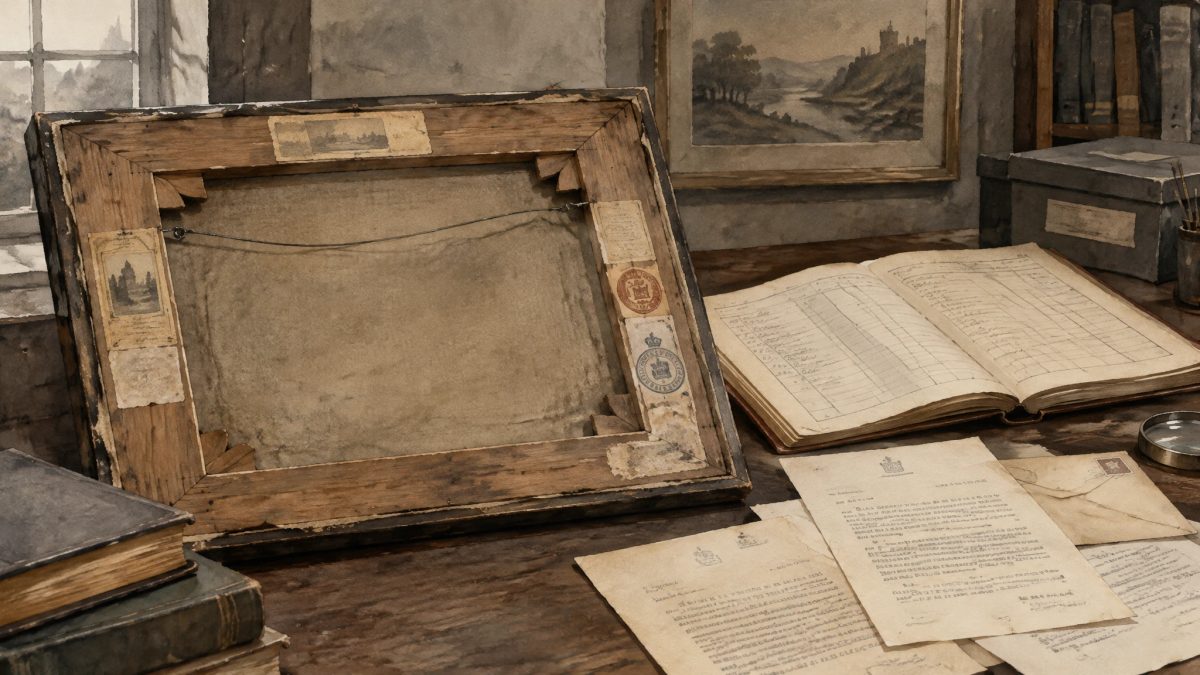
- Read the back of the work. Gallery labels, customs stamps, inventory numbers and dealer codes are physical evidence of past owners and dealers, including owners of the 1930s.
- Identify the sellers of the 1930s. A Jewish owner, a sale shortly after emigration or a price far below comparable sales signals a possible sale under duress.
- Look for earlier settlements. A previous agreement or restitution appears in press archives and earlier catalogues; ask who signed it.
- Collect the family papers. Invoices, letters, insurance schedules and photographs of interiors from the 1930s to the 1950s date the work's presence in a collection.
- Disclose what you find. A consignor who shares a 1933 to 1945 question at the valuation stage gives the auction house time to research it before the catalogue goes public.
Each step brings a 1933 to 1945 question to light before the catalogue is public, months ahead of the final week in which the Van Gogh claim arrived. The house guide to rediscovered artworks found in a family home shows how the same documents support an attribution as well as a title.
FAQ: Nazi looted art auction questions
Can a Nazi looted art auction go ahead when heirs have made a claim?
Yes, when the current owner and the heirs agree terms before the sale. On 17 November 2026 the owners of Van Gogh's Châtaigniers en fleurs reached an agreement with all the legal descendants of Samuel and Hedwig Fischer, and the painting stayed in the New York sale of 18 November. Without an agreement, the auction house decides whether to keep or withdraw the lot; an open claim exposes the buyer to litigation in the United States or France.
Does a sale in 1936 outside Germany rule out a claim?
No. Point C of the 2024 Best Practices for the Washington Conference Principles states that a sale by a persecuted person between 1933 and 1945 can count as an involuntary transfer, whatever the country of sale. The Van Gogh claim concerned a sale in Amsterdam in June 1936, three months after the owners left Berlin. Claimants then examine the price, the timing and the reason for selling.
Who has to sign a settlement for it to protect the buyer?
Every lawful heir of the pre-war owner, identified under the inheritance law that applies. On 5 November 2026 a Paris court cancelled the 2024 London sale of a Pissarro because only two of the seven Flavian heirs had signed the pre-sale agreement. The court left the two signatories' agreement in force and restored the rights of the five others.
How long do heirs have to bring a claim in the United States?
Six years from the moment they actually discover the key facts of their claim, under the HEAR Act of 2025 signed on 13 April 2026. The law has no expiry date, unlike the 2016 version that was due to lapse at the end of 2026. It also removes the defence that the claimants waited too long before suing.
Does Luxembourg have a restitution commission for private claims?
Luxembourg has no dedicated commission and no official catalogue of looted art. A 1941 decree of the government-in-exile annulled confiscations ordered from 10 May 1940, and the Grand Duchy endorsed the 2024 Best Practices. Its national museum publishes the provenance of its wartime acquisitions online, and provenance research is under way in three main cultural institutions.
How LLB Auction works with an owner from the first photo
LLB Auction is a full service auction house for fine art and collectibles at 29 rue du Fort Elisabeth, L-1463 Luxembourg, with prices in euros and terms under Luxembourg law. The owner deals with one house from the first photo to the payment.
Free valuation from photographs. Lyna Brahami, Associate Specialist, answers each valuation request within 48 working hours. The valuation is free, confidential and without commitment. Send photographs of the back of the work, its labels and any family papers with the first message.
Examination before the sale. The specialist examines every object in person before it goes to sale. The house photographs, researches and catalogues the work, and the consignment contract records the agreed reserve and commission.
Published results. Each sale has a public results page, gathered at llb-auction.com/results, listing each lot offered and the hammer price of each lot sold. Sales are held online on llb-auction.com and listed on Interenchères, and sellers reach the house on WhatsApp and by phone at +352 661 225 970. Ask your questions through the valuation request.
Conclusion
The two cases of November 2026 set a working rule for any work whose history crosses the years 1933 to 1945. A settlement that every lawful heir signed allowed a Van Gogh estimated at around $180 million to stay in its sale; a settlement that two heirs out of seven signed did not protect a Pissarro sold for £1.2 million once the five others went to court. The US HEAR Act of 2025, the French nullity of wartime seizures and Germany's binding arbitration since 1 December 2025 give heirs more routes than at any time since the Washington Conference of 1998.
For an owner, the protection lies in research done before consignment: the chain of owners, the loss registers, the labels and the heirs. For a bidder, it lies in reading the catalogue wording and asking who signed. A Nazi looted art auction can close cleanly when that work is done before the catalogue is public.
Also worth reading:
- Art provenance: the due diligence behind every lot
- Art restitution and title: the checks that protect a buyer
- Rediscovered artworks: how a lost painting is confirmed, valued and sold
- How online art auctions work, from first bid to settlement
Sources:
- Sotheby's makes last-minute deal to sell $180m Van Gogh painting following dispute : The Art Newspaper, Martin Bailey, 17 November 2026
- Van Gogh sale to go ahead, despite last-minute claim the $180M painting was sold "under duress" in Nazi era : CNN, 17 November 2026
- French court orders restitution of Pissarro painting sold at Sotheby's for £1.2m to heirs of Jewish banker : The Art Newspaper, Vincent Noce, 6 November 2026
- Best Practices for the Washington Conference Principles on Nazi-Confiscated Art : US Department of State, 5 March 2024, list of endorsing states as of 29 September 2026
- US congress passes revamped Holocaust recovery bill that sidesteps many legal defences : The Art Newspaper, Martha Lufkin, 17 March 2026, updated 13 April 2026
- Start der Schiedsgerichtsbarkeit NS-Raubgut : Der Beauftragte der Bundesregierung für Kultur und Medien, 1 December 2025
- La loi du 22 juillet 2023 sur la restitution des biens culturels spoliés : Ministère de la Culture, 23 July 2023
- JUST Act Report: Luxembourg : US Department of State, report to Congress
- Country Overview : Claims Conference and World Jewish Restitution Organization, Holocaust Looted Art and Cultural Property Initiative, 24 June 2026
- The Art Loss Register : Art Loss Register, database and search figures, consulted November 2026
Sell or buy with the house
Lyna Brahami values a work from your photos, free, within 48 working hours. The house then catalogues it, offers it in an online sale and settles you with a statement once the buyer has paid.

Associate Specialist