In this article
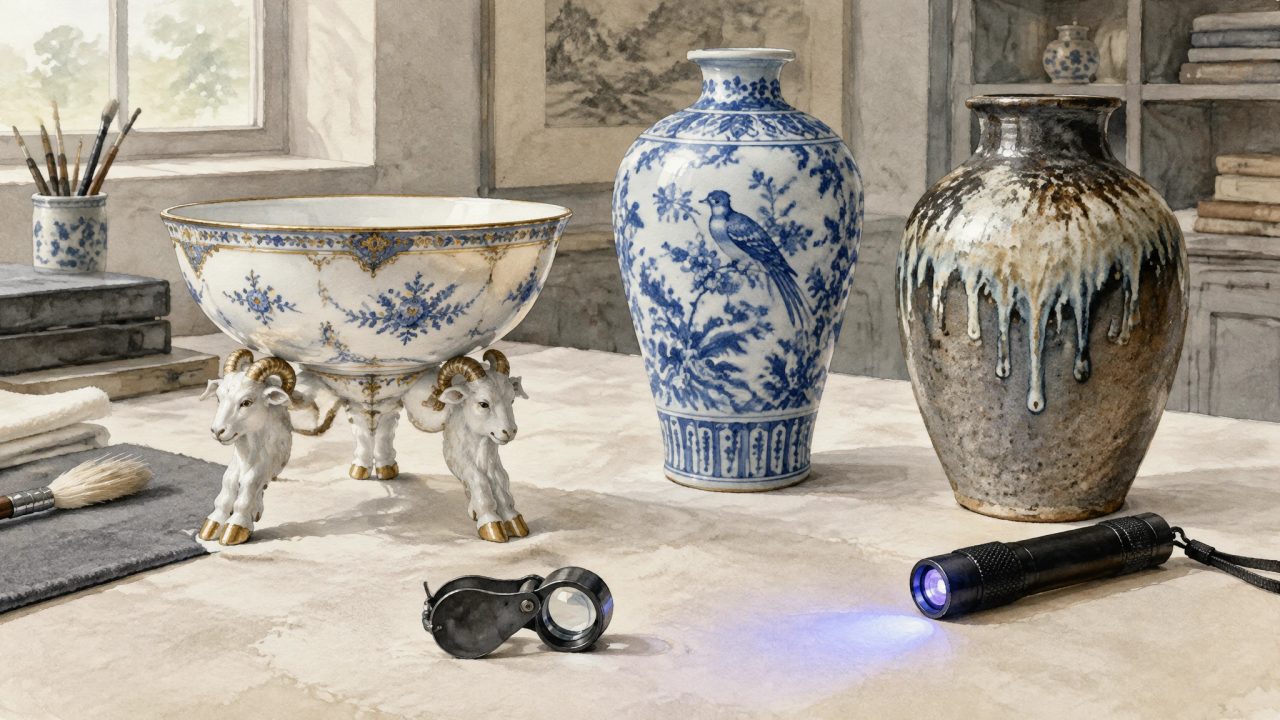
Two porcelain bowls shaped like a breast, each resting on a tripod of goats' heads, share the same model and the same factory. One, made by the Sèvres manufactory for Marie-Antoinette's dairy at Rambouillet and delivered in 1787 or 1788, goes to auction at Hôtel Drouot on 26 November 2026 with an estimate of €1 million to €2 million. The other, a reissue made by the same manufactory in 1992, carried an estimate of €600 to €800. Learning how to identify valuable pottery and porcelain means learning to see the difference between those two objects: the body they are made of, the marks on the base, the period of manufacture and the condition of the surface. October 2026 gave the question new urgency, with a first ceramics-only sale at Artcurial in Paris, a scholarly collection of French art pottery at Bonhams and a pair of Kangxi vases hammered at £180,000 in Dorset.
Key takeaways:
- Artcurial held its first auction devoted solely to ceramics on 23 October 2026 in Paris, with estimates from €500 to €800 for a Shōzō Michikawa pot of 2004 up to €12,000 to €15,000 for a Carolein Smit sculpture of 2010.
- A Sèvres jatte-téton from the Rambouillet dairy service of 1787 to 1788 is estimated at €1 million to €2 million for 26 November 2026; a 1992 reissue of the same model was estimated at €600 to €800.
- A pair of Kangxi blue and white "soldier" vases and covers hammered at £180,000 at Duke's of Dorchester in October 2026.
- Under ultraviolet light, adhesives, paints and fills that are not part of the original ceramic show up against the fired glaze, so a buyer asks whether the piece was examined under UV before bidding.
- In 2026, 20% of high net worth collectors named fraud, forgery or manipulation as a risk of the market.
Ceramics at auction in autumn 2026: why the Paris season turned to clay
Artcurial put ceramics at the centre of the Paris calendar on 23 October 2026 with "Earth & Fire: Ceramics", the first sale the house had ever devoted to the medium alone. The auction ran during Art Basel Paris and the Ceramic Art Fair + Glass, after a public viewing from 17 to 22 October, and was curated by Jean-Marc Dimanche, co-founder of Ceramic Brussels. Artcurial described the sale as "a significant milestone in the institutional and market recognition of ceramics" and referred to "a renewed wave of interest" among collectors. The catalogue mixed classical, Japanese and craft ceramics with emerging and established artists, which makes it a useful cross-section of the price levels a collector meets today.
The published estimates show how wide the range is inside a single sale:
| Artist | Work and date | Estimate (October 2026) |
|---|---|---|
| Carolein Smit (born 1960) | Two Headed Lamb, 2010 | €12,000 to €15,000 |
| Betty Woodman (1930 to 2018) | Summer Vase, New York, 1996 | €10,000 to €15,000 |
| Georges Jouve (1910 to 1964) | Vase bouteille, about 1950 | €5,000 to €7,000 |
| Kazuo Takiguchi (born 1953) | Untitled, about 1990 | €3,500 to €4,500 |
| Jacques Blin (1920 to 1995) | Blue glazed vase, about 1960 to 1970 | €3,000 to €4,000 |
| Shōzō Michikawa (born 1953) | Natural Ash Glaze Pot, 2004 | €500 to €800 |
Institutional recognition explains part of the spread. Betty Woodman became, in 2006, the first living woman artist to receive a retrospective at the Metropolitan Museum of Art, and Shōzō Michikawa was, in 2005, the first foreign ceramicist to hold a solo exhibition in the Forbidden City in Beijing. Artcurial's presentation of the sale lists both facts beside the estimates, because buyers price recognition.
Bonhams answered from London with the Strobel Collection, a group of French art pottery assembled over five decades by Professor Stephan Strobel and Madeleine Strobel and offered in a Modern Decorative Art & Design sale in autumn 2026. French art pottery is the body of stoneware and earthenware made by independent French potters from the 1880s onwards, a generation that includes Jean-Joseph Carriès, Ernest Chaplet and Auguste Delaherche. Bonhams presented the Strobels' approach as scholarly: they collected by makers, techniques, marks and glazes, the four criteria this guide follows.
The high end of the field moved in the same weeks. A pair of Kangxi blue and white porcelain "soldier" vases and covers hammered at £180,000 when Duke's of Dorchester sold contents from Breamore House, near Fordingbridge in the New Forest. Kangxi is the reign of the Chinese emperor of the Qing dynasty who ruled China from 1662 to 1722. Finally, the Sèvres bowl from the Rambouillet dairy resurfaced in the inventory of a Paris dealer's estate and was announced for a Drouot sale on 26 November 2026.
The broader market data explains why houses invest in the category. In 2026, fine and decorative art accounted for 55% of the spending of the 3,100 high net worth collectors surveyed across 10 markets, up from 49% in 2025; within the remaining 45% spent on collectibles, antiques took 9% of the total and design 6%. Ceramics sit across all three of those categories.
Free valuation from a photo
Send a photo. Lyna Brahami replies within 48 working hours, free and without commitment.
Drop your photos here
or
Prefer WhatsApp?
Send the photos on WhatsAppWrite to +352 661 225 970. The reply comes in the conversation.
Earthenware, stoneware or porcelain: what the body tells you first
The body of a ceramic is the fired clay itself, and identifying it is the first step in any valuation. Three families cover almost everything that reaches a saleroom. Earthenware is clay fired at a relatively low temperature; it stays porous and soft, which is why it is glazed to hold liquid and why a chip on an earthenware plate shows a matt, absorbent edge. Stoneware is fired hotter until the clay fuses into a dense, hard body that holds water even without a glaze; Japanese ash glazed pots belong here, as do the stoneware pieces of the French art potters. Porcelain is a white body rich in kaolin (a fine white clay) fired until it vitrifies, which makes it hard, dense and, when thin, translucent.
Vitrification has a measurable threshold. Ceramic standards treat a body as vitrified once it absorbs less than 0.5% of its weight in water, and porcelain bodies tested in laboratory conditions reached that level, together with their maximum density, at 1280 °C. Porcelain formulas contain a higher proportion of kaolin and a lower proportion of fluxes (minerals such as feldspar that lower the melting point) than stoneware formulas. For the collector the consequence is practical: high-fired ceramics have a hard, glassy fabric and a securely attached glaze, while low-fired ceramics have a soft, porous fabric and a glaze that flakes more readily.
European porcelain adds a second distinction. Soft-paste porcelain is an artificial porcelain made without kaolin, fired at a lower temperature, with a warm, creamy surface. Hard-paste porcelain is true porcelain based on kaolin. Sèvres did not master hard paste until 1769. Compared with soft paste, the hard-paste body is whiter and more durable, and it can be potted or moulded more thinly. A Sèvres piece dated before 1769 that shows the cold, bright white body of hard paste therefore raises an immediate question about its date.
Four observations identify the body before any mark is read:
- The foot rim. The unglazed ring on which the piece stands shows the body directly: buff, red or grey and granular for earthenware, dense and grey or brown for stoneware, fine and white for porcelain.
- Translucency. A thin porcelain rim held against a lamp lets light through; earthenware and most stoneware stay opaque.
- Weight and sound. Vitrified bodies are dense and ring when tapped gently with a fingernail; porous earthenware gives a duller note.
- The edge of any chip. A glassy, shell-like fracture belongs to porcelain; a matt, crumbly edge belongs to earthenware.
None of these observations replaces the specialist, and a cracked piece rings dully whatever its body. They do let an owner describe the object accurately in a valuation request, and they let a buyer read a catalogue entry that says "stoneware" or "soft-paste porcelain" with an understanding of what those words commit the house to.
Pottery and porcelain marks: how to identify valuable pottery and porcelain from the base
A mark is any sign painted, printed, incised or impressed on a ceramic to record who made it, where or when. Marks are the first thing most owners look at and the last thing a specialist relies on. Chinese reign marks are widely faked, and specialists of Chinese ceramics state plainly that a mark cannot be relied on as proof of authenticity; every property of the object has to be considered together. The same discipline applies to European factory marks and to the signatures of studio potters.
Sèvres marks show both the usefulness and the limits of the system. The factory's mark is two interlaced letters L, the royal cipher, painted in blue; letters placed inside it record the year, and a pair of plates painted by Jean-Jacques Dieu carries the double letter "OO" for 1791. A closed crown above the interlaced Ls was, as a rule, used for hard-paste porcelain. The rule has exceptions: many Sèvres pieces in hard paste do not bear the crown, and between 1752 and 1792 the painter Jean-Jacques Sioux used a crown of a different style to mark his own work, a number of pieces of which are in soft paste. A crowned mark on a soft-paste body, or a crisp printed mark on a piece with a worn surface, is the kind of contradiction a cataloguer records.
Chinese reign marks follow a different logic. A reign mark gives the name of the emperor's era, in four or six characters, painted under or over the glaze or impressed in the base. The first imperial kiln at Jingdezhen dates to 1278, and by the Xuande reign (1426 to 1435) marks had become a regular feature of porcelain made in the imperial kilns. Potters of the Kangxi period (1662 to 1722) produced porcelain bearing the reign marks of earlier Ming emperors as a sign of respect; auction catalogues call these marks apocryphal, meaning that the mark names a reign other than the one in which the piece was made. The most copied apocryphal mark is that of the Chenghua reign (1465 to 1487), because imperial porcelain of that period was regarded as the finest. A Chenghua mark on a blue and white dish dates nothing on its own: the mark is compatible with a Ming, a Kangxi, a nineteenth century or a recent dish.
Studio signatures close the series. Potters such as Georges Jouve, Jacques Blin or Pol Chambost incised or painted their names or monograms in the clay, and twentieth century potters added workshop stamps. Signatures help attribution only when the technique, the glaze and the form agree with the maker's documented work. The vocabulary a catalogue uses to express doubt about a maker is the same ladder used for paintings, explained in our guide to attributed to vs studio of vs circle of.
A base is read in a fixed order:
- Method of marking. Note whether the mark is painted under the glaze, painted or printed over it, incised before firing or impressed.
- Agreement with the body. Check that the mark belongs to the type of body identified above, for example a hard-paste mark on a hard-paste piece.
- Wear. Compare the wear on the foot rim with the wear on the mark; an old base with a pristine overglaze mark needs explaining.
- Style of writing. Compare the calligraphy or lettering with documented examples in museum collections and reference books.
- Decorator's and gilder's marks. Look for secondary marks, which often identify individual painters at Sèvres and other factories.
- Paper labels and inventory numbers. Record labels, collection numbers and old exhibition stickers, which belong to provenance.
- Absence of a mark. Treat an unmarked base as information too: a missing mark proves nothing either way, and the body and decoration then carry the whole identification.
Period, later or reissue: the Sèvres bowl from Rambouillet as a lesson
The Rambouillet bowl is the clearest current example of why form and mark alone settle nothing. Between 1785 and 1787 Louis XVI had a dairy built for Marie-Antoinette at the Château de Rambouillet, and the royal manufactory at Sèvres made the service used there. The service was designed by Louis-Simon Boizot (1743 to 1809), head of the sculpture workshop, and the painter Jean-Jacques Lagrenée le Jeune (1739 to 1821). It was planned at 108 pieces; 65 were delivered, in 1787 and 1788. Its most famous model is the jatte-téton, a bowl in the shape of a breast set on a tripod of goats' heads, inspired by the mastos, a breast-shaped drinking cup used at Greek banquets. The legend that the bowl was moulded on the queen's breast has no basis.
Four original bowls are known. Two are in the Musée national de céramique at Sèvres and one is in the Museo Duca di Martina in Naples. The fourth, the only one in private hands, surfaced during the inventory of the estate of Galerie Meyer, a Paris dealer run by three generations of the same family. Its base carries black and purple scrolls on an ochre-orange ground, distinct from the pastel grounds of the three museum examples. A handwritten note found with the bowl traces it from the Rambouillet dairy to the Marquise de Chanaleilles (1784 to 1867), then to her grandson General Ferdinand de Salles (1831 to 1925), who sold it to Galerie Meyer. It goes to auction at Hôtel Drouot on 26 November 2026 with an estimate of €1 million to €2 million.
The same factory has reissued the model. A white bowl with gold fillets on a biscuit tripod with goats' heads, made by the Manufacture nationale de Sèvres in 1977, carries hollow marks with the date 1977 and the red stamp of the manufactory, and measures 11.5 cm high. Another, made in 1992 and 15 cm high, was offered in a Paris sale in December 2014 with an estimate of €600 to €800. Both reissues are honest objects: they are dated and marked, and catalogued as reissues of the 1787 model. Their value sits in a different universe from the original because period, documented provenance and decoration differ.
| Criterion | Original, Rambouillet service | Reissue, Manufacture nationale de Sèvres |
|---|---|---|
| Date of manufacture | 1787 to 1788 | 1977 and 1992 examples |
| Decoration of the tripod | Coloured ground with painted scrolls (ochre-orange on the private example) | White with gold fillets |
| Marks | Read against the documented 1787 model | Hollow marks with the year, red factory stamp (1977 example) |
| Provenance | Handwritten note tracing the bowl from Rambouillet to Galerie Meyer | Twentieth century production of the manufactory |
| Estimate | €1 million to €2 million (November 2026) | €600 to €800 (December 2014) |
The lesson extends far beyond Sèvres. A representative case shows the method: an heir finds a white breast-shaped bowl on a goat-head tripod in a family cabinet and searches the image online. The first results describe the Drouot bowl at €1 million to €2 million. The base, turned over, shows a hollow mark with the year and a red stamp, which places the piece among the twentieth century reissues; the €600 to €800 estimate of the 1992 example is the relevant comparable. Reading the base before reading the headlines saves the owner a disappointment and saves a buyer from an expensive mistake. Our analysis of why two almost identical works sell for wildly different prices applies the same reasoning to paintings and prints.
Condition in ceramics: what the report has to say
Condition moves the price of a ceramic more sharply than that of most paintings, because a break or a restoration changes the object itself. A useful condition report names each defect, locates it and says whether it is a firing flaw or later damage. The vocabulary is short and precise. A chip is a small loss of body or glaze, usually at the rim, foot or spout. A hairline is a fine crack running through the body, visible from both sides when held to the light. A firing flaw is a defect that occurred in the kiln, such as a glaze bubble, a kiln grit stuck to the foot or a firing crack. Crazing is a network of fine cracks in the glaze caused by a mismatch between the expansion of the glaze and the body during firing and cooling. Frits are minute chips along a rim.
Old repairs leave visible traces. Metal rivets were commonly used to hold broken pieces together, especially on objects that stayed in use, and iron or copper rivets stain the surrounding body as they corrode. Old adhesives become insoluble as they age, and a yellow, brittle adhesive line signals a fragile piece that may come apart. A buyer reading "riveted" in a catalogue learns that the piece was broken and kept, which matters to the price and to how the object should be handled and shipped. The fuller method for reading these documents appears in our guide on how to read a professional condition report.
Porcelain restoration and UV light form the heart of a modern examination. Ultraviolet radiation reveals adhesives, paints and fills that are not part of the original ceramic, and the examination is best carried out by a conservator familiar with the procedure. Decorative porcelain in museum collections is typically restored to fully obscure any breaks or losses, using fills shaped to the profile of the object and painted to match the glaze or gilding. Conservators work with epoxy resins such as Hxtal NYL-1, thickened with fumed silica and tinted with dry pigments, and they keep a record of each step. Sarah Barack, Senior Objects Conservator and Head of Conservation at Cooper Hewitt, Smithsonian Design Museum, puts the principle this way: "conservators always document all steps of the treatment so that it is apparent what work was done." In the market the same transparency belongs in the condition report, because an overpainted rim photographs perfectly and reveals itself only under the lamp or in the hand.
The effect of each defect on price depends on category and on the object's standing. A firing flaw on a stoneware vase by an art potter of the 1890s is part of the making and is described without alarm; the same flaw on eighteenth century porcelain made for a royal service is recorded with more weight. Professional restoration on a large decorative vase is described in the report and priced accordingly. Undeclared restoration on a piece offered as perfect is the most serious condition problem in the category. In a well-run saleroom the condition report governs, and no description states a condition better than the report.
A buyer should check five points before bidding on a ceramic lot:
- The full condition report. Request it when the catalogue entry gives only a summary.
- Ultraviolet examination. Ask whether the piece has been examined under UV light and what it showed.
- Additional photographs. Ask for images of the rim, the foot, the interior and the base under raking light.
- Old repairs. Check whether rivets, staples or adhesive lines are mentioned and where they are.
- Wording. Read every expression such as "minor", "small" or "professional restoration" against the photographs.
What drives value across factory porcelain, art pottery and contemporary ceramics
Value in ceramics rests on the same small set of variables across very different markets: maker or factory, period, body and technique, form and decoration, condition and provenance. Their relative weight changes by segment. Factory porcelain is judged first on period and decoration, because the factories produced over long spans and reissued their own models. French art pottery is judged on the maker and the glaze, because each piece is the result of a single firing experiment. Contemporary ceramics are judged on the artist's standing, which is built by exhibitions, museum collections and sale results.
| Segment | First question | Typical evidence | Example price level in 2026 |
|---|---|---|---|
| European and Chinese factory porcelain | Period and decoration | Body, marks, documented models, provenance | £180,000 hammer for a pair of Kangxi soldier vases; €1 million to €2 million estimate for the Rambouillet bowl |
| French art pottery, 1880s to 1910s | Maker and glaze | Incised signatures, glaze effects, scholarly literature | Collections built over five decades on makers, marks and glazes, offered at Bonhams in autumn 2026 |
| Post-war and contemporary ceramics | Artist's standing | Exhibitions, museum holdings, previous results | €500 to €800 for a Michikawa pot of 2004; €12,000 to €15,000 for a Smit sculpture of 2010 |
Provenance carries particular weight because ceramics travel through households as everyday objects and lose their history quickly. The Rambouillet bowl is worth a museum-level estimate partly because a handwritten note links it, owner by owner, to the dairy for which it was made. The Kangxi pair sold from the contents of Breamore House reached the saleroom with its country house history attached. Our hub on provenance, attribution and condition sets out how ownership history is documented and checked.
Taste matters too, and it shifts. In 2026, 22% of high net worth collectors used apps or AI tools to research purchases, which puts photographs and published results at the centre of how buyers find ceramics. Owners who follow sale results of the makers they hold make better decisions about when to sell. The most reliable indicator of what a specific piece is worth remains the hammer price of comparable pieces in comparable condition, which is why public results matter more than asking prices.
How to identify valuable pottery and porcelain before you photograph it for a valuation
A valuation from photographs works when the photographs answer the questions a specialist would ask in the room. Good images let the specialist identify the body, read the mark, judge the decoration and locate any damage before the piece is ever moved. Poor images produce a cautious answer and a request for more pictures. Owners who prepare the set below save themselves a round of correspondence.
- The whole object, front and back. Photograph it against a plain, neutral background in daylight, with no filter.
- The profile. Take a side view at eye level, which shows the form and any distortion from firing.
- The base and mark. Shoot straight down, in focus, with the mark readable, plus a second view at an angle to show whether it is painted, printed or incised.
- The rim and foot. Take close views all the way round, where chips and frits are found.
- The interior. Photograph the inside of bowls, vases and cups, where cracks often start.
- Damage under raking light. Light every crack, chip or repair from the side so that the relief shows.
- Labels and documents. Include inventory stickers, old invoices, letters and photographs of the piece in its former setting.
- Dimensions. Record height and diameter in centimetres.
Photographs open the conversation; they do not close it. At LLB Auction the specialist examines every object in person before it goes to sale, and the house researches and catalogues each lot itself. This is particularly important for ceramics, where UV examination, the weight of the piece and the feel of a restored area under the fingertip complete what a picture shows.
FAQ: pottery and porcelain at auction
How to identify valuable pottery and porcelain at home: what can an owner check alone?
An owner can check four things without equipment: the colour and texture of the unglazed foot rim, the translucency of a thin rim against a lamp, the mark on the base and its manner of application, and any chips, cracks or repairs. These observations do not establish value or authenticity. They give the specialist an accurate description and the right photographs, which makes the free valuation faster and more precise.
Does a Sèvres or Chinese reign mark prove that a piece is genuine?
No mark proves authenticity on its own. Chinese reign marks were widely copied, and potters of the Kangxi period (1662 to 1722) used Ming reign marks as a sign of respect; catalogues call these marks apocryphal. At Sèvres, the closed crown above the interlaced Ls marked hard paste as a rule, yet many hard-paste pieces lack it and one painter used a crown on soft paste. A mark counts as evidence only when it agrees with the body, the decoration and the wear of the piece.
What is the difference between soft-paste and hard-paste porcelain?
Soft-paste porcelain is an artificial porcelain made without kaolin and fired at a lower temperature, with a warmer, creamier surface. Hard-paste porcelain is true porcelain based on kaolin, whiter and more durable. Sèvres mastered hard paste only in 1769, so the type of body helps date a piece. A hard-paste body on a Sèvres piece presented as earlier than 1769 calls for close examination of every other element.
How much does restoration reduce the value of a ceramic?
No single percentage applies across the category. The effect depends on the type of object, the extent and the quality of the work, and whether it is declared. Professional restoration on a large decorative vase is priced in when the condition report states it. Undeclared restoration on a piece offered as perfect is the most serious problem, which is why ultraviolet examination, which reveals adhesives, paints and fills that are not original, matters before any bid.
Is a reissue by the original factory worth collecting?
A reissue is an honest object when it is marked and dated as such, and it has its own market. The Manufacture nationale de Sèvres reissued the Rambouillet breast bowl in the twentieth century; a 1992 example was estimated at €600 to €800, against €1 million to €2 million for the 1787 to 1788 original offered in November 2026. A reissue should be bought at a reissue price, after the base has been read.
How LLB Auction values and sells ceramics
LLB Auction accepts every category of fine art and collectibles for valuation, including design and collectible objects, antiques, silver and decorative arts, the fields where pottery and porcelain belong. The owner deals with one house from the first photograph to the payment.
Free valuation from photographs. Lyna Brahami, Associate Specialist, answers each valuation request within 48 working hours. The valuation is free, confidential and without commitment, and sellers reach the house on WhatsApp and by phone at +352 661 225 970.
Examination, research and cataloguing. The specialist examines every object in person before it goes to sale. The house photographs, researches and catalogues each lot, and the seller's commission is agreed in the consignment contract.
Sale and published results. Sales are held online on llb-auction.com and listed on Interenchères. Every sale has a public results page with each lot and its hammer price.
Owners holding a vase, a figure or a service who want to know what it is can send the photographs described above for a free valuation.
Conclusion
The autumn of 2026 showed the whole range of the ceramics market in a few weeks: a first ceramics-only sale in Paris, a scholarly collection of French art pottery in London, a pair of Kangxi vases at £180,000 and a Sèvres bowl from Marie-Antoinette's dairy estimated at €1 million to €2 million while a reissue of the same model sits at €600 to €800. The figures will change; the method behind them will hold. Body, marks, period, condition and provenance are read together, and none of them decides alone.
Knowing how to identify valuable pottery and porcelain starts with turning the piece over, reading the foot rim and the mark against each other, checking every repair under the right light and sending a specialist photographs that answer the obvious questions before they are asked.
Also worth reading:
- Provenance, attribution and condition: the due diligence behind every lot
- How to read a professional condition report
- The attribution ladder: attributed to vs studio of vs circle of
- Why two almost identical works sell for wildly different prices
- Buying sculpture at auction: casts, editions and what you actually own
Sources:
- Earth & Fire: Ceramics, Artcurial unveils a new auction dedicated to ceramics : Artcurial, 2026
- The Strobel Collection: A Passion for the Alchemy of Ceramics : Bonhams, 21 September 2026
- Long-lost Marie Antoinette breast bowl found : The History Blog, 24 October 2026
- Marie-Antoinette's Sèvres dairy bowl emerges after more than two centuries : Antiques Trade Gazette, 23 October 2026
- Kangxi blue and white porcelain soldier vases take six-figure sum at Dorset auction : Antiques Trade Gazette, 27 October 2026
- Le bol sein de la reine Marie-Antoinette, lot 18, reissue of 1977 : La Gazette Drouot
- Jatte téton, lot 14, Sèvres reissue of 1992 : Coutau-Bégarie, December 2014
- From AI to Gen Z: everything to know about the 2026 Survey of Global Collecting : Art Basel and UBS, Arts Economics, 8 October 2026
- Care of Ceramics and Glass, CCI Notes 5/1 : Canadian Conservation Institute, 11 September 2017
- A Closer Look: Porcelain Restoration : Cooper Hewitt, Smithsonian Design Museum, 18 April 2024
- Plate, Sèvres Manufactory, 1791, object 62.165.1 : The Metropolitan Museum of Art
- Hard-Paste Porcelain Plates from Sèvres with Chinoiserie Decoration : Antoine d'Albis, Metropolitan Museum Journal, volume 37, 2002
- Reign marks on Chinese ceramics : Royal Asian Art Society in the Netherlands, 29 April 2025
- Porcelain versus Porcelain Stoneware: So Close, So Different : Materials, 2023
Sell or buy with the house
Lyna Brahami values a work from your photos, free, within 48 working hours. The house then catalogues it, offers it in an online sale and settles you with a statement once the buyer has paid.

Associate Specialist