In this article
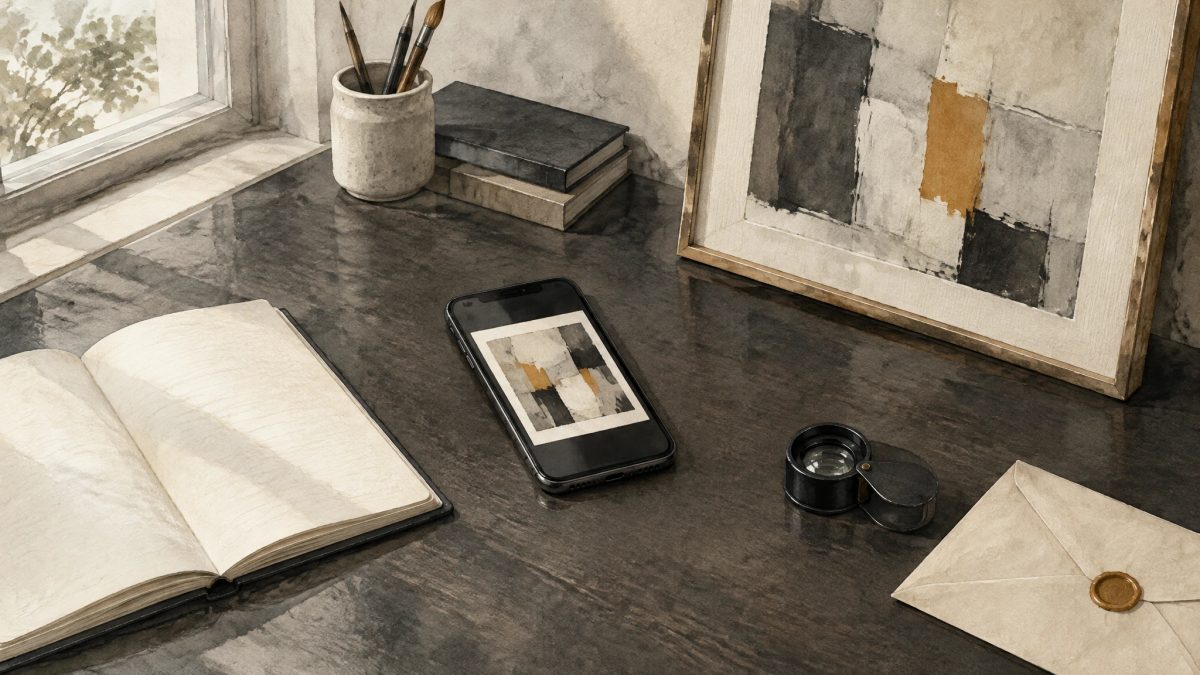
A collector who is offered a painting by direct message now joins the majority of wealthy buyers. In 2026, 53% of high net worth collectors who bought directly from a dealer did so through Instagram without seeing the work in person, against 43% in 2024. Buying art on Instagram has moved from novelty to habit, while the protections that come with a viewing, a catalogue entry and a written contract have not followed it into the inbox. This guide sets out the checks that replace the viewing (identity of the seller, condition, provenance, invoice, payment route, delivery and recourse), and how the same purchase compares with an online auction.
Key points:
- 53% of wealthy collectors who bought from a dealer in 2025 and 2026 bought through Instagram without viewing the work, up from 43% in 2024.
- In June 2026, 68% of the fraud reports made by Lloyds Banking Group customers started on a Meta platform (Facebook, Instagram or WhatsApp); losses to scam adverts there reached an estimated £66 million a year, against £27 million in 2023.
- Under Directive 2011/83/EU, a consumer who buys at a distance from a trader has 14 days to withdraw; the right does not cover a purchase from a private individual, a commissioned work made to the buyer's specifications, or a contract concluded at a public auction.
- Since 9 October 2025, banks in the euro area must check the name of the payee against the IBAN (International Bank Account Number) before a credit transfer leaves the account, a free safeguard every buyer should read before confirming.
What the 2026 survey shows about buying art on Instagram
The Art Basel and UBS Survey of Global Collecting is an annual study written by Clare McAndrew of Arts Economics; its 2026 edition, published in Zurich on 8 October 2026, drew on 3,100 high net worth collectors in 10 markets, from the United States and the United Kingdom to France, Germany, Hong Kong and Brazil. Its findings on channels describe a market in which the screen has become a normal place to close a sale. Among the 75% of respondents who bought directly from a dealer in 2025 and 2026, 53% bought through Instagram without viewing the work in person, ten points above the 43% recorded in 2024. External online platforms carried 27% of total spending, five points more than a year earlier and well above the 17% of 2024.
Purchases from artists themselves rose further. Buying directly from artists reached 69% of respondents, more than double the 2024 level; in the breakdown of those purchases, purchases from artists' studios stood at 48%, commissioned works at 40% and works bought through Instagram at 38%. Artist direct buying through Instagram was heavier among newcomers: it accounted for 8% of spending by collectors in the market for two years or less, against 2% for those collecting for 20 years or more. The platform also shapes what people choose. In 2026, 19% of collectors used recommendations from Instagram, 22% among Generation Z, and 32% cited Instagram or X as a source of advice.
The same respondents describe themselves as careful. In 2026, 72% of wealthy collectors carried out moderate or significant independent research before buying, up from 62% in 2025 and 80% among Generation Z. Apps and artificial intelligence (AI) tools were used by 22% of collectors, against 4% in 2024; 20% of respondents named fraud, forgery and market manipulation as a potential negative effect of AI on the market. The founder of Arts Economics, Clare McAndrew, summarised what these collectors value: "status comes less from price than from rarity, provenance, originality, and discovery." Provenance sits in that list, and it is the element a direct message transmits least well.
A collector who studies an artist for weeks and then transfers money to an account named in a chat has done the art historical work and skipped the transactional checks. The rest of this guide covers those checks.
Free valuation from a photo
Send a photo. Lyna Brahami replies within 48 working hours, free and without commitment.
Drop your photos here
or
Prefer WhatsApp?
Send the photos on WhatsAppWrite to +352 661 225 970. The reply comes in the conversation.
Where the money goes: impersonation and payment fraud on social platforms
Purchase fraud (a scam in which the buyer pays for goods that never arrive or do not exist) makes up the majority of all scams reported in the United Kingdom, and social platforms are where it starts. In an analysis published in May 2023, Lloyds Banking Group, the largest retail bank in the country, found that 68% of all purchase scams reported by its customers began on Facebook, including Facebook Marketplace, and Instagram, and they accounted for around 40% of the amount lost; the average loss across the British industry stood at around £570 in 2023. By June 2026, 68% of fraud reports from the bank's customers started on a Meta platform, and losses to scam adverts on those platforms had reached an estimated £66 million a year, against £27 million in 2023.
Liz Ziegler, Fraud Prevention Director of Lloyds Banking Group, described the problem in 2023 in terms that apply directly to art: "Social media has become the Wild West of online shopping in recent years, with very few checks in place to verify who is selling what." The safest rule given to online shoppers is to buy only what they have seen in person. For a collector who buys through Instagram, that rule is the one the market has abandoned, which is why the substitutes below matter.
Art scams on Instagram follow patterns that galleries now publish in their own warnings. A gallery phishing notice updated on 12 August 2026 lists the roles fraudsters assume: a gallery, an artist, a collector, a shipper, an advisor or a payment provider. Its red flags read as a checklist for any buyer:
- contact that stays on social media or messaging apps (Instagram, Facebook, WhatsApp, Telegram) and never moves to a verifiable address;
- messages from free email providers or lookalike domains with an extra word, a hyphen or a misspelling;
- urgent or secret payment requests, payment to a personal or newly changed account, or a last minute change of bank details;
- requests to pay in cryptocurrency, gift cards or peer to peer apps such as Zelle, Venmo or Cash App;
- requests for passwords, one time codes or remote access.
Account impersonation (a copy of a genuine artist's or gallery's profile, built from its own photographs and captions) is the pattern that most directly targets collectors. The copy writes first, quotes a price below the market and asks for a deposit to "reserve" the work. The genuine account never hears of the exchange. The defence is procedural: every message is treated as a lead, and the seller is confirmed through a channel the buyer finds independently.
Misdescription in good faith calls for the same discipline as fraud: verify the seller, then the work, then the payment, in that order.
Verifying the seller before the work
A buyer who verifies the work before the seller has the order wrong: a perfect condition report from an impostor is worthless. Identity comes first, and it rests on evidence outside the platform.
For an artist, the checks are simple and cumulative. The artist's website, gallery representation and exhibition history should name the same Instagram handle; a represented artist's gallery will confirm, by email from its own domain, whether a work is available and whether the artist sells directly at all. A "studio sale" offered by an account with a recent creation date, few posts or a slight variation of the official handle matches the impersonation pattern described above. The history of the account (years of posts, tagged exhibitions, replies from known institutions) is better evidence than its follower count.
For a gallery or dealer, the checks are commercial. A trading business has a registered company, a VAT number in the European Union, a street address and a landline. The buyer looks these up in the national business register and calls the number found there, never the one supplied in the conversation. Professional membership (a dealers' association, an art fair's exhibitor list) is a further anchor because it is published by a third party.
For a private seller, the position is the weakest. The seller is an individual whose identity the buyer must establish personally, the purchase carries none of the consumer protections that apply to traders, and the provenance of the work rests on the seller's word. A private sale through a direct message deserves the strictest version of every check that follows.
Two signals override everything else. Any request to move the payment to a different account than the one named on the invoice, and any pressure to pay before a written description has been sent, end the exchange until they are explained by a phone call to a verified number.
Condition, light and scale without a viewing
A viewing answers three questions that photographs answer badly: the true state of the surface, the colour under neutral light, and the physical presence of the work at its real size. Each has a substitute, and none is complete.
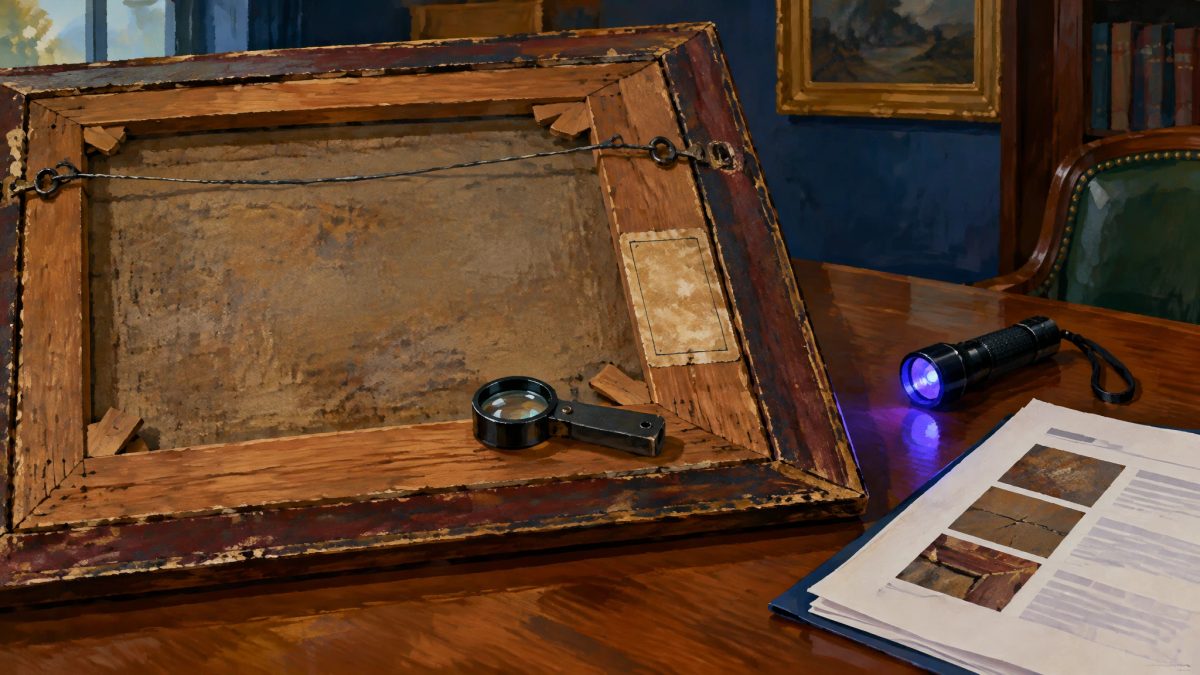
A condition report is a written description of the physical state of a work: its support, its surface, any damage, losses, restorations, discolouration and the state of the frame. A serious seller provides one in writing before payment. For a painting it should state whether the canvas has been relined, whether there is retouching visible under ultraviolet light, whether the varnish has yellowed, and the condition of the stretcher. For a work on paper it should mention foxing, toning, light staining and whether the sheet is trimmed or laid down. The vocabulary is standardised enough that a vague report ("good condition for its age") is itself information.
Photographs fill the rest. A buyer asks for images that the seller has no reason to stage: the whole work unframed, the back of the canvas or the sheet, the signature in close up, the edges, and a raking light view, in which a lamp is placed low and to one side so that cracks, lifting paint and repairs throw shadows. A live video call, during which the seller turns the work, tilts it under light and shows the label on the back, is the closest substitute for a viewing and has the advantage of being hard to fake with a stock image.
Scale is the error that photographs make most reliably. A buyer measures the stated dimensions on the wall where the work will hang before agreeing a price, and asks for a photograph of the work beside an object of known size.
The written description of the work closes this stage. Title, date, medium, support, dimensions with and without frame, signature and inscriptions, edition number for a print or a cast, and the condition report should all exist as text, sent by the seller, before money moves. That text becomes part of the contract and is the reference point if the work that arrives differs from the work described.
Provenance, certificate and invoice
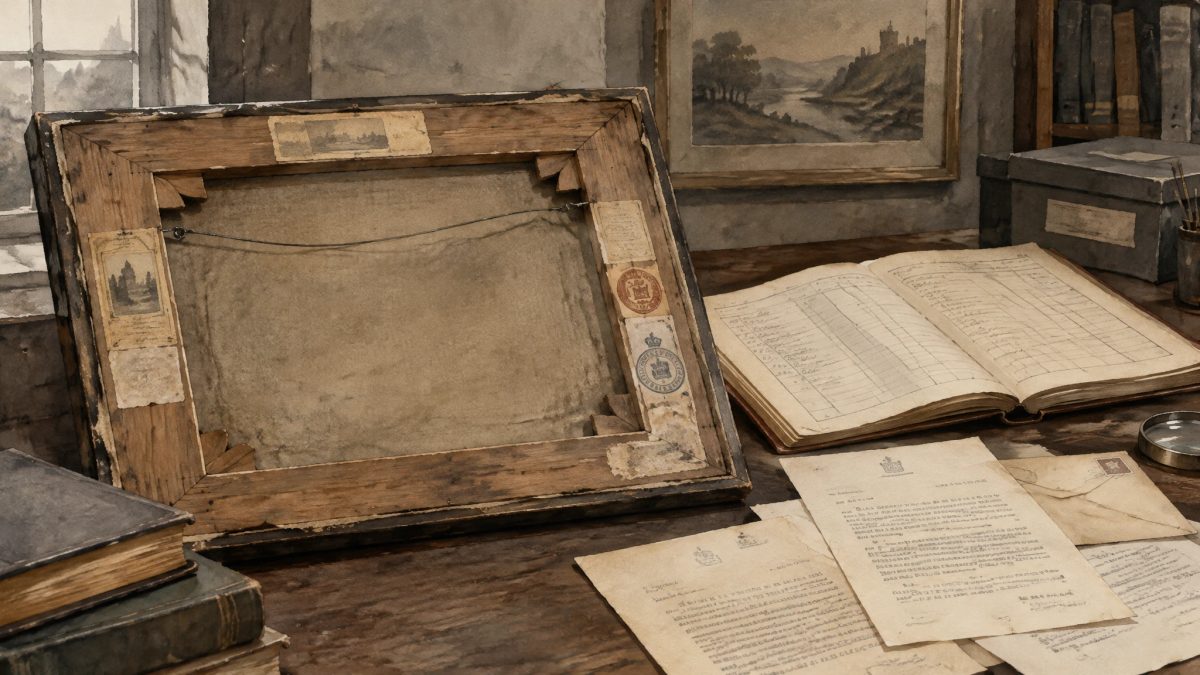
Provenance is the documented history of ownership of a work, from the artist to the present owner, supported by invoices, exhibition catalogues, labels, letters and sale records. For a work bought directly from the artist, provenance starts with the buyer and is simple; for any secondary market work offered through a direct message, it is the most important document after the seller's identity.
The questions are direct. From whom did the seller acquire the work, when, and with what paperwork? Has it been exhibited, published or sold at auction before? Is it recorded in a catalogue raisonné, the scholarly inventory of an artist's complete works? Does a certificate of authenticity exist, and who issued it, since a certificate from the artist, the estate or a recognised committee carries weight while one signed by the seller adds nothing? Each answer should be backed by a copy of the document. Gaps in ownership between 1933 and 1945 deserve particular attention for European works, and a check against a stolen art register is a routine step for any work of significant value. Museum robberies have risen steeply in recent years; Jean-Yves Goriou, head of the EU Organised Crime Unit at Europol, has said: "We have observed a clear and steep increase in the number of museum robbery cases since around 2022/2023."
The invoice is the document most often missing from an Instagram sale and the one a buyer needs most. A proper invoice names the seller with a full legal identity and address, the buyer, the work with its full description, the price, the currency, the treatment of VAT (value added tax) and the payment terms. Without an invoice, the buyer holds no proof of purchase for insurance, resale, export or a dispute, and a future sale through an auction house will begin with a question about provenance that the buyer cannot answer. The invoice of one purchase becomes a line in the provenance of the next sale.
Payment, shipping and the right to return
The payment route decides what happens if something goes wrong. A credit transfer (a payment the buyer instructs from their own account to the seller's account) is final once sent, and recovering it after a fraud depends on the receiving bank and on the law of the buyer's country. A card payment through a registered merchant carries chargeback rights within the limits set by the card network; a payment through an escrow service holds the money until the buyer confirms receipt. Cryptocurrency, gift cards and peer to peer apps offer no route back at all, which is why fraudsters ask for them.
Verification of payee is the check every buyer in the euro area now has free of charge. Regulation (EU) 2024/886, which amended the European rules on euro payments, requires a payer's bank to verify the name of the payee against the IBAN before a credit transfer is executed; banks in the euro area have had to offer the service since 9 October 2025. The bank returns a result (a match, a close match with the registered name, no match, or a check that was not possible) and the payer decides whether to proceed. A "no match" on an art purchase is a reason to stop and call the seller on a verified number; the service checks name and account only and does not identify the person behind the account.
Shipping is the second exposure. The invoice or a separate written agreement should state who arranges transport, who insures it, for what value, and when the risk passes to the buyer. The buyer photographs the packaging and the work on arrival, before signing a clean delivery receipt, and reports any damage in writing on the same day.
The right to return depends on who the seller is. Under Directive 2011/83/EU on consumer rights, a consumer who concludes a distance contract with a trader, such as a purchase from a gallery through messages and a bank transfer, has a period of 14 days to withdraw without giving a reason. The right does not apply to a purchase from a private individual, who is not a trader. It does not apply to "goods made to the consumer's specifications or clearly personalised", which in practice covers a commissioned work, a category that accounted for 40% of artist direct purchases in the 2026 survey. It does not apply to "contracts concluded at a public auction" either, which the Directive defines as a sale run by an auctioneer that consumers attend, or have the possibility to attend, in person; its recitals add that online platforms used for auction purposes are not a public auction within that meaning. Whether a withdrawal right applies to a particular online sale therefore depends on its format and on its conditions of sale, which the buyer reads before bidding.
Buying art on Instagram or at an online auction: the same purchase compared
The two channels differ in who carries out the checks: on Instagram the buyer performs every one of them, while at auction part of the checking takes place before the work is offered. The table below sets the two side by side on the seven checks this guide describes.
| Check | Direct message on Instagram | Online auction at an established house |
|---|---|---|
| Identity of the seller | Established by the buyer, outside the platform | The house is the counterparty; its address, registration and terms are public |
| Description of the work | Whatever the seller sends, if asked | Catalogue entry with dimensions, medium and the house's description, published before the sale |
| Condition | Report and photographs on request | Condition information on request before bidding; at LLB Auction the specialist examines every object in person before it goes to sale |
| Provenance | Seller's word plus any documents supplied | Researched by the house during cataloguing |
| Price and costs | Negotiated; VAT treatment stated only if the buyer asks | Hammer price plus the buyer's premium stated in the conditions of the sale |
| Payment | To the seller's account, by the route the seller requests | To the auction house, which settles the seller afterwards |
| Record of the price | Private | Hammer price published with the sale results |
Three differences matter most. At auction the buyer pays the house, which has a fixed address and published conditions and settles the seller afterwards. A house that sees the object before it is offered has filtered out problems a buyer would otherwise discover on delivery. A hammer price published with the results is a public reference for insurance and resale; a private Instagram price is known only to the two parties.
The auction route has its own obligations. The buyer pays a premium on top of the hammer price, at the rate stated in the conditions of each sale; the successful bidder is bound to buy; and authenticity risk is addressed by the conditions of sale, which a buyer reads in full before registering. Our guide to registering to bid at an online auction explains the identity checks a house carries out on its bidders, which mirror the checks this guide asks a buyer to carry out on an Instagram seller.
Ten checks before transferring money
A buyer who works through this list in order has replaced most of what a viewing and a catalogue would have supplied. Any item that cannot be completed is a reason to pause.
- Seller's identity. Confirm the artist, gallery or individual through a website, register entry or gallery representation found independently of the conversation.
- Contact channel. Move the exchange to an email address on the seller's own domain and a phone number from a public listing.
- Written description. Obtain title, date, medium, dimensions, signature, inscriptions and edition number in writing.
- Condition report. Obtain a written report covering support, surface, restorations and frame.
- Unstaged images. Ask for the back, the edges, the signature in close up and a raking light view, or a live video call.
- Provenance documents. Request copies of the invoices, labels, exhibition records and certificate that support the ownership history.
- Register check. Search a stolen art register for works of significant value and check European works for gaps between 1933 and 1945.
- Invoice. Require a full invoice naming seller, buyer, work, price, currency and VAT treatment before payment.
- Payment route. Pay by a traceable method, read the verification of payee result, and refuse any late change of bank details.
- Transport and recourse. Agree insurance, packing, transfer of risk and a written return or remedy clause before the work ships.
The list protects the art historical judgement a collector has already made. It costs a few days and a few emails. The average loss to a purchase scam across the British banking industry stood at around £570 in 2023, and a painting raises the stake far above that.
For the scientific end of the same question (pigment analysis, ultraviolet examination and laboratory dating), our guide to spotting a forgery before you bid sets out the triage from photograph to laboratory, and the hub on art provenance, attribution and condition gathers every guide on the documents behind a work.
FAQ: buying art on Instagram
Is buying art on Instagram safe?
It is as safe as the checks the buyer performs. In 2026, 53% of wealthy collectors who bought from a dealer did so through Instagram without seeing the work. The risk lies in the payment and the identity of the seller: in June 2026, 68% of fraud reports made by Lloyds Banking Group customers started on Meta platforms. Confirm the seller independently, obtain a written description, condition report and invoice, and pay by a traceable route before treating the purchase as safe.
How do I spot Instagram art scams?
The recurring signs are published in gallery warnings: contact that stays inside messaging apps, an account created recently or with a handle one character away from the genuine one, a price below the market, pressure to pay a deposit quickly, a change of bank details, and requests for cryptocurrency, gift cards or peer to peer payments. A genuine seller accepts a call on a number the buyer finds independently and sends a written invoice. A seller who refuses either should be treated as unverified, whatever the quality of the photographs.
Can I return a work bought from a gallery through Instagram?
Within the European Union, a consumer who buys at a distance from a trader has 14 days to withdraw under Directive 2011/83/EU, without giving a reason. The right does not apply to purchases from private individuals, to commissioned works made to the buyer's specifications, or to contracts concluded at a public auction. A buyer outside the European Union depends on the law chosen in the contract. The safest course is to agree a written return or remedy clause with the seller before payment, whatever the legal default.
What should a condition report for an online art purchase include?
It describes the support (canvas, panel, paper), the surface, any damage, losses, retouching or relining, the state of the varnish, and the frame. For works on paper it mentions foxing, toning, staining and whether the sheet is trimmed. Ask for it in writing before paying, with photographs of the back, the edges, the signature and a raking light view. A report that only says "good condition" is incomplete; a precise one becomes part of the contract and is the reference if the work that arrives differs from the work described.
Is an online auction safer than buying from an artist's Instagram account?
The two channels distribute the work differently. Buying from a living artist's verified studio account is low risk on authenticity and provenance; the main checks are identity, condition and payment. For secondary market works, an auction house acts as counterparty, researches and catalogues the work before the sale, publishes the conditions and the buyer's premium, receives payment and settles the seller afterwards. At LLB Auction the specialist examines every object in person before it goes to sale, and the hammer price of each lot sold is published.
How LLB Auction serves a collector buying online
LLB Auction is a full service auction house for fine art and collectibles, at 29 rue du Fort Elisabeth, L-1463 Luxembourg, selling online on llb-auction.com, with sales also listed on Interenchères. Prices are in euros and terms are under Luxembourg law. For a collector used to buying through a screen, the house supplies the checks this guide describes before a work is offered.
Examination before the sale. The specialist examines every object in person before it goes to sale, so the description a bidder reads rests on a physical inspection of the work.
One counterparty, published terms. The buyer pays the house, which settles the seller with a statement afterwards. The buyer's premium is stated in the conditions of each sale, so the full cost of a lot is known before a bid is placed.
A public record of every price. Each sale has a public results page, gathered at the results of LLB Auction, listing each lot offered and the hammer price of each lot sold, which gives a buyer a reference for insurance and any future resale.
Collectors who own a work and want to know its value send photographs for a free, confidential valuation; Lyna Brahami, Associate Specialist, answers each request within 48 working hours. Before a first bid, the page on how to buy at LLB Auction sets out registration, bidding, payment and collection step by step.
Conclusion
In 2026 a majority of wealthy collectors who bought from dealers did so without seeing the work, and 72% researched before buying, while the platforms where those purchases begin are the ones banks associate with most purchase fraud. The answer is a procedure: verify the seller outside the platform, obtain a written description, a condition report, provenance documents and an invoice, pay by a traceable route after reading the verification of payee result, and agree transport and recourse in writing. Where a direct message cannot supply those elements, an auction house that examines, catalogues and publishes its results supplies them in advance. Applied in that order, the ten checks give buying art on Instagram the documentary footing that a viewing, a catalogue and a contract once supplied.
Also worth reading:
-
Art provenance, attribution and condition: the due diligence behind every lot
-
Finding, acquiring and showing off: how rich buyers use social media to build art collections: The Art Newspaper, Aimee Dawson, 20 November 2026
-
The Art Basel and UBS Survey of Global Collecting 2026: UBS media release, 8 October 2026
-
From AI to Gen Z: everything to know about the 2026 Survey of Global Collecting: Art Basel, 8 October 2026
-
Scammers love Meta, according to Lloyds Bank: Malwarebytes, 9 June 2026
-
Two-thirds of all online shopping scams now start on Facebook and Instagram: Lloyds Banking Group, 30 May 2023
-
Phishing notice: KB Fine Art, updated 12 August 2026
-
Directive 2011/83/EU on consumer rights: Official Journal of the European Union, 25 October 2011
-
Regulation (EU) 2024/886 on instant credit transfers in euro: Official Journal of the European Union, 13 March 2024
-
Verification Of Payee (VOP) scheme: European Payments Council, rulebook version 1.1 published 16 March 2026
-
Museum heists on the rise: are new criminal markets, motives and tactics evolving?: The Art Newspaper, Riah Pryor, 13 November 2026
Sell or buy with the house
Lyna Brahami values a work from your photos, free, within 48 working hours. The house then catalogues it, offers it in an online sale and settles you with a statement once the buyer has paid.

Associate Specialist