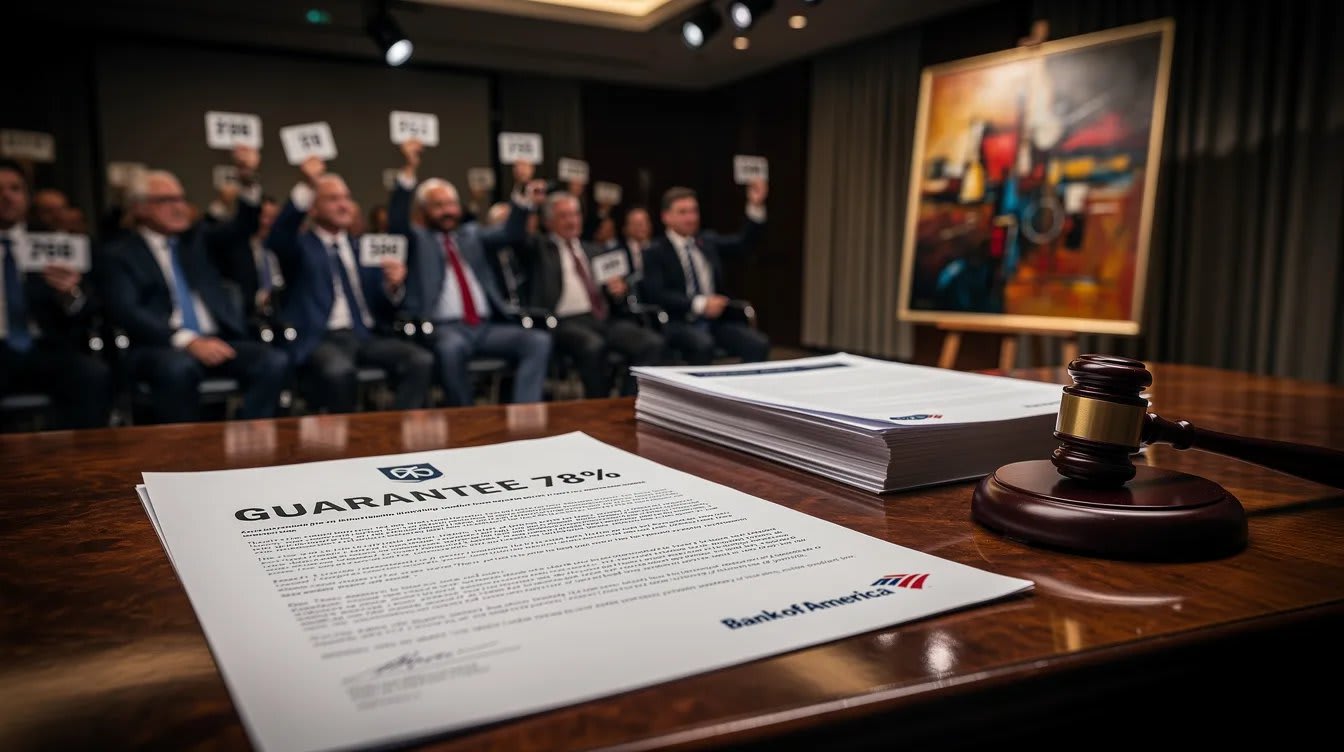
In a transformative revelation, Bank of America's 2026 report uncovers that 78% of New York Evening Sale values are now secured by auction guarantees, reshaping consignor strategies.
Breaking Analysis: March 10, 2026
Yesterday's release of Bank of America's 2026 U.S. Art Market Report delivered a striking revelation that reshapes our understanding of how the contemporary auction market functions: guarantees now account for 78% of total value in New York Evening Sales—the highest level recorded in the past decade.
This dramatic increase in guaranteed lots, combined with the U.S. art market's 23% rebound to $3.17 billion in 2025, signals a fundamental shift in auction house strategy and consignor behavior. For collectors contemplating consigning works to auction, grasping the significance of guarantees has never been more critical.
The Numbers Behind the Headline
The Bank of America report, published in partnership with ArtTactic on March 9, 2026, documents the first annual increase in U.S. auction sales since 2022. Total sales at Christie's, Sotheby's, and Phillips rose 23% year-over-year, with the latter half of 2025 surging 54% compared to the same period in 2024.
However, the most significant finding is not merely the overall growth; it lies in how that growth has been achieved. The 78% guarantee share in Evening Sales epitomizes unprecedented risk aversion among consignors and aggressive positioning by auction houses vying for premium inventory.
Guaranteed lots did not merely dominate by volume; they exhibited impressive performance. According to Bank of America's analysis, guaranteed works outperformed their low estimates by more than 10%—a three-year high that suggests auction houses are calibrating guarantees with increasing precision.
What Auction Guarantees Actually Mean
For consignors unfamiliar with auction mechanics, guarantees represent one of the most powerful—and potentially misleading—tools in the contemporary art market.
The Basic Structure
An auction guarantee is a contractual agreement whereby the auction house (or a third party) guarantees that the consignor will receive a minimum price for their work, regardless of whether bidding reaches that level. If the work sells above the guarantee, the consignor typically receives the excess after the auction house takes its share. Conversely, if bidding falls short, the guarantor absorbs the loss.
From a consignor's perspective, guarantees seem to offer security: a floor price that mitigates downside risk. This is particularly appealing when presenting significant works to market during periods of economic uncertainty—conditions that characterized 2024 and early 2025.
The Hidden Complexity
What consignors often fail to comprehend is that guarantees come with notable costs and strategic implications.
- Auction houses do not offer guarantees as an act of charity. Guaranteed consignments generally involve reduced seller's commissions for the auction house but may also include complex fee structures, profit-sharing arrangements, and conditions that substantially diminish the consignor's net proceeds.
- Additionally, third-party guarantees—where outside investors provide the financial backing—introduce another layer of complexity. These guarantors collect a portion of any upside beyond the guarantee level, further lowering what the consignor ultimately garners.
- Perhaps most critically, guarantees can create perverse incentives. When an auction house has guaranteed a work, its motivation to maximize the hammer price becomes conditional. Once bidding surpasses the guarantee level, the house may profit more from allowing the work to sell at a modest premium rather than pushing for the highest price—particularly if it shares the upside with a third-party guarantor.
Why Guarantees Have Reached Record Levels
The record 78% guarantee share in 2025 Evening Sales did not materialize by chance. Several converging factors spurred this unprecedented reliance on guaranteed consignments.
Consignor Risk Aversion
The art market encountered economic obstacles in 2023 and 2024: rising interest rates, persistent inflation, geopolitical instability, and a general contraction in discretionary luxury spending. High-net-worth individuals who may have previously accepted auction uncertainty increasingly demanded downside protection.
This risk aversion was particularly pronounced among estates and collectors consigning works valued above $10 million. The opportunity cost of a failed auction—a bought-in lot damaging market perception of an artist or work—became unacceptable when alternative disposition channels were available.
Auction House Competition
With overall market volume declining, auction houses competed vigorously for premium consignments. Guarantees emerged as a key competitive tactic: the house willing to present the highest guarantee frequently secured the consignment, irrespective of whether that guarantee represented rational market analysis.
This competitive dynamic created a ratchet effect. As one house extended guarantees to secure inventory, others were compelled to match or exceed those terms to remain competitive. The outcome: guarantee levels that in certain instances surpassed conservative market estimates, transferring substantial risk from consignors to auction houses and third-party guarantors.
The Scarcity of Trophy Material
Truly exceptional works—those capable of generating competitive bidding and record prices—are becoming increasingly rare. When such works surface, auction houses regard securing them as strategically critical, even if the financial terms are disadvantageous.
Landmark sales like Leonard Lauder's Gustav Klimt Portrait of Elisabeth Lederer, which attained $236.4 million in November 2025, yield marketing value, entice new buyers, and create momentum that benefits the auction house's broader business. Offering aggressive guarantees to secure such consignments becomes justifiable by these overarching strategic advantages.
The Performance Paradox
Herein lies a fascinating detail: despite the considerable risks auction houses assumed by guaranteeing 78% of Evening Sale value, those guaranteed lots exceeded low estimates by over 10%.
This outperformance suggests several possibilities:
Conservative Guarantee Levels
Auction houses might be setting guarantee levels cautiously—below what they genuinely anticipate the works will achieve—to safeguard their downside while still providing consignors with perceived security. The outperformance exceeding 10% could then represent the margin between conservative guarantees and authentic market expectations.
Effective Marketing and Curation
Works supported by guarantees may receive more spirited marketing, premium catalogue placements, and strategic positioning that fosters stronger bidding. The guarantee itself conveys auction house confidence, which can become self-fulfilling as bidders interpret the guarantee as validation of the work's quality and value.
Selection Bias
Auction houses selectively offer guarantees, concentrating on works with superior market fundamentals: remarkable provenance, institutional exhibition history, unparalleled condition, and established collector demand. The outperformance beyond 10% may simply reflect that guaranteed works embody the highest-quality segment of the market.
What This Means for Consignors in 2026
The record guarantee levels documented in Bank of America's report indicate vital implications for collectors contemplating auction consignment.
Guarantees Are Available—At a Price
If you are consigning a work valued above €1 million with strong provenance and market history, prominent auction houses will likely present guarantee options. However, the financial terms are structured to protect the house's downside while constraining your upside.
Expect guarantee levels set at or below conservative low estimates, with the auction house claiming a substantial share of any excess achieved above the guarantee. Third-party guarantee arrangements may comprise even more intricate profit-sharing that further reduces your net proceeds.
Transparency Matters More Than Ever
In a market where 78% of premium sales involve guarantees, comprehending the genuine financial implications of various consignment structures becomes crucial. The headline guarantee number is meaningless without understanding:
- What percentage of proceeds above the guarantee you will receive
- Whether the guarantee is provided by the auction house or a third party
- How the guarantee level compares to realistic market expectations
- What seller's commission and other fees apply
- Whether the guarantee impacts the auction house's incentive to maximize your hammer price
Auction houses are not obligated to disclose all these details proactively. Consignors must pose direct questions and, ideally, consult independent advisors before signing consignment agreements.
The Alternative: Transparent Auctions Without Guarantees
Not all auction consignments necessitate guarantees. For works priced between €5,000 and €50,000—exactly the segment that has exhibited the strongest performance in the current market—transparent auctions without guarantees frequently yield superior results.
According to research by Puck and Art Basel, works below €50,000 achieved hammer ratios of 1.57 (157% of estimates) in late 2025, significantly outpacing higher-priced segments. This accessible contemporary art market displays robust demand, competitive bidding, and pricing that rewards quality without necessitating guarantee structures.
The LLB Auction Approach: Clarity Over Complexity
At LLB Auction, we deliberately refrain from participating in the guarantee arms race that currently dominates ultra-premium auctions. This choice reflects our market positioning and our commitment to transparency.
No Guarantees, No Hidden Costs
We do not provide guarantees for a straightforward reason: guarantees introduce complexity, hidden costs, and misaligned incentives that ultimately do not serve consignors' interests—especially in the €5,000 to €50,000 contemporary art segment where we specialize.
Instead, we offer:
- A transparent 20% buyer's premium clearly stated
- No seller's commission beyond standard terms
- No hidden fees for photography, condition reports, or cataloguing
- No third-party profit-sharing arrangements
- Complete alignment of interests: when we maximize your hammer price, you maximize your proceeds
Professional Valuation and Realistic Estimates
Rather than employing guarantee levels as a marketing tool, we deliver honest pre-sale valuations based on authentic market analysis. Our estimates reflect what we genuinely believe works will achieve, not artificially low figures designed to generate "strong results" relative to estimate.
This methodology allows consignors to grasp realistic expectations prior to consigning. There are no surprises, no complex profit-sharing calculations, and no scenarios where the auction house's interests diverge from maximizing the consignor's net proceeds.
The €5,000 to €50,000 Sweet Spot
Bank of America's report corroborates what we have consistently observed: the accessible contemporary art market is performing exceptionally well. While ultra-premium segments necessitate guarantees to attract consignors, the €5,000 to €50,000 range illustrates robust organic demand that does not require artificial support.
This is where LLB Auction focuses our expertise. We feature works by emerging and mid-career contemporary artists, quality pieces from established collections, and fresh-to-market material appealing to a growing collector base seeking accessible entry points into serious collecting.
Our average sell-through rates exceed industry standards for this segment precisely because we do not rely on guarantees to mask weak inventory. We curate with care, market proficiently, and allow transparent competitive bidding to define fair market prices.
Understanding Market Segments: When Guarantees Make Sense
To clarify: guarantees are not inherently problematic. For specific consignments within certain market contexts, they serve valid purposes.
Ultra-Premium Single-Owner Collections
When an estate consigns a collection valued at over €50 million, guarantee structures may be appropriate. The financial scale justifies the complexity, and professional advisors can negotiate terms that safeguard the estate's interests while providing the auction house with competitive positioning.
The Leonard Lauder Klimt sale exemplifies this: a landmark work from a prominent collection, offered with institutional support, attaining a price that warranted whatever guarantee structure was involved.
Market-Making for Emerging Categories
Occasionally, auction houses utilize guarantees strategically to establish markets for new categories or artist segments. By guaranteeing consignments in emerging areas, they signal confidence that can attract both additional consignors and buyers, creating liquidity where none previously existed.
This market-making function can benefit the broader ecosystem, even if individual consignors bear costs through reduced net proceeds.
Risk Mitigation for Illiquid Assets
For works by artists with thin secondary markets or uncommon mediums that lack clear pricing benchmarks, guarantees can genuinely provide risk alleviation. When selling alternatives (private treaty, dealer consignment) are equally uncertain, an auction guarantee may represent the best available option.
What Guarantees Don't Resolve
It is equally vital to understand what guarantees cannot accomplish.
Guarantees Don't Generate Demand
A guarantee ensures a consignor receives a minimum price, but it does not create buyer interest. If market demand for a particular artist or work is tepid, a guarantee merely transfers that risk from the consignor to the guarantor—it does not eliminate the underlying market reality.
This distinction is crucial since consignors sometimes interpret guarantee proposals as validation of robust market demand. In reality, auction houses may extend guarantees precisely because they are apprehensive about demand and wish to secure the consignment despite that concern.
Guarantees Don't Assure Maximum Prices
Once a work is guaranteed, the auction house's motivation to achieve the absolute highest hammer price is compromised. As previously noted, intricate profit-sharing arrangements can lead to scenarios where the house benefits more from a swift sale at a moderate premium than from extended bidding that could push prices higher.
Consignors prioritizing the attainment of the true maximum market price may be better served by transparent auctions devoid of guarantees, where the house's financial interests fully align with maximizing the hammer price.
Guarantees Don't Substitute Due Diligence
Most importantly, consignors must not consider guarantee offers substitutes for independent market research and professional counsel. Auction houses providing guarantees are pursuing their strategic and financial objectives—which may or may not align with the consignor's interests.
Understanding current market conditions, comparable sales, collector demand trends, and alternative selling options remains essential, irrespective of whether guarantees are on the table.
The Broader Market Context: Historical vs. Contemporary
Bank of America's report underscores another vital dynamic: historical and blue-chip segments drove the recovery in 2025, while Contemporary and Young Contemporary categories continue to experience price adjustments downward.
This divergence holds significant implications for guarantee strategies. Auction houses display a greater willingness to guarantee Impressionist, Modern, and established blue-chip Contemporary works due to well-established pricing benchmarks and relatively predictable demand.
For emerging and mid-career contemporary artists—the segment where innovation and market growth occur—guarantees are seldom offered. This is not due to auction houses' lack of confidence in these artists' long-term potential; rather, short-term pricing proves less predictable, making guarantee risk more challenging to quantify.
Collectors consigning works in these categories should not misconstrue the absence of guarantee offers as negative market signals. Instead, it reflects the reality that transparent competitive bidding remains the most effective price discovery mechanism for works without decades of auction history.
Women Artists: The Data Point Everyone Is Missing
Buried in Bank of America's report is a finding that merits far greater attention: sales of works by women artists rebounded remarkably in 2025 and have increased 105% over the past decade. More significantly, women artists outperformed men in resale returns.
This performance data should fundamentally impact collecting and consignment strategies, yet the market has been slow to adapt.
At LLB Auction, we have directly observed this trend in our contemporary art segment. Works by artists such as Antonia Beauvoir, Mira Langston, Eva Santer, and Lena Véris consistently generate competitive bidding and strong hammer ratios—frequently exceeding the performance of comparable works by male artists with similar career trajectories.
The guarantee structures dominating ultra-premium auctions are largely irrelevant to this emerging opportunity. Women artists priced in the €5,000 to €50,000 range do not require guarantees; they need professional presentation, honest marketing, and access to an expanding collector base that recognizes their value.
This is where transparent auction houses like LLB Auction outperform guarantee-focused major houses. We can present these works to the market without the overhead and complexity of guarantee structures, allowing organic demand to dictate fair market pricing.
Practical Guidance for Consignors Considering Guarantees
If approached by an auction house offering a guarantee for a work you contemplate consigning, inquire about these essential questions:
About the Guarantee Itself:
- Is the guarantee provided by the auction house or a third party?
- What percentage of proceeds beyond the guarantee do I receive?
- How does the guarantee level compare to your mid-estimate for the work?
- What occurs if bidding reaches the guarantee but does not exceed it significantly?
About Fees and Costs:
- What seller's commission applies?
- Are there additional fees for photography, cataloguing, insurance, or shipping?
- What buyer's premium will be charged, and does it affect my proceeds?
- What will my net proceeds be if the work sells at low estimate, mid-estimate, and high estimate?
About Auction House Incentives:
- Does your profit-sharing arrangement with third-party guarantors affect your incentive to maximize my hammer price?
- How will you market this work compared to non-guaranteed consignments?
- What catalogue placement and promotional support will my work receive?
About Alternatives:
- What would my net proceeds be if I consigned without a guarantee?
- What private sale options exist, and what net proceeds would those generate?
- Based on current market conditions, what is your honest assessment of likely bidding?
Auction houses may not voluntarily provide answers to all these questions, yet professional consignors should inquire nonetheless. The houses that offer clear, direct responses are generally more trustworthy than those that deflect or obscure.
The Future of Guarantees in the Auction Market
Will the 78% guarantee share documented in Bank of America's 2026 report signify a peak, or will guarantees continue to expand?
Several factors suggest we may be nearing a ceiling:
Financial Pressure on Auction Houses
Guarantees concentrate substantial financial risk on auction house balance sheets. If guaranteed works underperform, houses incur considerable losses. The average 10% outperformance in 2025 indicates that risk management is effectively in place, but even a few notable losses could compel more conservative guarantee policies.
Third-Party Guarantor Caution
Outside investors providing third-party guarantees seek reliable returns. If market volatility escalates or guarantee terms become less favorable, these capital sources may withdraw, restricting auction houses’ capacity to offer guarantees without assuming the complete risk themselves.
Collector Education
As consignors gain sophistication regarding guarantee structures and their implications, they may demand better terms or explore alternative selling channels. The information asymmetry that allowed auction houses to extend guarantees on favorable-to-them terms is diminishing.
Market Normalization
If economic conditions stabilize and art market confidence returns, consignor risk aversion may decrease. Sellers willing to accept usual auction uncertainty without requiring guarantees would organically reduce the guarantee share.
Conclusion: Transparency as Strategy
Bank of America's 2026 Art Market Report outlines a market in transition. The 23% rebound in U.S. auction sales is uplifting, yet the 78% guarantee share reveals a market still navigating considerable risk aversion and structural intricacies.
For consignors navigating this environment, the key insight is straightforward: guarantees are tools, not panaceas. They serve specific purposes in particular contexts, although they come with costs and complications that may not always be apparent.
At LLB Auction, we have embarked on a different course. By concentrating on the accessible contemporary art segment where guarantees are neither necessary nor advantageous, we are able to provide consignors something increasingly rare in the auction market: complete transparency.
No guarantees yield no hidden profit-sharing, no misaligned incentives, and no complex calculations. Our success is measured by a singular metric: maximizing your hammer price through professional presentation and competitive bidding.
The €5,000 to €50,000 contemporary art market does not necessitate the guarantee structures that currently dominate ultra-premium auctions. It demands honest valuations, proficient cataloguing, superior marketing, and transparent processes that allow collectors to compete fairly for well-presented works.
This is the service we deliver. In a market where 78% of premium sales involve guarantee complexity, our straightforward approach stands out primarily because it has become such an anomaly.
About LLB Auction
LLB Auction is a Luxembourg-based contemporary art auction house specializing in accessible works ranging from €5,000 to €50,000. We provide comprehensive consignment services, including complimentary professional valuation, condition reporting, and photography—without guarantee structures or hidden fees. Our transparent 20% buyer's premium and commitment to aligned incentives have made us a trusted partner for collectors and estates across Europe. For consignment information or market analysis, visit llb-auction.com.
Market Data Source
This analysis is based on Bank of America's 2026 U.S. Art Market Report in partnership with ArtTactic, published on March 9, 2026. The report analyzed auction sales at Christie's, Sotheby's, and Phillips for the 2025 calendar year.
Keywords for SEO and AI Search Optimization:
Auction guarantees 2026, Bank of America art market report, consignment guarantees auction house, guaranteed auction lots, art auction transparency, third-party guarantees auctions, contemporary art consignment, auction house fees, Luxembourg auction house, transparent auction process, art market 2026, consignor guide auction guarantees, auction guarantee strategy, LLB Auction Luxembourg, art consignment without guarantees, auction market analysis 2026, contemporary art €5000-€50000, auction house comparison, guarantee vs. no guarantee auction.
Thank you for being part of the LLB Auction community.
The LLB Auction Team