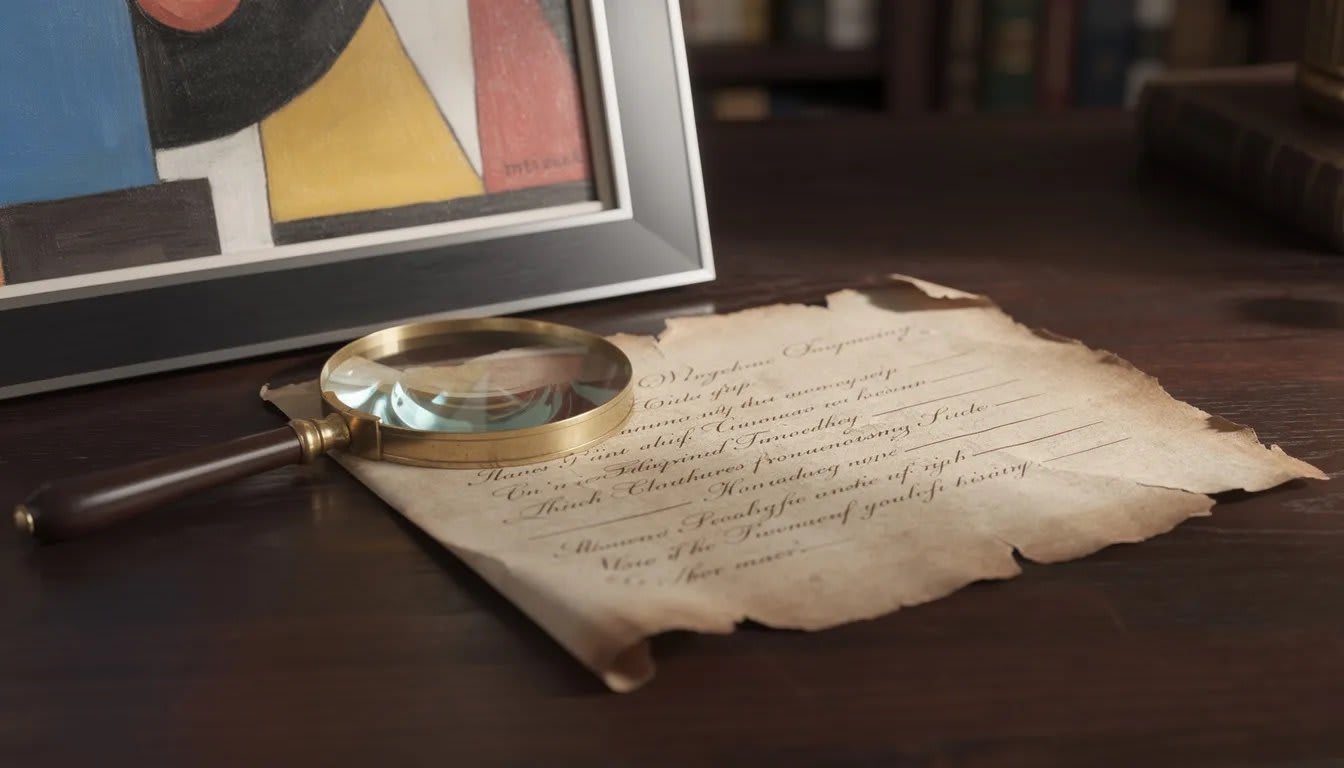
In the world of art auctions, the tale each artwork possesses can significantly enhance its monetary worth, adding layers of allure and authenticity to its existence.
The Art of Provenance: Unveiling the Value of Art History
When a painting achieves a sale price at auction that exceeds its pre-sale estimate by a factor of ten, seasoned collectors frequently remain unfazed. They understand that beneath the impressive hammer price lies a narrative — a narrative that weaves through decades of ownership, exhibition history, and meticulous documentation. This narrative is known as provenance, and in the contemporary art market, it serves as the most potent catalyst for value appreciation.
What Is Provenance?
Provenance denotes the documented journey of an artwork's ownership and location from the moment it departed the artist's studio to its current state. A comprehensive provenance record may encompass the names of every collector who possessed the work, the galleries that represented it, the exhibitions in which it has been displayed, auction records from previous sales, and any publications in which it has been featured or reproduced.
Essentially, provenance serves to answer a pivotal question posed by every discerning buyer prior to placing a bid: where has this artwork been, and who has possessed it?
The term itself is derived from the French provenir, meaning "to come from." In the art world, the origins of a piece are of paramount importance.
Why Provenance Drives Value at Auction
The interplay between provenance and auction value unfolds on multiple levels, each mutually reinforcing the other.
Authentication and trust form the bedrock of this relationship. An artwork with a clear and unbroken chain of ownership is considerably easier to authenticate than one riddled with gaps or inconsistencies. When buyers can verify that an artwork has traversed reputable galleries, graced esteemed museum exhibitions, or was acquired directly from the artist’s studio, their confidence in its authenticity fortifies. This confidence, in the dynamic environment of an auction, translates seamlessly into competitive bidding.
Prestigious ownership introduces a layer of cultural significance that transcends mere authentication. A piece that has been part of a distinguished private collection — perhaps of a renowned museum trustee, an influential gallerist, or a major institutional collection — carries with it the implicit endorsement of its former owners. Collectors are not merely acquiring a painting; they are, in many respects, joining a lineage.
Exhibition and publication history further enhance an artwork's standing. A piece that has been featured in a landmark retrospective at a prestigious institution, reproduced in an authoritative monograph, or selected for an international art fair demonstrates critical recognition that bidders find immensely reassuring. It signals that experts have scrutinized, valued, and deemed the work worthy of public appreciation.
A Real Difference in Results
The influence of provenance on hammer prices is well-documented throughout the auction landscape. Works with exceptional provenance consistently outperform their counterparts with less distinguished histories. The financial disparity can be substantial — in certain instances, it may even double or triple the final price achieved.
Consider two works by the same artist, produced during the same period, and in comparable condition. One piece boasts a clear ownership history tracing back to the artist’s estate, having passed through two eminent European collections and featured at a significant international fair. The other was acquired privately two decades ago with scant documentation. While both may be entirely authentic, the former will almost invariably command a significantly higher price in the auction room — because buyers are not solely purchasing the object itself but also the certainty and narrative that envelop it.
The Challenges of Incomplete Provenance
Gaps in provenance are not inherently alarming, yet they necessitate diligent investigation. Works that have changed hands during tumultuous periods of conflict, political strife, or economic upheaval may exhibit incomplete records not due to fault of their current owners. The art market has established rigorous protocols for addressing such gaps, including cross-referencing with international databases dedicated to looted or displaced artworks and engaging with specialist researchers.
At LLB Auction, every piece submitted for consignment undergoes thorough provenance scrutiny. We do not accept documentation at face value — we verify it, trace it, and where voids exist, we investigate their origins. This meticulousness safeguards our buyers, our consignors, and the integrity of every transaction that unfolds.
How Consignors Can Strengthen Their Artwork's Provenance
If you are contemplating the sale of a work at auction, the documentation you present can significantly influence the final outcome. Consider the following crucial steps.
- Gather every document you possess. Invoices, receipts, gallery correspondence, exhibition catalogs, insurance records, and photographs of the work in situ all contribute to establishing a compelling provenance. Even informal documentation — a letter from the artist, a catalogue entry, a reproduction in a magazine — adds weight to the history.
- Be transparent about gaps. If you obtained a work without complete documentation, communicate this candidly. Auction specialists possess the experience to navigate incomplete records and often can bridge gaps through independent research. Attempting to obscure or misrepresent inconsistencies will only create complications down the line.
- Preserve all documentation you receive. Upon acquiring a work — whether at auction, from a gallery, or directly from the artist — retain every piece of associated documentation. The certificate of authenticity, the auction catalogue, the gallery invoice, the condition report: each of these becomes an integral part of the work's provenance and will amplify its value when you eventually choose to sell.
Provenance in the Age of Digital Transparency
The art market is undergoing a transformative shift toward greater transparency, fueled by technological advancements that facilitate the tracking of ownership histories, verification of records, and documentation validation. Online databases, blockchain technology for certificates of ownership, and international registries for stolen art are all reshaping the way provenance is established and affirmed.
For both collectors and consignors, this evolution is largely advantageous. Improved transparency diminishes the risk of fraud, bolsters buyer confidence, and consequently fosters stronger auction results. Auction houses that adopt these tools — and invest in the expertise necessary to wield them effectively — are poised to deliver the best outcomes for their clients.
Conclusion
Provenance transcends mere bureaucratic formality; it embodies the living narrative of an artwork — a record of its journey through the world, the collectors who embraced it, the institutions that acknowledged it, and the experts who authenticat it. This historical context possesses genuine, measurable value in the auction arena.
At LLB Auction, we comprehend that successfully selling art involves crafting its narrative with both charisma and integrity. Our specialists collaborate closely with each consignor to construct the most compelling case for every work — for we recognize that a meticulously documented provenance serves as one of the most formidable tools available to achieve remarkable results.
Considering consigning a work? Connect with our team for a confidential provenance review and valuation.
Thank you for being part of the LLB Auction community.
The LLB Auction Team