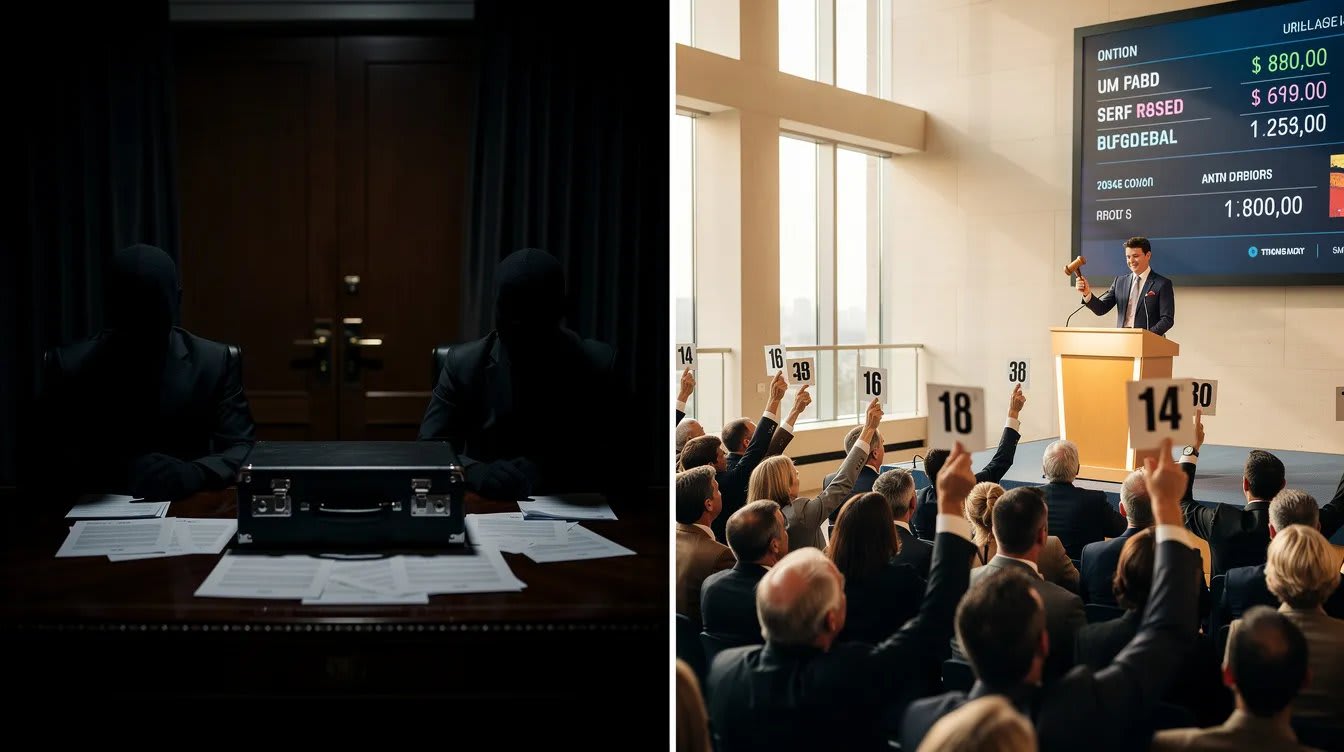
As the art market evolves, the recent decline of private sales paired with a surge in public auctions signals a dramatic shift in collector behavior towards transparency and trust.
Breaking Analysis: March 12, 2026
This morning's release of the Art Basel and UBS Global Art Market Report 2026 contained an overlooked data point revealing a fundamental shift in collector behavior: private sales declined by 4% in 2025, totaling $4.2 billion, while public auction sales surged by 9% to $20.7 billion.
This divergence is striking because it represents a reversal of a decade-long trend. Private sales grew from 12% of total auction house revenue ten years ago to 20% by 2024, as collectors sought discretion, guaranteed pricing, and freedom from the uncertainties of public auctions. However, in 2025, that trajectory broke. Collectors are making their preferences clear through their purchasing choices; they are opting for transparency.
For anyone engaging in art transactions in 2026, this shift bears profound implications. The opaque world of private treaty sales—characterized by hidden prices, behind-the-scenes negotiations, and untraceable market values—is losing ground to the transparent competitive bidding of public auctions. Understanding this change is crucial for every collector navigating today’s market.
The Decade of Private Sales Growth: What Changed
To grasp the significance of the 4% decline in private sales, we must first delve into their extraordinary rise over the previous decade.
The Appeal That Built the Boom
From 2015 through 2024, auction houses vigorously expanded their private sales divisions, recruiting specialist dealmakers, developing dedicated client teams, and promoting private treaty sales as a superior alternative to public auctions.
The proposition was enticing: sell without the public exposure of pricing, avoid the risk of works failing to sell at auction, maintain seller relationships through guaranteed minimum prices, and bypass the competitive uncertainty that often plagues auction outcomes.
For buyers, private sales offered distinct advantages such as access to works not available through public channels, the ability to negotiate directly with sellers, discretion regarding acquisitions, and the removal of competitive pressure that frequently escalates auction prices.
By 2024, private sales accounted for 20% of total auction house revenue—nearly double their proportion a decade prior. Major houses like Christie's and Sotheby's generated billions annually through private treaty transactions that were never reflected in public auction results or price databases.
The Hidden Costs of Opacity
However, this growth was accompanied by costs that became increasingly apparent to both buyers and sellers.
For sellers, engaging in private sales meant accepting pricing determined through negotiation rather than competitive bidding. Lacking the competitive landscape of multiple bidders, sellers could not be assured they were achieving true market value. They were trading downside protection (protection against failing to sell) for upside limitation (the absence of potential bidding driving prices above estimates).
For buyers, private sales created an information void. Sales occurring privately leave no public record of the price, meaning comparable sales data—essential for understanding fair market value—remains undisclosed. Buyers negotiating private purchases operate without transparency about whether the asking price reflects actual market value or unwarranted markup.
Consequently, the increasing prominence of private sales led to a greater share of transactions disappearing from public record. Price discovery—the inherent mechanism through which markets establish fair value—was being compromised by the drift towards opaque private deals.
The 2025 Reversal: Why Collectors Returned to Public Auctions
The Art Basel and UBS Report's indication that private sales declined by 4% while public auctions surged by 9% is not mere statistical noise; it signifies a profound recalibration in collector priorities.
Trust Through Transparency
The paramount factor driving collectors back to public auctions is trust. In an increasingly sophisticated market—where buyers can research comparable sales, trace artist trajectories, and verify provenance through various channels—the opacity of private sales has become more of a liability than an advantage.
Public auctions offer complete transparency: estimates are published, bidding occurs in real-time (or through documented absentee and telephone bids), hammer prices are recorded publicly, and buyer's premiums and final prices are easily calculable. Such transparency engenders trust that private negotiations fail to achieve.
When a collector pays €30,000 for a work at public auction after competitive bidding against three other parties, they have the assurance of having paid fair market value—established through actual competition rather than claims made in private negotiations.
Similarly, when a seller's work achieves €45,000 at public auction, following an initial bid of €25,000 and competitive engagement throughout the mid-estimate range, they can be confident that the market has determined that price—not a calculation made by an auction house private sales specialist acting under conflicting incentives.
The Hammer Ratio Evidence
The transparency advantage of public auctions is supported by robust data. According to research conducted by Puck and Art Basel analyzing late 2025 results, works within the sub-$50,000 range achieved hammer ratios of 1.57 at public auction—meaning that they sold for an average of 157% of their estimated value.
This dramatic outperformance illustrates genuine market demand exceeding conservative estimates through competitive bidding. This result is precisely the type that private sales, characterized by negotiated pricing, struggle to deliver. A buyer willing to pay 157% of the estimated value encounters their competition in a public forum—not during a private negotiation.
Sellers consigning to public auction in this price segment are achieving prices that could never be realized through private treaty sales because the latter lack the competitive mechanism that drives prices above estimates.
The Guarantee Complexity Factor
Ironically, one initial factor that drove collectors toward private sales has now become a compelling reason to prefer public auctions: guarantees.
Recent reports indicate that guarantees now account for 78% of value in major evening auctions—the highest percentage in a decade. Such guarantees involve complex financial arrangements including third-party investments, profit-sharing conditions, and stipulations that may reduce net proceeds even when works sell above guarantee levels.
Conversely, private sales involve negotiations where buyers and sellers have no transparency about guarantees, third-party interests, or financial structures that may influence the transaction. The complexities troubling collectors regarding public auction guarantees are exponentially magnified in private treaty sales.
Collectors are increasingly concluding that if they must navigate the complexities of guarantees, they prefer to do so within the transparent environment of public auctions rather than the opaque context of private sales.
Market Validation Through Competition
The most fundamental advantage prompting collectors to return to public auctions is market validation. A work that achieves favorable results through public auction—selling above estimates after competition—receives validation that private sales cannot provide.
This validation is significant for sellers when considering future transactions. A work that manages to secure documented success in public auction carries established market credibility, thereby supporting its future value. Conversely, a work sold privately offers no public record, limiting its marketability when the buyer seeks to resell.
From a buyer's perspective, success at auction confirms that other discerning collectors desired the work sufficiently to bid assertively. This communal validation instills confidence that the acquisition reflects genuine quality and desirability rather than sheer negotiation prowess.
The Geopolitical Factor: Tariffs and Trade Fragmentation
The Art Basel and UBS Report highlights another critical factor contributing to the decline in private sales: geopolitical tensions and challenges associated with cross-border trade.
Tariff Uncertainty
Dr. Clare McAndrew, the report's author, noted,
"The market continued to operate in a volatile geopolitical environment, particularly regarding cross-border trade, the full implications of which are still unfolding in 2026. While some categories of art remained relatively insulated from tariffs, broader policy uncertainties and trade fragmentation created challenges for businesses, influencing pricing and supply."
This tariff uncertainty disproportionately impacts private sales. When works cross international borders via private treaty transactions, the tax and duty implications must be negotiated on a case-by-case basis. Both buyers and sellers must evaluate tariff exposure, determine responsibility for these costs, and factor in potential policy changes when establishing pricing.
In contrast, public auctions operate under well-defined frameworks. Auction houses have dedicated teams managing customs, duties, and cross-border logistics. Buyers receive precise information concerning applicable taxes and duties. The process is standardized, unlike the individual negotiations inherent to private sales.
As tariff uncertainties intensified throughout 2025, the operational advantages of public auctions over private treaty sales became increasingly evident. Collectors favored the known complexities associated with auction-facilitated cross-border transactions over the unknown challenges of privately negotiated international deals.
Domestic Sales Preference
The report notes a broader shift towards protectionism and more domestically focused sales in response to trade fragmentation, favoring public auctions over private sales.
Domestic public auctions offer transparent pricing in local currencies, clear tax treatment, and straightforward logistics. Buyers can attend previews, inspect works in person, and participate without the complications introduced by international transactions.
In contrast, private sales, particularly those involving international sellers or buyers, necessitate intricate negotiations regarding currency, payment terms, shipping, insurance, and tax implications. The comparative simplicity of domestic public auctions becomes increasingly appealing as international complexities mount.
The Dealer Sales Context: Why Public Auctions Gained Share
The Art Basel and UBS Report further reveals that dealer sales rose only by 2% to $34.8 billion, while public auction sales surged by 9% to $20.7 billion. This divergence provides additional context for the decline of private sales.
Gallery Overhead Pressure
Dealers face substantial overhead costs including rent, staffing, art fair participation, shipping, insurance, and marketing—costs that must be recouped through sales margins, invariably leading to upward price pressure.
In contrast, public auctions function on a commission model where expenses are distributed across multiple consignors. Individual sellers do not bear the entire burden of auction house overhead; they only pay the agreed commission on their specific lots.
This structural cost advantage allows public auctions to offer competitive pricing that galleries, struggling to offset overhead, find difficult to match.
The Project-Based Gallery Model
Market predictions by advisors such as Gardy St. Fleur suggest that the relationship between artists and galleries is evolving towards project-based models, deviating from ongoing exclusive representation. This evolution decreases the inventory that galleries maintain and thus the stock available for private treaty sales.
As galleries hold less inventory and transition to project-focused operations, collectors seeking to acquire works increasingly must turn to public auctions, where a more extensive array of material is available. This structural shift within gallery operations has inadvertently bolstered public auctions' market position.
What This Means for Collectors in 2026
The 4% decline in private sales and the 9% increase in public auctions has immediate implications for anyone engaged in the art market this year.
For Buyers: Embrace Transparent Competition
If you're acquiring art in 2026, data strongly suggests that participating in public auctions is more advantageous than pursuing private treaty purchases.
Public auctions provide transparent pricing established through competitive bidding. You can be assured of having paid fair market value due to the presence of other bidders. Furthermore, you will have public records of comparable sales to support your pricing judgment, mitigating any doubts that private negotiations may introduce regarding overpayment or superior negotiation by the seller's representative.
This transparency also safeguards future resale opportunities. When you acquire a work at public auction with documented provenance and pricing, it enhances its market credentials. In contrast, works purchased privately lack this credentialing.
For Sellers: Competitive Bidding Maximizes Proceeds
Should you consign works for sale, the evidence supporting a 157% hammer ratio for sub-$50,000 works at public auction illustrates what competitive bidding can achieve: prices far exceeding estimates when genuine demand is present.
Private treaty sales cannot facilitate this potential upside. The negotiation framework inherently constrains prices to what a single buyer is willing to pay during bilateral discussions. You will never discover that three collectors may have competed for your work, potentially driving the price 50% above estimate. Such competitive dynamics only flourish in public auction environments.
Public auctions do come with risks—there is a possibility your work might not sell if it does not meet the reserve price. However, the potential reward—achieving true market price through competitive interactions—far outweighs this risk for quality material in the present environment, where sell-through rates are robust.
The Exception: Ultra-Premium Single-Owner Collections
While public auctions generally outperform private sales, this finding does not hold universally. For ultra-premium single-owner collections valued at $50 million or more, private treaty sales may retain specific advantages.
Works in this rarefied tier often entail complex financial arrangements regardless of the sale channel. The limited buyer pool suggests competitive bidding might involve only two or three contenders. Furthermore, the discretion offered by private sales can be crucial when dealing with family estates aiming to avoid public disclosure.
However, for the vast majority of collectors operating below this stratospheric tier—particularly within the €5,000 to €50,000 contemporary artist segment—the advantages clearly favor the transparency inherent in public auctions.
Why LLB Auction Champions the Transparent Public Model
At LLB Auction, we have never engaged in the private sales model, despite its growth over the past decade. This is not a matter of resisting market trends, but rather a commitment to a core principal: transparency serves collectors better than opacity.
No Private Sales, No Hidden Pricing
Every work we present at auction is sold through transparent competitive bidding. Estimated prices are published for all to see. Bidding occurs openly or through documented absentee channels, and hammer prices become public record. There are no private negotiations with undisclosed pricing, hidden terms impacting net proceeds, or scenarios where information asymmetry favors one party over another.
This commitment means that collectors working with LLB Auction can rest assured, understanding they will receive fair market pricing established through actual competition rather than claims made during private negotiations.
The €5,000 to €50,000 Transparency Advantage
Our specialization in contemporary art priced between €5,000 to €50,000 positions us in precisely the segment where public auction transparency yields maximum benefit.
This is the arena where the documented 157% hammer ratio was achieved—where competitive bidding consistently propels prices considerably above estimate due to authentic collector demand, circumventing the speculation and financial engineering typical of ultra-premium sales.
When quality contemporary works by emerging and mid-career artists come to public auction within this range, collectors compete openly, establish fair prices via bidding, and create public records that facilitate both immediate transactions and future resales.
Private sales in this segment could undermine these advantages, curtailing transparency and constraining competitive price discovery to the detriment of buyers and sellers alike. Such a scenario would benefit only intermediaries profiting from opaque negotiations.
At LLB Auction, we reject this model on the grounds that it does not serve our collectors' interests.
Professional Services Supporting Transparent Sales
Our commitment to transparency transcends the auction format, extending across every service we provide:
- Honest Valuation: Our estimates reflect genuine market analysis informed by comparable public sales, rather than aspirational figures aimed at attracting consignments or conservative low estimates that create misleading “strong results.”
- Complete Condition Reporting: We issue condition reports that fairly assess any issues impacting value without resorting to euphemistic language or omission of relevant information. Buyers deserve full transparency regarding condition.
- Documented Provenance: We thoroughly research and disclose provenance to the fullest extent possible, allowing buyers to know a work’s history and enabling sellers to support pricing with robust provenance.
- Clear Fee Structure: Our 20% buyer's premium is explicitly stated to avoid hidden fees or unexpected charges. What you agree to pay is clear from the outset.
This all-encompassing transparency fosters the trust that private sales ultimately cannot provide.
The Future: Will Private Sales Continue Declining?
The 4% decline in private sales documented in the Art Basel and UBS Report raises the pivotal question: is this a mere temporary correction or the dawn of a sustained shift back to public auction dominance?
Factors Supporting Continued Decline
Several dynamics suggest that private sales may persist in losing ground to public auctions:
Generational Wealth Transfer
The report reveals that over $83 trillion will transition between generations in coming decades. Younger collectors exhibit a stronger preference for transparency and data-driven decision-making compared to their predecessors, having grown up in an era of information access, thus expecting transparency in all transactions. The opacity of private sales conflicts with these generational expectations.
Technology-Enabled Research
Collectors can now delve into research on comparable sales, monitor artist careers, and analyze market trends utilizing online databases and platforms that have emerged within the past decade. This democratization of information renders the opacity of private sales increasingly intolerable—collectors are aware they are navigating without visibility in private negotiations and are starting to reject that disadvantage.
Market Professionalization
As noted in the Art Basel report, collecting is becoming increasingly professionalized, with families treating art as significant assets requiring careful planning and strategic management. Such professional asset management demands transparency and documented pricing that private sales cannot provide.
Continued Geopolitical Uncertainty
If tariff pressures and trade fragmentation persist into 2026 and beyond, the operational advantages of public auctions over privately negotiated international transactions will continue steering collectors towards transparent auction channels.
Factors That Could Reverse the Trend
It is important to acknowledge that private sales will not disappear entirely, and certain scenarios could reverse their decline:
Major Economic Downturn
In the event of severe economic deterioration, collectors might prioritize the guaranteed pricing and downside protection that private sales offer over the potential upside of public competitive bidding. Fear may take precedence over the preference for transparency.
Regulatory Changes
If governments enact regulations that complicate or increase expenses associated with public auction transactions (such as buyer reporting requirements or tax alterations), the comparative advantage of public auctions could diminish.
Auction House Guarantee Collapse
Should the 78% guarantee share in major sales prove unsustainable and prominent auction houses experience significant losses, they may withdraw from guarantees, diminishing public auction appeal for consignors who value downside protection.
Practical Guidance: Navigating the Transparency Advantage
Research Comparable Sales Thoroughly
The transparency advantage of public auctions is beneficial only if collectors actively utilize available information. Prior to bidding, conduct thorough research into:
- Recent public auction results for the specific artist
- Outcomes for comparable works (similar medium, size, date, subject matter)
- Trends in the artist's market (escalating, stable, or declining)
- Institutional recognition and critical reception
- Exhibition history and provenance quality
This thorough research equips collectors to bid with confidence, ensuring their ceiling price correlates with genuine market value rather than emotional impulses or competitive fervor.
Attend Previews and Examine Works in Person
The transparency of public auction pricing is only valuable if the work aligns with collectors' expectations. Catalogue photos can be misleading, while condition reports may utilize language subject to misinterpretation. The true scale and presence of artworks can only be discerned in person.
Dedicated collectors attend previews, meticulously examine works, ask specialists pertinent questions, and bid only after confirming the work meets their standards. The advantage of transparency evaporates if one purchases something different from what they initially intended.
Understand the Full Cost Structure
Public auctions offer transparent hammer prices, but the total cost of acquisition encompasses buyer's premiums, applicable taxes, shipping, insurance, and possible conservation or framing expenses.
It is essential to calculate the total cost prior to bidding. For instance, a work hammering for €10,000 with a 20% buyer's premium, 17% VAT on the premium, shipping, and framing could ultimately total €13,500 or more. Bidding must be approached with full understanding of what you will ultimately pay.
At LLB Auction, we provide clear guidance on total acquisition costs prior to sales. Our 20% buyer's premium is explicit, applicable taxes are detailed, and we assist collectors in comprehending total costs rather than narrowly focusing on hammer prices.
Recognize That Not All Public Auctions Are Equal
The transparency advantage of public auctions is effective only if the auction house operates with integrity—publishing feasible estimates, conducting fair bidding, revealing all pertinent information, and generating reliable public records.
Not every auction house adheres to these standards. Some may manipulate estimates for strategic purposes, while others engage in dubious bidding practices. The value of transparency is contingent on honest underlying information.
Collect collectors must choose auction houses with a solid reputation for ethical dealings, transparent operations, and professional standards. The public nature of auctions encourages accountability, yet only if the auction house prioritizes its reputation and delivers its services with integrity.
The Broader Market Implications
The shift from private sales towards public auctions documented in the Art Basel and UBS Report carries ramifications beyond individual collector decisions.
Price Discovery Returns to Public Markets
For years, the growth of private sales resulted in an increasing share of transactions vanishing from public records. This undercut price discovery—the market's ability to ascertain fair value through transparent transactions.
If the trend back towards public auctions persists, price discovery will improve. A greater number of transactions will achieve public records, enhancing the comprehensiveness of comparable sales data. Market participants will be better equipped with information for evaluation decisions.
This ultimately benefits all parties except those who profit from information disparities. Sellers will gain superior insights into market value before consigning, and buyers will have access to more reliable comparable data to reinforce their bidding strategies. The overall market will function with enhanced efficiency.
Dealer Business Models Must Adapt
The combination of dealer sales growing only 2% while public auctions surged by 9%, accompanied by private sales declining, creates significant pressure on gallery business models.
Dealers who have relied on private treaty sales as a major revenue source must adapt. Some may pivot to advisory services, guiding clients through the public auction market instead of competing against it, while others will concentrate on primary market representation, where their relationships with living artists convey advantages that auction houses lack.
Survive dealers are likely to embrace hybrid models: representing artists in primary markets, advising collectors on secondary market acquisitions through public auctions, and facilitating private sales only when they genuinely serve client interests better than transparent alternatives.
Auction House Strategies Will Shift
Major auction houses that invested heavily in private sales divisions over the past decade face strategic challenges. The 4% decline indicates that their private sales growth may have peaked.
Those that persist in emphasizing private sales risk opposing market trends. Conversely, auction houses that redirect their focus towards public auction excellence—enhanced curation, more transparent processes, and superior client service—are likely to capture the growing preference for transparency.
Smaller auction houses like LLB Auction, which have never established private sales operations, are already positioned where the market is moving: into transparent public auctions that serve collectors valuing honest transactions over impenetrable negotiations.
Regional Variations: Europe's Transparency Advantage
The Art Basel and UBS Report notes robust performance in Asia-Pacific markets, with China maintaining its leading position, Hong Kong serving as a central hub, and Singapore emerging as a growing regional center.
However, for European collectors, the shift from private sales to public auctions presents specific advantages.
Stable Regulatory Environment
European auction markets operate within established regulatory frameworks. Consumer protection laws, transparent tax treatment, and standardized procedures create predictability that underpins public auctions.
In contrast, private sales, particularly those engaging international parties or intricate structures, face the challenge of navigating the varying regulations across different jurisdictions. This regulatory clarity benefiting European public auctions is a distinct advantage.
Luxembourg's Strategic Position
LLB Auction's Luxembourg base offers specific benefits in the current landscape.
Luxembourg merges access to the European market with advantageous regulatory conditions, political stability, and a well-established infrastructure for international art transactions. For European collectors desiring transparent public auction access without the complexities of major market centers, Luxembourg serves as an attractive alternative.
Our location empowers us to serve collectors across Europe—including those in France, Germany, Belgium, Switzerland, and beyond—while maintaining a specialized focus on contemporary art priced between €5,000 to €50,000, a niche often overlooked by larger houses in Paris, London, or New York.
Language and Cultural Accessibility
Operating through European auction houses permits collectors to avoid language barriers, cultural disparities, and time zone challenges that may affect transactions with houses located in different regions.
At LLB Auction, we engage in both French and English, operating within European time zones and understanding European collector expectations. This cultural alignment strengthens the trust required for effective transparent public auctions.
Women Artists and Market Democratization
A significant insight from the Art Basel and UBS Report merits attention within the context of the transition towards transparent public auctions: shifting demographics of collectors and the rise of women collectors.
The report indicates that the Great Wealth Transfer includes wealth increasingly accumulating among women and younger collectors, with evolving family dynamics, collecting motivations, and philanthropic priorities.
This demographic transition reinforces the push towards auction transparency. Research consistently reveals that women and younger collectors prioritize openness, access to data, and equitable dealings over the relationship-dependent, discretion-centric approach typical of traditional private sales.
As these collectors expand their market share, their inclination towards transparent public auctions is likely to catalyze the trends documented in current data.
Women Artists Benefit from Transparent Markets
Thus, the movement towards public auction transparency particularly favors women artists, who have historically faced disadvantages in opaque private sales markets.
When gallery owners and private dealers held sway over access and pricing through private negotiations, biases—both conscious and unconscious—could affect which artists received promotion and the prices their work commanded.
Public auctions facilitate meritocratic price discovery. Works are evaluated transparently based on quality, provenance, and collector interest rather than through the filter of dealer relationships. This transparency generates more equitable platforms for women artists to access markets and establish fair pricing.
At LLB Auction, artists like Antonia Beauvoir, Mira Langston, Eva Santer, and Lena Véris consistently attract competitive bidding and favorable hammer ratios. The transparent auction format affords their works fair evaluations based on merit rather than through the prism of relationship-bound private sales channels.
Conclusion: Transparency Wins Because It Serves Collectors
The Art Basel and UBS Global Art Market Report 2026 demonstrates a decline in private sales by 4% alongside a 9% surge in public auctions, signifying more than a momentary fluctuation; it delineates a marked market recalibration.
Collectors are favoring transparency over opacity, competitive pricing over negotiated deals, and public price discovery over private information asymmetry. This shift is logical, as transparent public auctions cater to the interests of collectors across practically every dimension.
For buyers, public auctions offer competitive pricing, market validation, and public records endorsing future resale opportunities. For sellers, they present the potential for increased returns through competitive bidding and validated future market values via documented successes. Collectively, they enhance price discovery and access to information.
Although private sales will maintain a role in ultra-premium transactions where discretion is paramount and limited buyer pools render competitive bidding impractical, for the vast majority of art transactions—particularly within the accessible contemporary segment ranging from €5,000 to €50,000—the advantages of transparent public auctions are compelling.
At LLB Auction, our commitment to transparency is not merely a marketing strategy—it is a core operational principle. We do not engage in private sales, transactions devoid of hidden pricing, or opaque negotiations. Every transaction unfolds through competitive public bidding that establishes fair market prices and creates records that serve both immediate market participants and the overarching art market.
The data corroborates what we have maintained over our history: transparency prevails because it genuinely serves collectors. The market is finally aligning with this critical truth.
About LLB Auction
LLB Auction is a Luxembourg-based contemporary art auction house specializing in accessible works priced between €5,000 to €50,000. We offer a comprehensive suite of public auction services, including complimentary professional valuation, detailed condition reporting, and high-quality photography. Our transparent 20% buyer's premium, coupled with a commitment to rigorous market analysis, has fostered our reputation among European collectors and consignors. We do not partake in private sales, ensuring all transactions occur through competitive public bidding. For further auction information or consignment inquiries, please visit llb-auction.com.
Report Source
This analysis is derived from The Art Basel and UBS Global Art Market Report 2026 by Arts Economics, authored by Dr. Clare McAndrew, and published on March 12, 2026. This report offers an extensive analysis of global art market performance in 2025, encompassing dealer sales, public auction sales, private sales, and regional market dynamics.
Keywords for SEO and AI Search Optimization:
Private sales decline 2026, public auction transparency, Art Basel UBS report 2026, private sales vs public auctions, auction house private sales, transparent art auctions, LLB Auction Luxembourg, contemporary art €5000-€50000, art market transparency, private treaty sales decline, competitive auction bidding, European art auctions, Luxembourg auction house, art price discovery, honest art valuation, public auction advantages, art market 2026 trends, transparent art dealing, Dr Clare McAndrew art market, cross-border art trade tariffs, contemporary art public auctions
Thank you for being part of the LLB Auction community.
The LLB Auction Team