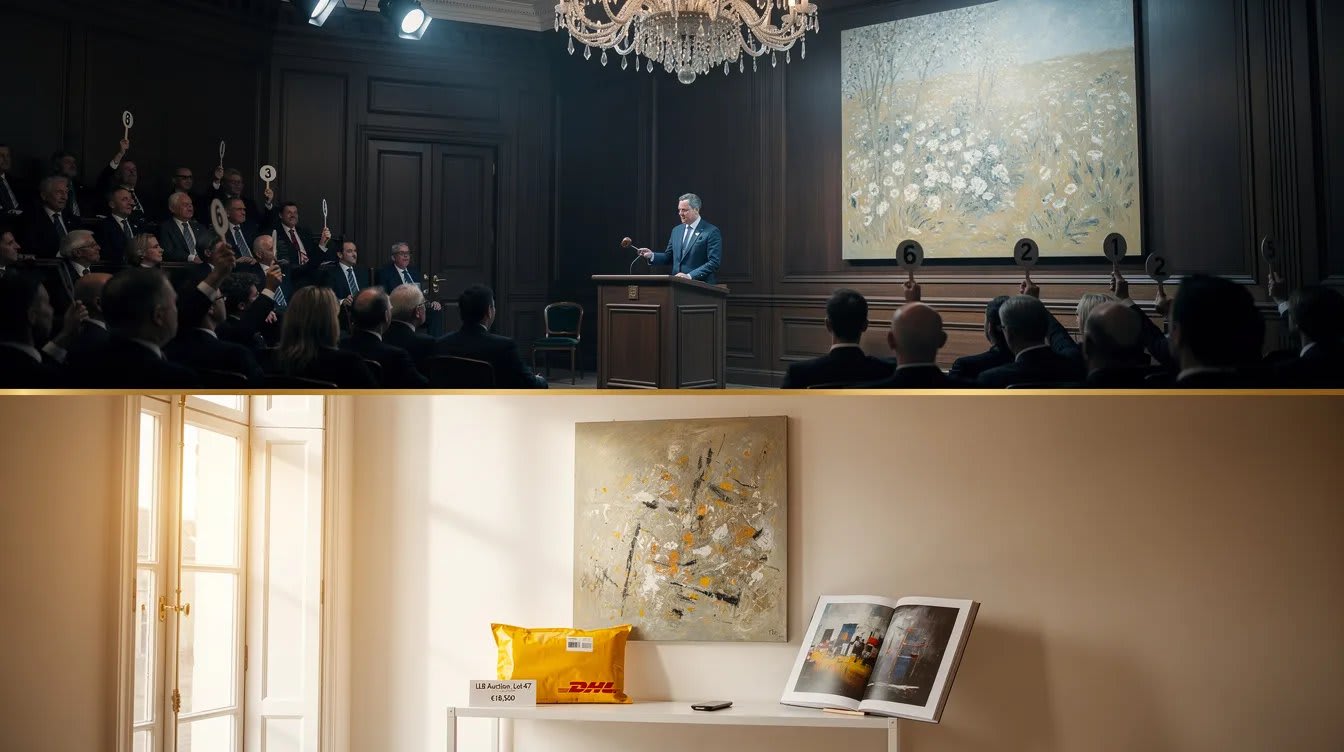
In a world facing adversity, the art market not only endures—it thrives. As global tensions rise, collectors have the opportunity to make astute decisions that can secure their collections for years to come.
Published by LLB Auction — Luxembourg's Contemporary Art Auction House | Tuesday 31 March 2026
This morning, The Art Newspaper published a piece that every serious collector should read meticulously, ideally more than once. The headline: "Art trade stays buoyant amid global turmoil." This compelling article opens with a striking scene from early March, during which missile exchanges occurred between US, Israeli, and Iranian forces in Southwest Asia, while simultaneously, the wealthiest individuals in the world were bidding millions for blue-chip artworks in London.
The figures are staggering: Sotheby's evening sale reported an impressive 110% increase from last spring, while Christie's sales rose by 52%. Sotheby’s managed to sell every lot offered, while Christie's sold 96% of its 93 lots.
The conclusion appears self-evident: art possesses remarkable resilience and serves as a safe haven, enduring through even the most tumultuous times.
However, a deeper inspection of the data reveals a far more intricate and actionable truth—one that is poised to reshape your collecting strategy in 2026.
The Two Numbers That Tell the Real Story
Two specific lots from the London March sales exemplify the underlying logic of the market more clearly than any aggregate statistics could.
- Lot one: a Claude Monet painting depicting an Italian garden from 1884, characterized as aesthetically pleasing yet art historically insignificant, was purchased for £4 million at auction in 2007. It achieved a sale price of £8.2 million in March at Sotheby’s London. This denotes a remarkable return of approximately +105% over a span of 19 years, not accounting for transaction costs, storage, insurance, or inflation.
- Lot two: a Jean-Michel Basquiat mixed-media work created in 1986 was acquired at auction for €3.7 million in 2017 but sold for only £4.5 million—significantly below its low estimate of £6 million. This resulted in a modest return of approximately +22% over 9 years, similarly excluding costs.
The Monet has effectively doubled in value over 19 years, whilst the Basquiat barely appreciated over 9 years and fell short of expectations by 25%.
This analysis does not serve as a critique of Basquiat’s merit; rather, it critiques the speculative momentum and hype that inflated his 2017 price. The art market between 2017 and 2022 was riddled with this kind of logic. According to the Bank of America / ArtTactic report of 2026, artworks resold within five years of acquisition experienced an average annual depreciation of 5.7% in 2025.
Collectors who procured the Basquiat in 2017 were not lacking in discernment; they were investing in a narrative the market fervently promoted. Conversely, those who purchased the Monet in 2007 focused on quality, rarity, and irreplaceable historical significance, opting to hold onto it for nearly two decades.
The core lesson does not advocate for purchasing Monet over Basquiat. Instead, it highlights the importance of entry price, selection quality, and holding duration. These three elements ultimately dictate whether your collection will thrive amidst the inevitable crises the world will face.
Why Art Survives Geopolitical Turmoil — and Why That Matters for You
Exploring the rationale behind art's value preservation during wars, recessions, and political upheaval is incredibly relevant; and the answer is essential for every collector.
Art functions as a non-correlating asset. While financial markets may react to geopolitical events with volatility, capital flight, and fluctuating currencies, the art market remains largely insulated from these dynamics. It cannot be digitally transacted, short-sold, or liquidated in mere moments. Instead, it exists as a physical embodiment of culture that transcends momentary news cycles.
Morgan Long, a London-based art adviser cited in The Art Newspaper, articulated a noteworthy observation from last month’s auction in London: "flight to quality." This term signifies a departure not towards safety in the traditional sense—such as gold, bonds, or cash—but rather a movement towards quality: exceptional works with genuine cultural significance, irreplaceable provenance, and established market histories.
Today’s landscape reveals a significant uptick in high-quality offerings, particularly visible in London, where a greater volume of genuinely superior lots with attractive estimates are entering the market.
Quality is presently receiving disproportionate rewards. Works that outperformed their estimates in London were those accompanied by clear historical context, strong provenance, and authentic rarity. In contrast, high-profile contemporary pieces that failed to reach their estimates often stemmed from a foundation of speculative momentum rather than intrinsic excellence.
This same pattern became evident during Art Basel Hong Kong last week, where consistently sound sales of mid-market works with authentic artistic conviction stood in stark contrast to the variable outcomes produced by trophy-hunting at the top tier.
The €5,000–€50,000 Opportunity That Most Collectors Are Missing
Herein lies a truth that the major auction houses would prefer to remain obscured.
While the results from the March auctions in London—Monet at £8.2 million, a Henry Moore piece at £26.3 million, and Francis Bacon at £16 million—are extraordinary, they reflect a market accessible only to approximately 50,000 individuals globally. The remaining 99% of prospective collectors, eager to build meaningful collections and acquire works of genuine cultural value, find themselves navigating a vastly different segment.
That segment—ranging from €5,000 to €50,000—consistently performs well, generating higher hammer ratios and providing stronger returns per euro invested than any other category in the market today.
The Art Basel & UBS Global Art Market Report of 2026 verified this: the sub-€50,000 segment boasts a hammer ratio of 1.57, indicating that works in this range sell, on average, for 157% of their low estimates. This represents the most robust ratio across the entire market—not at the top, nor in the mid-six-figure range, but in the realm where genuine collectors are diligently establishing remarkable collections.
This is precisely where LLB Auction operates, presenting the most enticing collecting opportunity of the decade.
What LLB Auction Offers That No Other European Platform Matches
Let us delineate what engaging with the €5,000–€50,000 segment through LLB Auction entails.
- The buyer's premium is set at 20%. In contrast, Sotheby's has recently increased theirs to 28%, while Christie's stands at 27%. For a €30,000 acquisition, this difference translates to €2,400 per transaction that you retain instead of directing towards institutional overheads. Over the course of ten acquisitions at this price point, the cumulative difference amounts to €24,000—enough to fund an additional artwork.
- Shipping costs range from €150 to €450 via DHL, including full professional packaging and insurance. This is notably lower than the €2,500 to €4,500 typically charged by premier auction houses for cross-border purchases. Such savings are not trivial; for a collector aiming to build a collection of twenty works, the cumulative savings in shipping could finance the acquisition of yet another piece.
- Every lot undergoes authentication by our specialist team before bidding commences. This essential step holds tremendous long-term value. The provenance documentation established at this stage is what renders a piece saleable, loanable, and insurable in decades to come. The collectors who curated the great collections of the 20th century were meticulous about documentation; those constructing the revered collections of the 21st century must embody the same diligence.
- Luxembourg's EU regulatory framework ensures VAT clarity, alleviates post-Brexit complications for intra-EU transactions, and positions LLB within a stable legal landscape, making the Grand Duchy one of Europe’s most trusted financial hubs.
The Artists That Make the Argument Concrete
The principle of "flight to quality" applies across all price levels. At LLB Auction, this pursuit of quality translates into works by artists whose practices possess profound depth, whose outputs are intentionally limited, and whose markets are being cultivated with long-term collector value in mind, rather than moments of speculation.
- Richard Prince (1994) weaves together image culture, photography, and painting—his works delve into enduring questions, maintaining relevance as long as visual technology exists, underpinned by conceptually rigorous ideas and historical grounding. His pieces are accessible at price points reflecting early positioning, not market peaks.
- Antonia Beauvoir creates singular figurative artworks—no editions or shortcuts. Each canvas represents a unique object, accompanied by complete documentation from its inception. The psychological intensity and formal precision present in her work have garnered sustained institutional acclaim, making early acquisitions an astute decision for collectors.
- Ansou Niabaly embodies a visceral energy in his painterly explorations of memory and displacement, engaging a global collector audience through the emotional depth and geographical breadth of his practice.
- Yun Sé traverses Eastern and Western visual traditions, employing formal control and intentional production limits that create genuine scarcity. His work stands in conversation with leading Asian artists prominently featured at Art Basel Hong Kong last week.
- Léa Véris and Eva Santer both cultivate practices distinguished by material intelligence and psychological precision, producing works that quietly compound in value without the need for sensational headlines.
These selections do not represent speculative gambles; they embody quality choices—available now through a platform offering the lowest premiums and the most transparent fee structure across European auctions. This embodies the Monet principle applied to the contemporary market.
The Right Question to Ask Right Now
The Art Newspaper's article this morning posed a rhetorical inquiry: will the art market succumb to global turmoil? The conclusive response, as established in March 2026, is a resounding no. The art market perseveres, as it always has.
However, a far more crucial inquiry remains—one that ultimately dictates whether your collection will endure alongside it. Did you invest in quality or momentum? Did you acquire at a price that allows for patience? Did you select a platform that safeguards your capital through modest fees and transparent costs? Did you obtain documentation capable of standing the test of time?
The Monet that doubled its value in 19 years and the Basquiat that fell short of its estimate by 25% shared the same auction room during the same week, facilitated by the same auction house. The market is not a monolith; it embodies a spectrum of individual decisions—some made with patience, diligence, and heartfelt conviction, while others resulted from speculative fervor and insufficient attentiveness to fundamentals.
LLB Auction caters to the former type of collector. Those who recognize that, while the art market endures all trials, it only rewards those who engage with it wisely.
Art indeed survives wars, recessions, and crises. The durability of your collection relies entirely on the choices you make today.
LLB Auction is a Luxembourg-based online auction house specializing in contemporary art priced between €5,000 and €50,000. Buyer's premium: 20% — one of the lowest in the professional market. Shipping via DHL with full insurance: €150–€450 within Europe. Expert authentication is provided for every lot. Browse current offerings and upcoming sales at llb-auction.com.
Tags: art market resilience 2026, art investment geopolitical turmoil, London auction results March 2026, Monet Basquiat auction comparison, flight to quality art 2026, LLB Auction Luxembourg, buy contemporary art online Europe, 20% buyer's premium auction, contemporary art €5000 €50000, art market recovery 2026, Richard Prince 1994, Antonia Beauvoir, Ansou Niabaly, Yun Sé, Léa Véris, Eva Santer, online art auction Luxembourg, art collecting strategy 2026, Sotheby's Christie's London March 2026
Thank you for being part of the LLB Auction community.
The LLB Auction Team