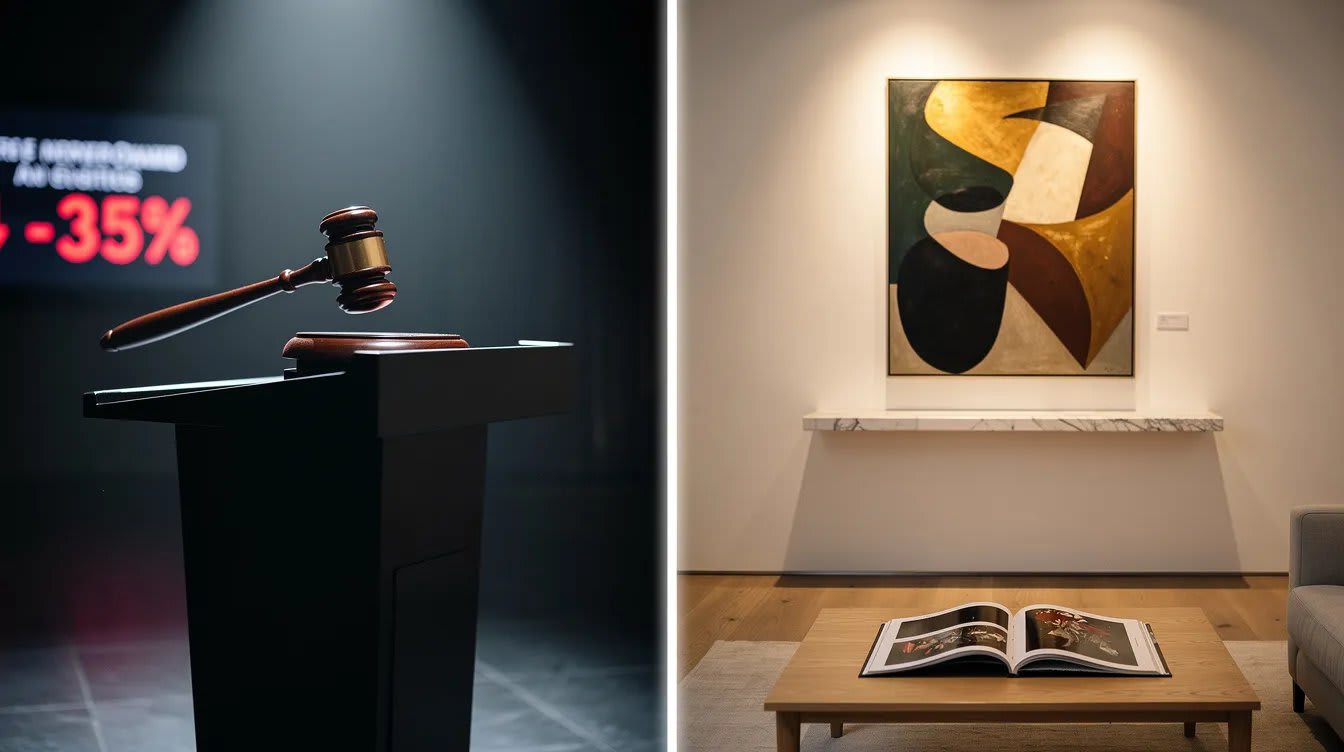
As the art market recalibrates in 2026, new insights reveal that short-term flipping leads to losses while well-timed, long-term collecting offers the promise of enduring value.
Published by LLB Auction — Luxembourg's Contemporary Art Auction House
A pivotal figure emerged on 9 March 2026, a detail that every art collector — and every aspiring art collector — should carefully contemplate.
According to the Bank of America's inaugural 2026 U.S. Art Market Report, produced in partnership with analytics firm ArtTactic, artworks resold within five years of acquisition experienced an average loss of approximately 5.7% annually in 2025. This figure is alarming; rather than breaking even or yielding modest profits, it underscores a regrettable trend of consistent losses for those who entered the market with the intention to flip.
Conversely, the same report confirmed the sustained value of works held for over a decade, which continued to yield positive returns.
This revelation is not a mere data point. It represents a significant verdict on an entire strategy within the art market — one that thrived during the boom years of 2020 to 2022, tarnished the reputations of a generation of emerging artists, and is now, decisively, over.
The Decade of the Flip — and Its Collapse
To grasp the implications of this staggering figure, it is vital to examine the circumstances that preceded it.
During the pandemic-era art boom, a phenomenon emerged that was genuinely unprecedented in modern market history. Collectors — many new to the landscape and buoyed by liquidity from persistently low interest rates — began purchasing works by young contemporary artists not for their personal enjoyment, but to resell shortly thereafter. Auction houses, eager to capitalize on this burgeoning demand, began accepting works for consignment almost immediately following their original sale.
This resulted, for a time, in sensational outcomes. Pieces that initially sold for €20,000 during a gallery opening would appear at auction a year later with estimates reaching €120,000. Some succeeded, but many did not. However, this pattern persisted until it ultimately unraveled.
The data from Bank of America and ArtTactic now provides clarity. In 2022, speculative buyers invested $347 million on young contemporary artists at Christie's, Sotheby's, and Phillips combined. By 2025, that number plummeted to approximately $101 million — a staggering decline of nearly 71% over three years. Furthermore, the works acquired during the boom years, when reintroduced to the market in 2025, lost an average of 5.7% per annum on their original purchase price — and this does not even account for auction commissions, buyer's premiums, storage, insurance, or the myriad of transaction costs associated with any sale.
The true economic fallout for a speculative buyer who purchased in 2021 and sought to sell in 2025 was, therefore, significantly more severe than -5.7% annually; it was, in many cases, disastrous.
"A Return to Discipline": What the Report Actually Says
The Bank of America report does not depict this situation as a crisis. Rather, it accurately frames it as a correction toward a more healthful art market.
Drew Watson, Head of Art Services at Bank of America, articulated this perspective clearly: "What we observed in 2025 was not a resurgence of speculation, but a reinstatement of discipline. Major collections and estates entered the market, permitting collectors to prioritize quality, provenance, and long-term significance. This shift helped stabilize the market and lays a healthier groundwork for future growth."
The report's headline figures corroborate this evaluation. U.S. auction sales rose 23% year-on-year in 2025 to reach $3.17 billion — marking the first annual increase since 2022. Nonetheless, it is vital to note that the number of lots sold fell by nearly 20%. Fewer works, yet stronger outcomes; the market is contracting in volume while expanding in quality. This is not an indication of a market in distress but rather one that is recalibrating itself around what art truly represents.
Impressionist and Modern artworks were primarily responsible for this rebound — pieces with profound historical validation and supply that cannot be artificially generated. In stark contrast, the Young Contemporary sector shrank by approximately 40%. The message is unmistakable: patience is rewarded, while impatience is penalized.
The Holding Period Has Always Been the Secret
This is not a novel concept. While the data substantiating it is recent, the principle has long been recognized by astute collectors.
Art is not a liquid asset. It cannot be traded like stocks or bonds. Every transaction entails considerable friction: commissions paid by sellers, premiums paid by buyers, shipping, insurance, storage, authentication, and the simple reality that finding the right buyer for a specific work at an opportune moment necessitates time. The art market's variant of "buy low, sell high" calls for holding periods measured in decades, not fleeting months.
The Bank of America report quantifies this insight: works held for over ten years continued to yield positive returns in 2025. This duration is the relevant investment horizon for art — not five years, and certainly not one or two.
For a collector purchasing a work at €15,000 today and retaining it for fifteen years, the dynamics differ significantly from those encountered by someone who attempted to flip a trend-driven emerging artist in 2022. The former is building a lasting collection; the latter engaged in speculation within a market they misconstrued.
Why This Validates the LLB Auction Approach
LLB Auction was never designed for the speculative market; it was created for genuine collectors.
The distinction carries weight, and the Bank of America data substantiates this assertion. LLB operates in the price bracket of €5,000–€50,000 — the segment where authentic collections are forged, where emerging and mid-career artists are acquired at entry-level prices that render long-term holding economically desirable, and where the friction costs connected with buying and selling remain manageable.
This is crucial. One of the reasons the -5.7% annual loss statistic is so detrimental for short-term flippers is that the fees charged by auction houses amplify it dramatically. At major houses like Christie's, Sotheby's, and Phillips, buyer's premiums can soar to 26% on lower-value lots. Seller's commissions further exacerbate costs. For international buyers, shipping can add between €2,500 to €4,500 for each transaction. When these costs are taken into account within a short holding period, even a modest decline in hammer price morphs into a substantial loss.
LLB Auction ensures that buyer's premiums remain below the industry average, with no concealed fees and DHL shipping costs ranging from €150 to €450 instead of the thousands typically charged by larger auction houses. For collectors committed to a long-term holding strategy — acquiring works now and retaining them for a decade or more — these savings significantly enhance future returns.
The report also highlights a finding particularly pertinent to LLB's artist program: sales of works by women artists rebounded in 2025 following a dip the previous year, showcasing a remarkable 105% increase over the past decade — outpacing resale returns for male artists. This context reinforces the significance of LLB's representation of artists such as Antonia Beauvoir, Léa Véris, and Eva Santer, each establishing distinctive practices with promising long-term trajectories, making them particularly appealing to the disciplined collector.
The Artists Worth Holding for a Decade
The Bank of America report's core revelation — that long-term holding generates positive returns while short-term trading results in losses — begs the crucial question: which artists, available today at reasonable price points, possess the characteristics that support a decade-long commitment?
The answer resides not in fleeting buzz or institutional endorsement, but in the intrinsic quality and coherence of the artist's practice. An artist with a comprehensive, evolving portfolio — one that rewards sustained consideration and matures in meaningful ways over time — is the kind of artist whose market value quietly appreciates while speculators grapple with losses of 5.7% annually.
LLB Auction's program, in partnership with Lynart Store and the Shadow Collective, is structured precisely around this profile.
Richard Prince (1994) creates artworks that intricately weave together photography, painting, and cultural appropriation — a conceptually robust practice that engages deeply with the visual narratives of contemporary life. His work is resilient against fleeting trends as it tackles enduring questions.
Antonia Beauvoir crafts large-scale figurative paintings of remarkable psychological depth. Her hyperrealist examination of identity, which often veils and obscures, has already garnered institutional interest while remaining accessible to discerning collectors eager to enter at the optimal moment. The compelling combination of unique works — devoid of editions or shortcuts — and rising critical recognition epitomizes the profile the Bank of America data commends.
Ansou Niabaly channels a visceral painterly energy into dialogues surrounding memory, cultural identity, and displacement that resonate across diverse geographies and collector profiles, cultivating sustained secondary market demand.
Yun Sé bridges Eastern and Western artistic traditions through a formal rigor that ensures enduring relevance that transcends any single cultural moment. His deliberate restriction on annual production guarantees genuine scarcity.
Léa Véris and Eva Santer both cultivate careers marked by material intelligence and psychological richness. Both artists stand at junctures where acquiring their work today signifies a genuinely early investment in careers poised for sustained development, ultimately driving long-term market returns.
In each of these instances, the investment rationale — to whatever extent one applies it — mirrors the validated insight from the Bank of America report: acquire quality art at accessible prices, maintain conviction, and permit both the artwork and market to evolve on their own timeline.
The New Discipline of Collecting in 2026
The art market of 2026 diverges significantly from that of 2021. The speculative frenzy is behind us, and the existing data unambiguously outlines the cost to investors who engaged in that paradigm. The ongoing correction is both tangible and salutary.
What is now emerging is more sustainable: a market organized around genuine collecting — emphasizing the intrinsic relationship between a collector and a work, held over time, valued for its essence rather than its potential future worth.
Drew Watson of Bank of America succinctly articulated this shift: "The recalibration favors long-term stewardship over short-term trading — a crucial point since the historical patterns indicate that a long-term perspective has been the most reliable driver of value in art."
At LLB Auction, the contemporary works available today — within the €5,000 to €50,000 range and from artists demonstrating rigorous practices and authentic long-term trajectories — present precisely the type of acquisitions demanded by this new discipline of collecting.
While flippers lost 5.7% annually, heartfelt collectors thrived.
The decisive question remains: which category do you wish to inhabit?
LLB Auction is a Luxembourg-based online auction house specializing in contemporary art priced between €5,000 and €50,000. Buyer’s premiums are kept below the industry average, with no concealed fees involved. Explore current lots and upcoming sales at llb-auction.com.
Thank you for being part of the LLB Auction community.
The LLB Auction Team