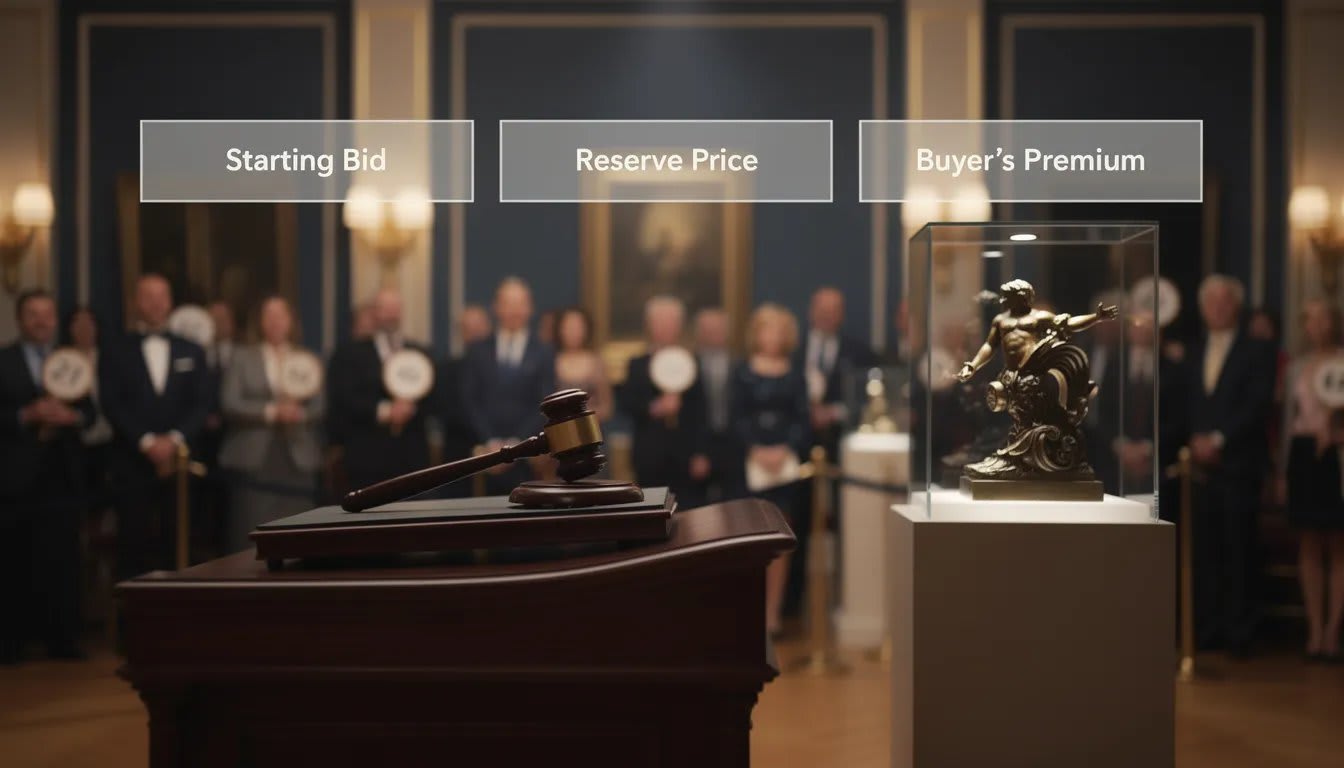
Step into the sophisticated realm of auctions, where understanding key terminology transforms you from a hesitant observer to a confident bidder ready to seize unique opportunities.
If you are new to the captivating realm of auctions, the specialized vocabulary can seem tremendously daunting. Terms such as "reserve price," "starting bid," and "buyer's premium" are frequently exchanged in casual conversation by seasoned collectors. However, what do these terms truly signify? Grasping these fundamental concepts is imperative before you raise your paddle, be it online or within the confines of a prestigious auction house.
This comprehensive guide seeks to illuminate the most pivotal auction terms, empowering you to navigate your inaugural bidding experience with unwavering confidence while steering clear of potentially costly misunderstandings.
Starting Price (Mise à Prix): Where the Bidding Begins
The starting price, often referred to as the opening bid, is precisely what it asserts: the initial amount at which bidding commences for a specific lot. This figure is set by the auction house and serves as the minimum acceptable first bid.
Why Starting Prices Matter
Auction houses meticulously calculate starting prices to generate interest while safeguarding the seller's interests. A starting price that is excessively high may dissuade bidders from participating, while one that is excessively low risks undervaluing a precious item. Typically, starting prices are positioned substantially below the estimated market value to inspire competitive bidding.
For instance, a vintage watch estimated at $5,000 to $7,000 may possess a starting price of $2,000. This creates an enticing entry point for bidders, whilst leaving ample room for the price to ascend to its authentic market value through competitive engagement.
Strategic Considerations
For prospective buyers, the starting price offers insights into the auction house's strategic approach. A notably low starting price commonly indicates that the auctioneer possesses confidence that the item will attract multiple bidders, ultimately driving the price upward organically. Conversely, a starting price nearer to the estimated value may suggest reduced certainty regarding demand.
Reserve Price: The Hidden Safety Net
The reserve price is arguably the most misunderstood notion in auctions. It represents the confidential minimum price the seller is willing to accept for an item. Unlike the starting price, the reserve price remains undisclosed to bidders.
How Reserve Prices Work
When a seller consigns an item for auction, they may establish a reserve price to shield themselves from incurring a loss. Should bidding fail to reach this minimum threshold, the item will be left unsold, a scenario commonly referred to as "failing to meet reserve" or "being bought in."
To illustrate: A seller consigns a painting with a reserve price of $10,000, while the starting price may be set at $3,000 to entice bidders. If bidding concludes at $8,000, the item will remain unsold as the reserve price has not been attained. The auctioneer may then announce "reserve not met" or simply transition to the ensuing lot.
The Reserve Indicator
In numerous auctions, you will encounter catalog listings marked with an "R" or "Reserve" to signify that a reserve price has been established. Some auction houses employ subtle cues during live auctions; the auctioneer may state, "I am still looking for more" or "the bidding is against you" to convey that the reserve has yet to be met.
No Reserve Auctions
Items categorized as "no reserve" (NR) or "absolute auction" will be sold to the highest bidder without regard to the final price. Such auctions create exhilarating opportunities for buyers, although they carry increased risk for sellers. No reserve auctions frequently incite more aggressive bidding, as participants recognize their genuine chance to secure a remarkable bargain.
Buyer's Premium (Frais d'Adjudication): The Additional Cost
The buyer's premium stands as an additional fee imposed by the auction house on top of the winning bid amount. This concept is one of the most crucial for buyers to comprehend, as it considerably influences the total amount you will pay.
Calculating the Total Cost
The buyer's premium is expressed as a percentage of the hammer price (the final winning bid). For example, if you secure an auction with a hammer price of $1,000 and the buyer's premium is 25%, your total payment will amount to $1,250, alongside any applicable taxes.
The formula remains straightforward:
Total Cost = Hammer Price + (Hammer Price × Buyer's Premium %) + Taxes
Typical Buyer's Premium Rates
Buyer's premiums tend to vary considerably across different auction houses and types of auctions:
- Major auction houses: Typically range from 20% to 28% (often tiered, with lower percentages for higher hammer prices).
- Online auction platforms: Often between 15% to 25%.
- Regional auction houses: Typically range from 10% to 20%.
- Specialty auctions: Can fluctuate from 10% to 30% depending on the category.
Some auction houses employ tiered structures. For instance:
- 28% on the first $200,000
- 22% on amounts ranging from $200,001 to $4,000,000
- 15% on sums exceeding $4,000,000
Why Buyer's Premiums Exist
Buyer's premiums assist auction houses in covering operational costs, encompassing marketing, cataloging, insurance, staff salaries, and facility maintenance. While they may appear to be an additional burden, these fees empower auction houses to provide expertise, authentication services, and a curated marketplace that benefits both buyers and sellers.
Seller's Commission: The Other Side
Moreover, it is essential to note that sellers typically incur a commission payable to the auction house, generally ranging from 10% to 20% of the hammer price. Thus, the auction house generates revenue from both parties involved in the transaction.
Other Essential Auction Terms
Estimate or Pre-Sale Estimate
The estimated price range presented in the catalog represents the auction house's expert opinion on the appropriate selling price for an item. For example: "Estimate: $3,000-$5,000." These estimates are crafted based on comparable sales, prevailing market conditions, and expert appraisal.
Hammer Price
The ultimate bid amount when the auctioneer's hammer falls, before the buyer's premium and taxes are factored in. This figure epitomizes the pure auction outcome, signifying what bidders were willing to pay amidst competitive bidding.
Lot Number
Each item or collection of items in an auction is assigned a unique lot number for identification and cataloging purposes. Generally, lots are sold sequentially by number, although high-value items may be strategically featured at critical points throughout the sale.
Absentee Bid or Commission Bid
A bid placed in advance by an individual unable to attend the auction in person. The auction house will bid on your behalf, striving to attain your maximum amount, while competing with live bidders, whether present in the room or participating online.
Increment
The predetermined amount by which bids must increase. For example, if the current bid stands at $1,000 and the increment is $100, the subsequent acceptable bid would thus be $1,100. Generally, increments ascend proportionally with the price level.
Tips for First-Time Bidders
Always factor in the buyer's premium when establishing your maximum bid. If you are willing to invest a total of $1,000 for an item and the buyer's premium is positioned at 25%, your maximum bid should ultimately be $800.
Research the auction house's terms and conditions prior to bidding. These documents delineate the buyer's premium percentage, payment terms, shipping options, and return policies.
Inquire about the reserve price policy. While the specific reserve amount will remain undisclosed, comprehending whether most lots possess reserves can inform your strategic approach.
Establish a firm budget and adhere to it steadfastly. The thrill of competitive bidding can provoke overspending, particularly when one neglects to consider the buyer's premium and applicable taxes.
Inspect items during preview periods wherever feasible. Catalog descriptions and photographs, while valuable, cannot substitute for a firsthand examination.
Conclusion
Comprehending auction terminology enables you to transition from a hesitant observer to a confident participant. The starting price reveals the point at which the auction journey commences, the reserve price safeguards the seller's interests, and the buyer's premium represents the auction house's service fee. Collectively, these concepts establish the foundational financial framework for every auction transaction.
Equipped with this understanding, you can approach your inaugural auction with realistic expectations, precise budgeting, and the confidence to bid strategically. The realm of auctions presents distinct opportunities to acquire exceptional items; now you possess the vocabulary essential for a fully engaging experience within this exhilarating marketplace.
Remember: every seasoned collector once embarked on their path as a first-time bidder. Take your time, pose inquiries, and remain undaunted by the intricate terminology. Welcome to the enthralling world of auctions!
Thank you for being part of the LLB Auction community.
The LLB Auction Team