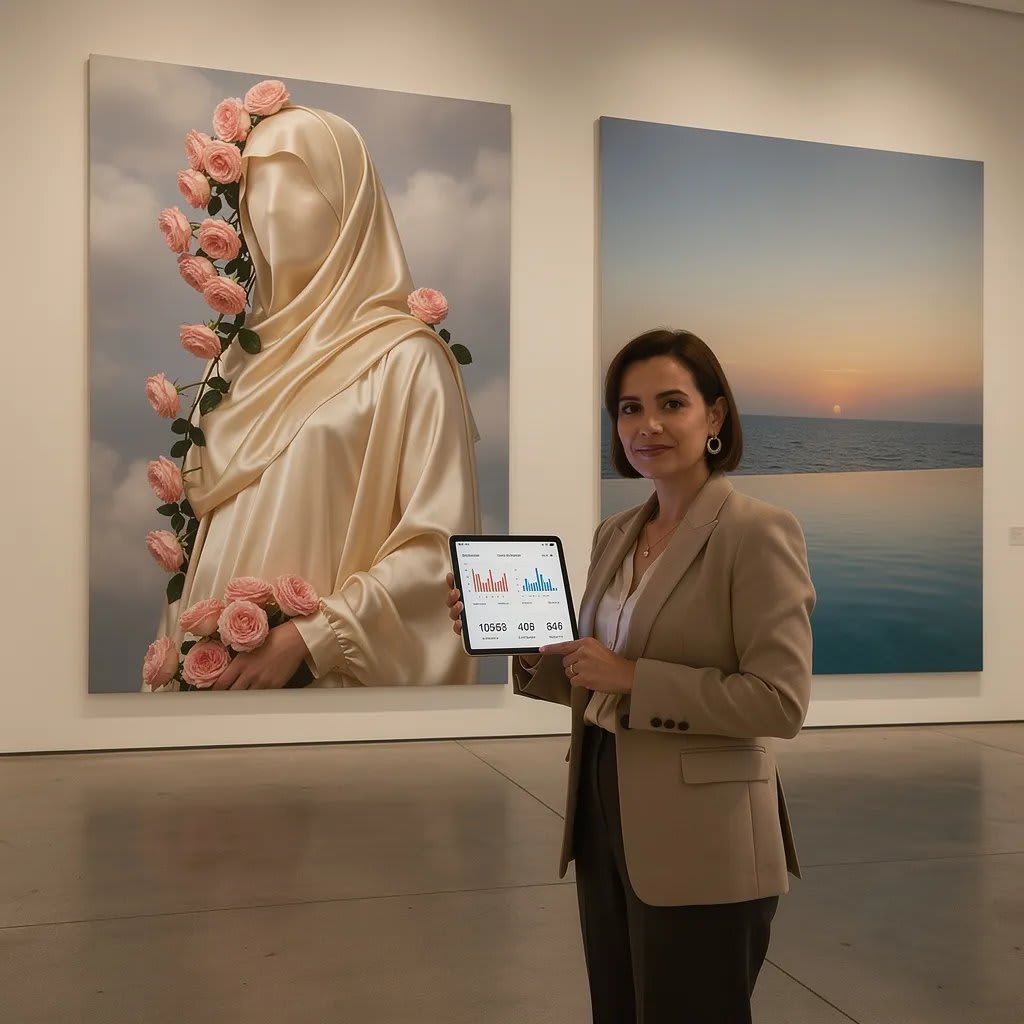
The art market is undergoing a monumental transformation as more than $83 trillion in assets shifts between generations, forever altering the landscape of contemporary art collecting.
Published by LLB Auction — Luxembourg's Contemporary Art Auction House
The art market stands at the precipice of its most significant structural transformation in modern history. This is not merely a market correction, a new medium, or even a geopolitical rebalancing; rather, it is something vastly more profound: a generational transfer of wealth on an unprecedented scale.
Remarkably, according to UBS chief economist Paul Donovan, as cited in the Art Basel & UBS Global Art Market Report 2026, more than $83 trillion in assets will shift between generations over the coming decades. This wealth transfer is remarkable, moving from Baby Boomers to Millennials, from Generation X to Generation Z, and from established heirs of legacy collections to a new class of youthful, digitally savvy buyers who perceive, collect, and purchase art in fundamentally different ways.
For the contemporary art auction market, this is not a mere backdrop; it is the defining narrative of the decade.
Who Is Inheriting, and What Do They Desire?
The enormity of the Great Wealth Transfer is staggering. In the United States alone, estimates indicate $80 to $85 trillion in assets will transition between generations by mid-century, with millennials poised to inherit upwards of $45 trillion. On a global scale, ultra-high-net-worth individuals currently control more than $2 trillion in art and collectibles, a significant portion of which is about to change hands.
However, it is crucial for every auction house to recognize a significant aspect of this transition: the heirs often do not share their parents' tastes.
The Morgan Stanley Art Resources Team has illustrated this divergence with clarity. As aging collectors evaluate their estates, they increasingly discover that children raised within a digital landscape — on platforms like Instagram and digital art sites — possess entirely different aesthetic preferences. The blue-chip safe bets of prior decades, which dominated the secondary market in the 1990s and 2000s, are not invariably being cherished or passed down. Instead, they are often liquidated, reassessed, or replaced.
This younger generation desires something distinct: emotionally resonant artwork, emerging voices, culturally significant artists, and accessible price ranges. They wish to collect with conviction, fueled by passion rather than mere financial interest.
The New Collector Profile: Digital, Informed, Value-Conscious
The Art Basel & UBS Report 2026 provides an insightful portrayal of this emerging class of collectors. They demonstrate a propensity to research artists online prior to engaging in bidding. Comfortable with a fully digital auction framework, they exhibit skepticism toward opaque fee structures and prefer platforms that champion price transparency. Particularly, they are highly active within the €5,000 to €50,000 price range, a segment that revealed a hammer ratio of 1.57 in 2025, indicating that artworks within this category sold, on average, at 157% of their low estimates.
This is no marginalized market. The Art Basel & UBS Report confirms that 63% of total online art sales value resides within the sub-$50,000 segment. This thriving part of the art market, which is expanding rapidly and attracting a multitude of new buyers, delineates where next-generation collectors are most engaged.
Moreover, this generation is motivated by novel reasons. Diverging from the speculative buyers of the 2010s, they are driven by cultural alignment, personal significance, and genuine connections with the artists they support. The practice of acquiring art solely as a store of value is yielding to experience-led, relationship-driven collecting, thus radically altering how auction houses must position themselves.
Why Online Auctions Are the Natural Home for This Generation
The next-generation collector did not grow up by contacting specialists at Christie's; rather, they emerged on platforms where discovery, transaction, and community converge seamlessly. For them, transitioning to online-first art buying is not merely a concession; it is simply the way they interface with the world.
LLB Auction, as a fully digital auction house located in Luxembourg, has been meticulously designed to meet this evolving reality. It offers all that this new generation of collectors has been seeking: complete transparency, competitive buyer's premiums, and unrestricted access to a carefully curated selection of contemporary works within the €5,000–€50,000 range.
While major auction houses in London, New York, and Paris layer additional fees — with shipping costs alone ballooning to €2,500 to €4,500 atop the hammer price — LLB Auction maintains buyer's premiums below the market average, ensuring an experience devoid of hidden charges or unexpected surprises. For a generation accustomed to clear pricing and digital trust, this is not merely a detail but a core reason to select LLB over traditional institutions.
Furthermore, Luxembourg's status as a European financial and regulatory hub adds another layer of assurance. As wealth circulates across borders — an inevitable occurrence during substantial generational transfers — having an EU-regulated auction platform capable of managing cross-border transactions with transparency and efficiency holds tremendous importance.
The Artists Defining the Collections of Tomorrow
What does this new breed of collector pursue? Analysis based on market signals, platform data, and cultural trends illustrated in the 2026 report points distinctly toward emerging and mid-career artists characterized by their distinct voices, strong narratives, and works available within the €5K–€50K range.
LLB Auction — in collaboration with Lynart Store — is closely aligned with artists who match this exact profile:
- Richard Prince (1994): His conceptually rich, media-aware practice resonates with collectors navigating an image-saturated culture. His work provocatively straddles the line between painting, photography, and cultural commentary — embodying the type of intellectually engaged work that next-gen collectors favor.
- Yun Sé: His visual language, rooted in the interplay between Eastern and Western aesthetics, results in creations that feel both universal and deeply personal. In a collecting environment increasingly influenced by global perspectives, Yun Sé's practice resonates across diverse geographies.
- Antonia Beauvoir: Engaging with themes of identity, feminism, and embodiment through rigorous formal strategies, her work garners institutional recognition while remaining accessible to novice collectors. Positioned within the market’s growing segment, her sales reflect an increase in female artists' representation, from 28% to 37% over the past seven years.
- Ansou Niabaly: His vibrant, painterly passion explores issues of belonging, memory, and cultural displacement — themes that resonate profoundly with a generation shaped by globalization and cultural hybridity.
- Léa Véris: She navigates materiality and surface in captivating ways that reward close observation, fostering lasting connections between collector and artwork rather than merely populating walls.
- Eva Santer: Through compositions that balance intimacy with conceptual lucidity, her practice explores the psychological textures of daily life. As collectors seek depth over spectacle, Eva Santer's work gains urgency.
These artists are accessible through LLB Auction, with price points specifically designed for the next generation of discerning collectors — a strategic focus rather than an afterthought.
Understanding the Impact of the Wealth Transfer on Auction Strategies
The Great Wealth Transfer introduces not only new buyers into the market but also new supply. The Art Basel & UBS Report highlights that estate sales and single-owner collections currently account for 43% of auction revenues, having surged by 132% year-on-year. As heirs inherit collections they do not wish to retain, those artworks require new homes.
For auction houses strategically positioned, this presents a dual opportunity: attracting the next generation of buyers on one hand and providing efficient, transparent consignment channels for estate-driven sellers on the other. LLB Auction's model — characterized by low fees, EU regulation, fully digital operation, and multilingual capabilities — adeptly benefits both parties simultaneously.
In contrast, major houses in London and New York are architecturally inclined toward the previous generation's market: grand physical spaces, complex guarantee frameworks, and specialist-driven relationships cultivated over decades. Their adaptation will not be swift. This creates genuine, structural opportunities for a platform like LLB to establish itself as the natural auction home for the generation now in the process of inheriting.
A Market in Transition — A Brief Window of Opportunity
Markets undergoing structural transition present unique openings. The Great Wealth Transfer represents one of the most distinct opportunities in the history of art collecting — a moment defined by the rewriting of traditional rules, where incumbents are slow to adapt, and the next generation of remarkable collections is taking shape.
The Art Basel & UBS Global Art Market Report 2026 indicates that 43% of dealers expect sales to improve in 2026, and that public auction sales increased by 9% last year — a signal of recovering market confidence precisely as this generational shift accelerates.
At LLB Auction, the contemporary works available today — from Richard Prince (1994) to Eva Santer, and from Ansou Niabaly to Antonia Beauvoir — exemplify the type of entry points critical to forming serious collections. Priced below €50,000, fully documented, transparently priced, and accessible from across Europe and beyond.
The $83 trillion is in motion. The pertinent question is where it will ultimately reside.
LLB Auction is a Luxembourg-based online auction house specializing in contemporary art priced between €5,000 and €50,000. Buyer's premiums are maintained below the industry average, with no concealed fees. Explore current lots and upcoming sales at llb-auction.com.
Tags: contemporary art auction, great wealth transfer, next generation collectors, millennials art collecting, LLB Auction Luxembourg, buy contemporary art online, Richard Prince 1994, Yun Sé artist, Antonia Beauvoir, Ansou Niabaly, Léa Véris, Eva Santer, art market 2026, Art Basel UBS report 2026, online art auction Europe
Thank you for being part of the LLB Auction community.
The LLB Auction Team