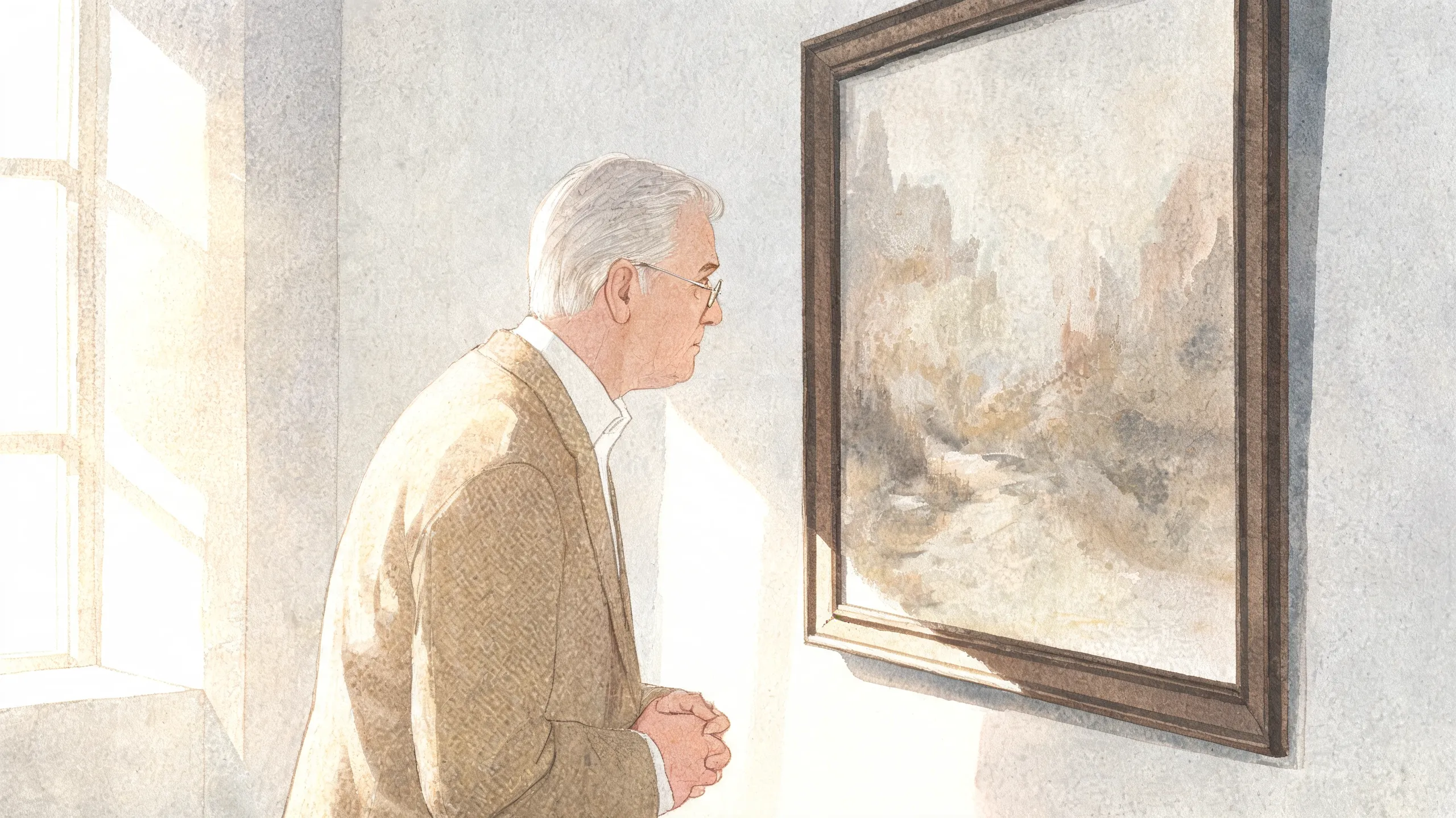
A painting gives up its meaning in layers, and most collectors are taught to read only the first. This guide sets out how to analyze a painting: elements and principles of art, composition, colour, light, iconography and technique, gathered into one repeatable method you can apply to the next work you stand in front of. It is the sequence a saleroom specialist follows before a single figure is discussed: description before interpretation, evidence before judgement. Read this way, a work stops being a biography or an anecdote and becomes a set of decisions an artist made, decisions you can name, weigh and, when the moment comes, value. Learning how to analyze a painting is less a matter of taste than of running that sequence in the right order.
Key takeaways:
- The elements of art (line, shape, form, value, colour, space, texture) are what an artist puts down; the principles (balance, contrast, emphasis, movement, rhythm, proportion, unity) are how those elements are organised.
- Tate defines formal analysis as the study of a work solely through its form: colour, brushwork, line, form and composition.
- Erwin Panofsky's three levels of meaning, pre-iconographic, iconographic and iconological, move a reading from what you see to what the work meant.
- Infrared reflectography images a painting in the 900 to 1700 nanometre range to expose the underdrawing and the pentimenti beneath the visible surface.
- The global art market reached $59.6 billion in 2025, with public auction sales up 9%, by the Art Basel and UBS report; in a market that size, documented close reading is what earns confidence.
How to Analyze a Painting: Elements and Principles of Art
Begin with what is in front of you, not what you have read about it. Tate defines formalism as the study of art based solely on an analysis of its form, the way it is made and what it looks like, and a formalist critic attends to five qualities: colour, brushwork, form, line and composition. That discipline of looking before meaning is the foundation of every serious reading, and it is what stops a collector from mistaking a familiar subject for an understood picture. That gap between recognising a subject and reading a work is exactly what learning how to analyze a painting closes.
The working vocabulary divides into two sets, and keeping them apart is half the skill. The elements of art are the building blocks an artist places on the surface: line, shape, form, value, colour, space and texture. The principles of art are the decisions that organise those elements into a whole: balance, contrast, emphasis, movement, rhythm, proportion and unity. The elements are nouns, the principles are grammar. Knowing how to analyze a painting: elements and principles of art, means holding both in view at once, naming what you see and then naming how it was arranged to act on you.
| Elements of art (what you see) | Principles of art (how it is arranged) |
|---|---|
| Line, shape and form | Balance and symmetry |
| Value, from light to dark | Contrast and emphasis |
| Colour and hue | Movement and rhythm |
| Space and depth | Proportion and scale |
| Texture and surface | Unity and harmony |
Most weak readings stop at the elements, listing what is depicted without asking why it was put together that way. The principles are where intention lives, and intention is what separates a masterpiece from a competent picture. A work that balances a heavy dark mass against a small bright accent has made a decision about your attention; naming that decision is the move from looking to reading. The rest of this guide on how to analyze a painting takes that move apart, question by question.
How to Analyze a Painting: Elements and Principles of Art, Question by Question
A method only works if it runs in order, from description toward interpretation, never the reverse. These seven questions are the sequence a specialist follows, and they double as a complete step-by-step method for analysing any painting you encounter.
- What am I looking at? Name the medium, the support and the genre. Oil on canvas, acrylic on board, a portrait, a still life, a pure abstraction. The physical facts come first.
- Where does my eye go first? Find the focal point and the lines that lead to it. Composition is the artist's script for your attention, and your first fixation is rarely an accident.
- What is the light doing? Read value before colour. Map the lightest and darkest passages and the direction from which the light falls.
- What does the colour make me feel? Identify the palette, its temperature and the emotional register it sets before you can explain it.
- What is hidden in plain sight? Decode the symbols, objects and gestures that a contemporary viewer would have recognised at once.
- How was it made? Study the surface: brushwork, layering, ground and the marks of the hand and the tools that left them.
- What would set its value? Weigh attribution, condition and provenance last, once the reading is complete and not before.
Run these in sequence and the work resolves from a single impression into a stack of named decisions. Skip ahead to question seven, as the market often tempts a buyer to do, and the reading collapses into a guess.
That order is the spine of how to analyze a painting, and it scales. The same seven questions work on a Renaissance altarpiece, a 1960s silkscreen and a raw abstract canvas, because each asks about a decision every artist has to make. What changes from work to work is the answer, not the question, and a collector who internalises the sequence stops depending on whoever happens to be standing next to them in the room.
What You Are Looking At, and What Came Before
The first question, what am I looking at, is also the one most often skipped. A painting is a physical object before it is an image, and the object carries information. Medium is the material an artist worked in. The Museum of Modern Art's learning resource describes paint as a combination of pigment, binder and solvent: in oil paint the binder is usually linseed oil, which dries to the touch in about one week and, over decades, yellows and cracks in patterns a conservator can read like tree rings. Acrylic, introduced to artists in the mid twentieth century, dries in minutes and stays comparatively stable. The medium dates a work, shapes its surface and records how it has aged.
Support is the surface the paint sits on, whether canvas, panel, paper or board, and it carries its own evidence. A canvas can be relined, a panel can split along the grain, paper can foxe and discolour, and each behaviour helps date and condition a work. Reading the support is the part of how to analyze a painting that beginners skip and specialists never do, because the support often survives to tell the truth when the surface has been cleaned or restored into ambiguity.
Genre is the category a work belongs to: portrait, landscape, still life, history painting, abstraction. Each genre arrived with its own conventions, and an artist either honoured them or broke them deliberately. Knowing the convention is the only way to notice the break, and the break is usually where the meaning sits. A portrait that refuses to flatter, a still life that will not stay decorative, these are arguments, not decorations.

No painting arrives from nowhere, and reading what came before means placing the work in a lineage. The Metropolitan Museum of Art's Heilbrunn Timeline of Art History, more than 1,000 essays and 300 chronologies written by the museum's own curators, exists precisely to map those lineages movement by movement and region by region. A 1962 silkscreen makes a different kind of sense once you can see what photography and advertising had already done to the image it borrows. Reading the precedent is not an academic luxury; it is how you tell a genuine innovation from a recycled gesture, and that distinction is one a collector pays for. Reading the object and its lineage is the first discipline in how to analyze a painting, and it anchors everything that follows.
How Composition Leads the Eye
Composition is the arrangement of everything inside the frame, and it is the artist's most direct control over where you look. The focal point is the destination; the leading lines, the diagonals, edges and gazes that point toward it, are the route. A horizon placed high lowers the sky and grounds the viewer; a single figure pushed to one edge creates a tension the eye wants to resolve and cannot quite.
Painters work from a small repertoire of recurring structures, many of them traced by the Metropolitan Museum's Heilbrunn Timeline from the Renaissance onward. Symmetry steadies a composition and reads as calm, balance or authority. Asymmetry, held together by visual weight rather than mirroring, reads as movement and life. The triangle, with its stable base and rising apex, has organised figure groups for five centuries. Diagonals inject speed; strong horizontals and verticals slow everything to a stop.
Two proportional schemes recur often enough to look for by default. The rule of thirds divides the frame into a three by three grid and places key elements along the lines or at their intersections. The golden ratio, near 1 to 1.618, underlies many classical compositions and still reads as resolved to a modern eye. Neither is a law, and noticing where an artist ignores them is as telling as noticing where they comply.
To test where a composition sends you, look once quickly and notice your involuntary first fixation, then trace the path your eye takes afterward across the surface. That route is the artist's script, written in arrangement rather than words, and naming it is the core of how composition works as the artist's script. A masterpiece rarely lets the eye drift; it directs, delays and rewards, and a collector who can map that movement is reading the painting as the artist built it. Mapping that movement is the part of how to analyze a painting that most rewards slow, repeated looking.
Colour and Light as Emotional Control
Read value before you read colour. Value is the degree of lightness or darkness in a work, and it does the structural labour that colour usually takes the credit for. Squint at a painting until the hues drop away and only the pattern of lights and darks remains: that pattern is what gives the image its weight, its depth and its legibility from across a room. Chiaroscuro, the strong modelling of form through the contrast of light and shadow, builds volume and drama from value alone, which is why a great drawing in black chalk can move a viewer as much as a painting. Value is the first thing to read in how to analyze a painting, before a single hue is named.
Colour then steers feeling. Warm colours, the reds, oranges and yellows, advance toward the viewer and raise the temperature of a scene; cool colours, the blues and greens, recede and settle it. A restricted palette concentrates emotion to a single note; a deliberately discordant one unsettles, and means to. The Post-Impressionists made the principle explicit, and Tate records the painter and theorist Maurice Denis arguing that aesthetic pleasure was to be found in the painting itself, not in its subject, a claim that moved colour and form to the centre of meaning.
How a painter steers what you feel through colour and light is rarely accidental in a finished work. When a passage moves you and you cannot say why, the explanation is almost always in the value structure first and the colour temperature second. Naming the mechanism does not dissolve the feeling; it tells you the feeling was engineered, and by whom. Reading value first and colour second is a habit anyone learning how to analyze a painting can build in a single afternoon at a museum.
Hidden Symbols and Iconography
Once you have described the form, ask what it meant to the people who first saw it. Iconography is the study of subject matter in art: the symbols, figures and motifs a culture would have read at a glance. Its modern method comes from the art historian Erwin Panofsky, and Smarthistory sets out his three levels of meaning as the standard sequence for moving from surface to significance.
The first level is pre-iconographic description: naming the natural forms, a man, a candle, a skull, without any cultural interpretation. The second is iconographic analysis: recognising that the skull is a memento mori and the guttering candle a sign of life's brevity, because a period viewer would have made those connections automatically. The third is iconological interpretation: reading the work for its intrinsic meaning, what Panofsky called those underlying principles which reveal the basic attitude of a nation, a period, a class. At that third level, a still life of decaying fruit stops being a kitchen scene and becomes a seventeenth-century argument about mortality and excess.
Symbols are conventions, and conventions are local to a time and place. A reading that ignores period and culture will misfire, attaching modern meanings to objects that carried older ones, which is why reading symbols and iconography depends on knowing the world that produced the work. The discipline is to keep what you can see separate from what you are inferring, and to keep the inference honest. Smarthistory notes the method's limit: a purely abstract work, with no recognisable subject, offers iconography nothing to decode, and the reading must rest on form, material and context alone.
A short worked example shows the three levels in motion. A woman stands holding an empty balance before a table of pearls and gold: at the first level, a quiet domestic scene; at the second, the iconographic recognition that the empty scales and the gold and pearls signal divine judgement weighed against worldly vanity; at the third, the iconological reading of a culture weighing the material against the eternal. The same object, three depths, and how to analyze a painting means descending them in order rather than leaping straight to the conclusion.
The Artist's Technical Choices
How a work was made is recorded in its surface, and the surface is evidence that resists faking. The surface is the most honest witness in how to analyze a painting, because handling is far harder to forge convincingly than a signature. Brushwork ranges from the invisible, blended finish of academic painting to the loaded, gestural strokes of the Abstract Expressionists, and the handling is as personal as handwriting. Ground is the prepared layer between support and paint, and its colour and absorbency shape every mark laid over it; a warm ground left exposed at the edges of strokes can unify a whole picture.
Some choices sit below the visible surface, and imaging technology brings them up. Infrared reflectography, a scientific method that images a painting in the 900 to 1700 nanometre range, sees through upper paint layers to the underdrawing the artist laid down first, and it exposes pentimenti, the changes an artist made while working. The National Gallery in London used it on Raphael's Madonna of the Pinks, of about 1506 to 1507, revealing a fine metalpoint underdrawing and a bodice the artist reworked between drawing and painting. Those visible second thoughts are some of the strongest evidence of an authentic, searching hand rather than a copyist tracing a finished design.

The back of a work records as much as the front. Stretcher bars, canvas weave, labels, stamps and inscriptions trace where a painting has travelled and who has owned it, which is why what the signature and the verso reveal is a chapter of the reading in its own right, not a footnote to it. A specialist reads the verso with the same care as the image, because the chain of custody often lives there in pencil and paper. Reading the made surface, front and back, is where how to analyze a painting becomes a forensic discipline rather than a purely aesthetic one.
What Contemporaries Understood, and How Meaning Shifts
Every painting was made for an audience that knew things you do not. A contemporary viewer brought a shared vocabulary of religion, politics, myth and daily life, and read references now invisible without research. Recovering that first audience is the historian's task, and the same Smarthistory account of iconographic method that gives us Panofsky insists on it: meaning is built from the cultural knowledge a work assumed, and an image read outside that knowledge is read wrong. A gesture that signalled piety in 1500 can look merely decorative five centuries later.
Meaning then shifts across the centuries, and the shift is not a corruption to be corrected back to an original. A devotional panel becomes a museum object; a piece of state propaganda becomes a historical document; a once scandalous nude becomes a textbook example of technique. Each era reads a work through its own concerns, and the readings accumulate in layers rather than cancelling one another out. The honest approach holds two frames at once: what the work meant to the people who first stood before it, and what it has come to mean in the time since.
For a collector this is not abstract. A work whose maker has been reassessed by scholarship, or whose meaning has deepened with new research, reads differently in the room, and that later understanding is part of what each generation responds to when it looks. Reading the reception history is reading the work's afterlife, and a masterpiece is precisely a work that keeps generating fresh readings instead of exhausting itself in one. Holding past and present meanings together is the most demanding step in how to analyze a painting, and the one that keeps a masterpiece alive across generations.
How to Analyze a Painting: Elements and Principles of Art Before You Value It
Value is the last question in the sequence, never the first, and it rests on three things the reading has already prepared: attribution, condition and provenance. Knowing how to analyze a painting: elements and principles of art, is what lets you describe a work precisely enough to weigh those three with honesty rather than hope.
Attribution asks who made the work, and the close reading of hand, brushwork and underdrawing feeds the answer directly. Condition asks what physical state the work is in: a professional condition report records losses, lining, restoration and overpaint that an untrained eye slides past. Provenance is the documented chain of ownership, and the verso, with its labels and stamps, is where that chain is most often written down. None of the three is a matter of taste, and none can be settled by how much you like the picture; each is a matter of evidence that a reading either supplies or fails to. Each of the three is downstream of how to analyze a painting, because the close description is what makes the eventual judgement defensible.
The market rewards that evidence. By the Art Basel and UBS report authored by the economist Dr. Clare McAndrew, global art sales reached $59.6 billion in 2025, with public auction sales rising 9% to $20.7 billion and contemporary art holding a 14% share of fine art auction value. In a market that size, a confident and documented description is worth materially more than an optimistic one. Forgery makes the same point from the other side: a reading that cannot account for the surface, the materials and the paper trail is a reading that should pause before it bids, however attractive the image. This is why how to analyze a painting and how to value one honestly are the same skill approached from opposite ends of the same evidence.
Three Works, Read Closely
The method is easiest to trust once you watch it run on real objects. The following readings are drawn from works examined by LLB Auction specialists at intake, described here without attribution or valuation, to show the sequence rather than to grade the pieces. Each reading shows how to analyze a painting in the room, away from the textbook and under time pressure.
A large screenprint by a Pop-era artist, signed in pencil and numbered within a stated edition, came in for the Contemporary Art Spring 2026 sale. The reading began with the medium and the edition number, checked against the published catalogue of the artist's prints, then moved to the verso, where a gallery label and a framer's stamp were photographed and transcribed before any condition note was written. Object first, documentation second: the order is the safeguard against reading what you hope to find.
An acrylic on canvas, roughly 120 by 90 centimetres, abstract and unsigned on the face, presented a harder case. Raking light across the surface disclosed a pentimento, a reworked passage in the lower third where the paint sat in two campaigns, consistent with a hand composing rather than a copyist transcribing. The reading logged the observation as evidence, not as proof, and the condition report described the surface exactly as it stood, neither more nor less.
A small work on paper with light foxing and a discoloured mount showed how condition and reading meet. The mount was opened to inspect the full sheet, the foxing was mapped and logged, and the decision turned on what the report could state plainly to a buyer. Across that Spring 2026 sale, 25 lots were offered and 23 sold for roughly €39,480 in gross hammer, and every catalogue entry rested on a reading carried out in this order. In each, how to analyze a painting meant the same thing: object first, document second, judgement last.
How LLB Auction Helps You Read Before You Buy
LLB Auction is a contemporary art auction house built around a single discipline: reading the object closely before anyone is asked to bid on it. The curation is the product, and it rests on three commitments a collector can hold the house to.
Curated intake. Roughly 40% of submissions are declined. The willingness to walk away from inventory is what gives the catalogue its meaning, because a work that passes has cleared a real threshold of medium, condition and documentation rather than simply arriving for sale. The house treats how to analyze a painting as an operational standard, not a marketing flourish.
Documented due diligence. Every lot is read in the order this guide describes, with certificate and ownership checks and a published three-page condition report. The house documents the evidence it finds and lets the condition report stand as the record; it does not claim a certainty about authenticity or value that the evidence cannot support, and the buyer is told plainly what is known and what is not.
Transparent terms. Fees are disclosed before you bid: a 20% buyer's premium and a 10% seller's commission, with nothing added at checkout, across four timed online sales committed for 2026. The same readings that fill the catalogue are shared with collectors who register, so the reasoning behind each lot is visible before the sale opens. Register with LLB Auction to receive the next catalogue, the sale previews and the close readings behind every lot, and to watch how the method is applied to the works you might buy.
FAQ: How to Read and Analyze a Painting
What is the difference between the elements and the principles of art?
The elements of art are the building blocks an artist puts on the surface: line, shape, form, value, colour, space and texture. The principles of art are the ways those elements are organised: balance, contrast, emphasis, movement, rhythm, proportion and unity. The elements are what you see; the principles are how the artist arranged them to steer your eye and your feeling. A complete reading names both.
What is a simple step-by-step method to analyse a painting?
Move from description to interpretation in order. First, name the medium, support and genre. Second, map the composition and the focal point. Third, read value, colour and light. Fourth, identify the symbols and subject matter. Fifth, study the technique and surface. Sixth, place the work in its period and culture. Seventh, weigh condition, provenance and attribution before any judgement of value. Seven questions, always in that sequence. That sequence is the short version of how to analyze a painting.
How is formal analysis different from iconography?
Formal analysis, as Tate defines it, studies a work solely through its form: colour, brushwork, line, form and composition. Iconography, the method Erwin Panofsky systematised, reads subject matter, the stories, symbols and allegories a culture would have recognised. Formal analysis asks how the picture is built; iconography asks what it means. A full reading uses both, and in that order, form before meaning.
What can infrared reflectography reveal about a painting?
Infrared reflectography images a work in the 900 to 1700 nanometre range and sees through upper paint layers to the underdrawing the artist laid down first. It exposes pentimenti, the changes an artist made while working. The National Gallery in London used it on Raphael's Madonna of the Pinks of about 1506 to 1507 to reveal a metalpoint underdrawing and a reworked bodice, evidence of a composing hand rather than a copy.
Does close reading affect a painting's value at auction?
Yes, indirectly. Close reading does not set a price, but it informs the three factors that do: attribution, condition and provenance. A specialist who has read the surface, the verso and the documentation can describe a work accurately and disclose its limits. Public auction sales rose 9% to $20.7 billion in 2025, by the Art Basel and UBS report, and a market that size rewards documented confidence over optimism.
Can you analyse an abstract painting the same way?
Partly. Formal analysis applies fully, because an abstract canvas still has composition, value, colour, scale and surface to read. Iconography often does not, because there is no recognisable subject to decode. Smarthistory notes that purely abstract works make iconographic analysis impossible, so the reading rests on form, materials and context rather than on symbols.
Conclusion
A masterpiece does not hide from a careful viewer; it rewards one. The seven questions in this guide, from what am I looking at to what would set its value, turn a first impression into a set of named decisions, and the named decision is the only unit a collector can actually weigh. Form first, then meaning, then evidence: the order is the whole discipline, and reversing it is how buyers talk themselves into mistakes.
None of this requires a degree, only the patience to look in sequence and the honesty to separate what you see from what you infer. Learn how to analyze a painting: elements and principles of art, composition, colour, iconography and technique, and you carry a method that travels to the next work and the one after it, long after the particular picture in front of you has left the saleroom. That, in the end, is what learning how to analyze a painting gives a collector: portability, and independence from the last confident voice in the room.
Sources
Further reading from LLB Auction
- How composition works as the artist's script
- How to read symbols and iconography
- Colour and light: how painters steer what you feel
- What the signature reveals, and what it hides
- Before and after restoration: reading a cleaned work
References
- Formalism : Tate, 2024
- Iconography and iconographic analysis, an introduction : Smarthistory, 2023
- The Art Basel and UBS Global Art Market Report 2026 : Art Basel and UBS, 2026
- Studying Raphael: infrared examination : The National Gallery, London, 2023
- What is a medium? Art terms : MoMA Learning, 2023
- Heilbrunn Timeline of Art History : The Metropolitan Museum of Art, 2024