In this article
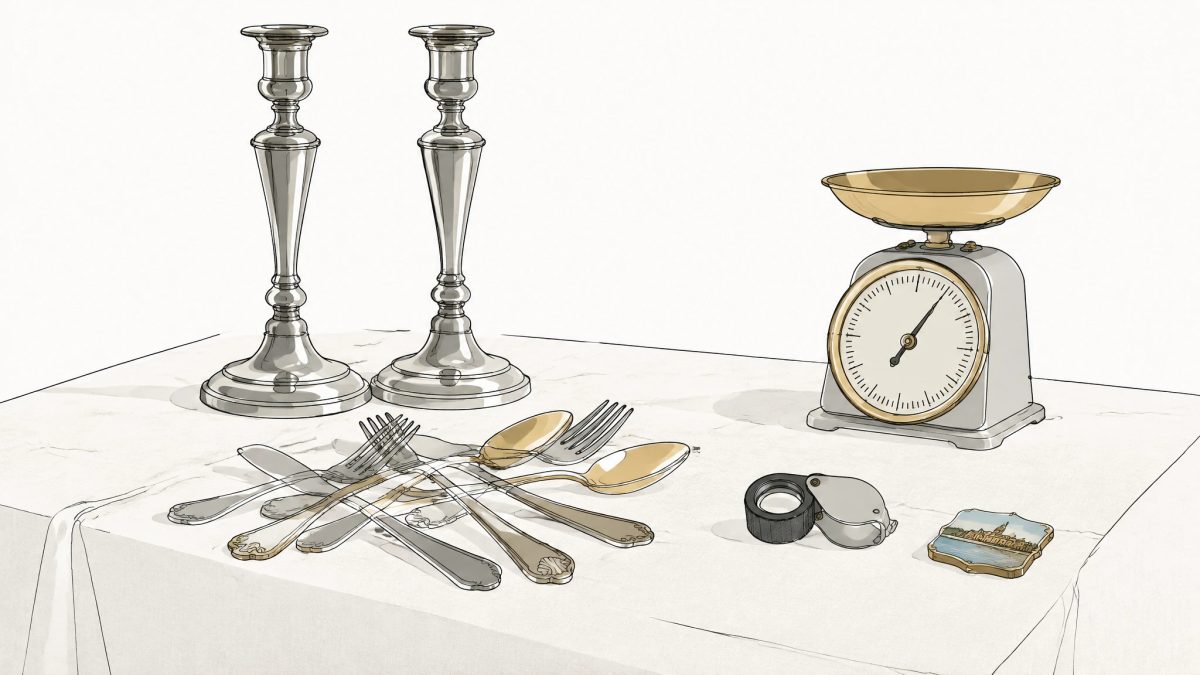
You are clearing a parent's home and you have a pair of heavy candlesticks, a cup from a flea market and a drawer of mixed forks and spoons in front of you. Before you polish, weigh or sell anything, you want to know how to tell if silver is real. The question carries money: sterling silver was worth about €1.09 a gram on 25 November 2026, so a drawer holding 1.5 kg of sterling flatware carries roughly €1,600 in metal alone, before any maker or period adds to it. If that drawer leaves your home in a house clearance lot priced as plate, you give that sum away. The marks on each piece answer the question in most cases, and a few safe checks at your kitchen table settle the rest. Then you photograph the marks and send them for a free valuation, which takes you about ten minutes; the answer reaches you within 48 working hours.
In short
- Fine silver traded at about €1.19 a gram and sterling at about €1.09 a gram on 25 November 2026; plate carries silver on its surface only and holds no comparable metal value.
- A standard mark (Sterling, 925, the lion passant, the Minerva head, 800 with a crescent and crown, Russian 84) means solid silver; EPNS, EP, EPBM, A1 or a French numbered square means plate.
- Your next step: photograph each mark and send the photos for a free valuation, about ten minutes of your time.
What your silver is worth per gram, and what plate is worth
Solid silver sells on two values: the metal, priced by the gram, and the object, priced by its maker, its date and its condition. On 25 November 2026 fine silver (999 parts per thousand) stood near €1.19 a gram and sterling (925 parts per thousand) near €1.09 a gram. Plate is a base metal body (copper, nickel silver or britannia metal) coated with a thin layer of silver, so its value rests on the object alone.
| What you hold | Silver content | Metal value per kilo of gross weight, 25 November 2026 |
|---|---|---|
| Sterling flatware, solid | 925 per thousand | about €1,090 |
| French first standard Minerva | 950 per thousand | about €1,130 |
| German or French 800 | 800 per thousand | about €950 |
| Weighted sterling candlesticks | 20 to 30% of gross weight is silver | about €220 to €330 |
| Electroplate (EPNS, EP, A1) | a surface layer only | negligible |
Decision: you hold a mixed lot, and every kilo of sterling you mistake for plate costs you about €1,090 in metal value at the 25 November 2026 price. Two routes are open to you: sort the lot yourself with the marks and the home checks below, or send photos of every mark you find and let a specialist sort it. The criterion is the marks: if each piece carries a legible standard mark, the table above prices your metal; if the marks are worn, foreign or missing, you need the specialist. Your next step: photograph the marks and send them for a free valuation, about ten minutes.
Free valuation from a photo
Send a photo. Lyna Brahami replies within 48 working hours, free and without commitment.
Drop your photos here
or
Prefer WhatsApp?
Send the photos on WhatsAppWrite to +352 661 225 970. The reply comes in the conversation.
How to tell if silver is real from its marks
A standard mark is the stamp that guarantees the silver content. Look for it first, with a 10x loupe and good light, on the back of a spoon handle, under the foot of a cup or on the rim of a candlestick base.
Marks that prove solid silver:
- Sterling or 925: at least 925 parts of silver per thousand. On American pieces the word STERLING has been the legal minimum claim since the 1906 Stamping Act, and it is the maker's own claim, since the United States has no national assay office (an independent body that tests precious metal and strikes the hallmark).
- The lion passant (a lion walking with three paws on the ground and the right forepaw raised): the British sterling mark, used by every English assay office after 1720. A full British hallmark adds a town mark (a leopard's head for London, an anchor for Birmingham), a date letter and the maker's initials.
- The Minerva head: the French guarantee mark since 1838, with a figure 1 for 950 per thousand or a figure 2 for 800 per thousand. The maker's mark beside it sits in a lozenge.
- 800 with a crescent moon and a crown: the German national mark, added in 1888 to the 1884 law that set 800 per thousand as the legal minimum.
- 84 in a Russian mark: 84 zolotniks, equal to 875 per thousand, used until 1927.
Marks that prove plate: EPNS (electroplated nickel silver), EP or EPC (electroplate, on copper for EPC), EPBM (electroplated britannia metal), A1, Triple Plate or Quadruple Plate on American pieces, and on French pieces a square or rectangle holding a figure such as 84, 90 or 100, which refers to the quantity of silver deposited. Sheffield plate, made from about 1743 by fusing a sheet of sterling onto copper, carries no silver marks at all.
How to tell if silver is real when a number misleads you
The same figure can point both ways. On a Russian piece 84 means 875 per thousand solid silver; inside a French square it means plate. A bare 925 struck by the maker, with no assay office mark beside it, is a claim you still need to check. Read your marks as a group before you sort the piece.
How to tell if silver is real at home: magnet, scale, wear and tarnish
When the marks are rubbed or absent, four checks narrow your answer without damaging anything. Run them in this order.
- The magnet. Silver is not magnetic. If a strong magnet grabs your piece, its body is steel or iron and the piece is not solid silver. A magnet that slides off proves less, because nickel silver and copper are not magnetic either.
- Weight against size. Silver has a density of 10.36 grams per cubic centimetre against about 8.7 for the nickel alloy under EPNS, so two matching teaspoons in the two metals differ by around 15% on your kitchen scale. A plated tray can still outweigh a sterling one when its walls are twice as thick, so you compare like with like.
- Wear. Look at the high points, the rims and the feet. Plate on nickel silver wears to a dull grey with a yellowish edge; plate on copper shows a pink flush, and Old Sheffield plate wears to copper. Sterling wears thin and keeps its colour.
- Tarnish. Sterling darkens evenly, from pale gold through violet blue to matte black. Green anywhere on your piece means plate.
These checks sort your pieces into likely silver and likely plate. They do not measure the silver content of a piece, and that measurement is what fixes its price.
Weighted candlesticks, filled handles and acid tests
Your heavy candlesticks are the piece most likely to mislead you. A weighted candlestick is a thin sterling shell over a core of plaster, pitch and sand or cement, closed with a felt disc or a metal plate under the base. American pieces are often stamped STERLING WEIGHTED or STERLING REINFORCED. On light mid-century American pairs, silver makes up 20 to 30% of the gross weight; on heavier Georgian or Victorian pieces, 30 to 40%. Most sterling table knives follow the same pattern: a steel blade joined to a thin sterling handle filled with cement or pitch. Their price rests on their form and their maker, because a scale reading overstates their silver three to five times.
Acid kits and touchstones read only the surface of your piece. The acid reacts with the surface, so a positive result on an unmarked piece can come from plate, because the fluid tests only the outer layer. Acid testing works on a scratch or a file cut in the metal, which leaves a mark on your piece. The Assay Office London measures fineness with non-destructive X-ray fluorescence; at LLB Auction the specialist examines every object in person before it goes to sale. Leave the acid to that examination, and do not polish or test your pieces before it.
How LLB Auction values your silver from photos
You send photographs, and LLB Auction tells you what you hold and what it can sell for.
- What you receive: a written valuation of each piece or lot, separating solid silver from plate and naming the marks the specialist reads on your photos.
- The delay: Lyna Brahami, Associate Specialist, answers each valuation request within 48 working hours.
- What it costs you: nothing. The valuation is free, confidential and without commitment. If you decide to sell, the seller's commission is agreed in your consignment contract, with an agreed reserve.
- What follows: the house photographs, researches and catalogues your silver, sells it online on llb-auction.com and on Interenchères, collects payment from the buyer and settles you with a statement. Every lot and its hammer price appear on the house's public results pages.
Photograph each mark flat and in focus, add one photograph of each whole piece and note the weight of each solid piece from your kitchen scale. You can also reach the house on WhatsApp or by phone at +352 661 225 970. If you are preparing a sale, the steps from enquiry to settlement are set out in consigning a work step by step.
Conclusion
The marks on your pieces settle most cases, and the four home checks sort the pieces whose marks are worn or missing. Whatever stays uncertain goes to the specialist, who examines each object in person without acid. You now know how to tell if silver is real; photograph your marks and send them for a free valuation, about ten minutes of your time, with an answer within 48 working hours.
Further reading:
- French silver marks country by country (in French)
- porcelain marks, glass signatures and furniture stamps
- indicative estimate or formal appraisal for your object
Sources:
- The Silver Society, Identify Your Silver, 3 February 2025
- The Goldsmiths' Company Assay Office London, FAQs, consulted November 2026
- Galerie Latrium, Les poinçons de l'argenterie française : Minerve, Vieillard, Coq, 8 September 2026
- White Metal Resources, Silver Hallmarks Guide: 925, 800, Sterling and World Marks Decoded, 12 August 2026
- White Metal Resources, Silver Candlesticks Value: The Weighted-Base Gotcha, 15 August 2026
- Antique Silver Hallmarks, EPNS vs sterling: five visible differences, 18 August 2026
- Antique Silver Hallmarks, Silver hollowware vs. flatware: identifying and valuing each, 25 July 2026
- CT Gold and Silver, Silver-Plated vs. Silver: How to Tell the Difference, 28 October 2026
- GoldPriceZ, Silver Price per Gram in Europe, 25 November 2026
Sell or buy with the house
Lyna Brahami values a work from your photos, free, within 48 working hours. The house then catalogues it, offers it in an online sale and settles you with a statement once the buyer has paid.

Associate Specialist