In this article
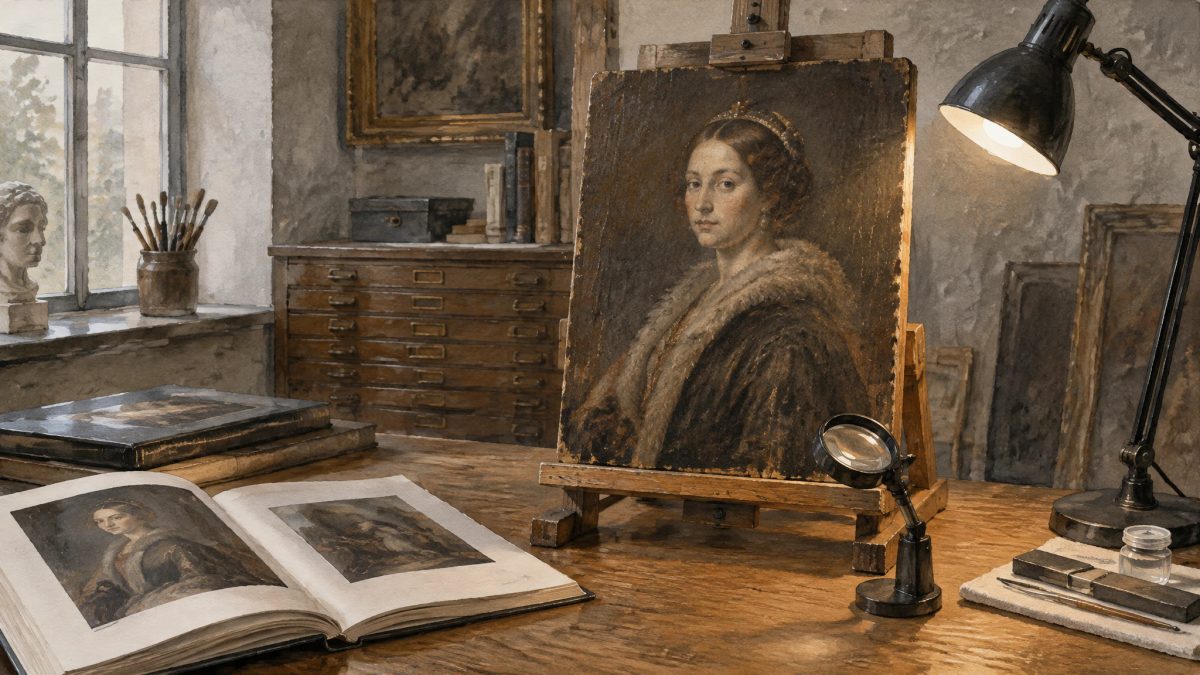
When a sold painting turned out to be valuable, the seller asks three questions in order: can the sale be undone, can the auction house or its expert be held responsible, and what should have happened before the work was consigned. The question returned to the trade press in November 2026. On 11 November a small panel catalogued as "Manner of Rembrandt van Rijn, 18th century" and estimated at £500 to £700 was hammered at £350,000 in Colchester, and on the same day a Madonna painted on obsidian, offered in Vienna as circle of Murillo at €5,000, sold for €286,000. Reports celebrate the buyers. This page takes the consignor's side. It sets out what civil law in Luxembourg and France allows a seller to claim, what English law expects of an auction house, and the checks that protect the price before a painting leaves the family.
Key takeaways:
- On 11 November 2026 a panel catalogued "Manner of Rembrandt" sold for £350,000 against a £700 high estimate, 500 times the top of the range, and a buyer's total of about £455,000.
- In Luxembourg, a seller who sold under a mistake about the substance of the work has five years from the discovery of the mistake to ask a court to annul the sale (Civil Code, articles 1110 and 1304).
- A sale catalogued with an accepted doubt, such as "attributed to", excludes a later claim for mistake on that point: the Fragonard ruling of 24 March 1987, written into the French Civil Code in 2016.
- In January 2015 the High Court in London dismissed a seller's negligence claim against Sotheby's over a painting sold for £42,000 as "follower of Caravaggio".
Two sleepers in one week of November 2026
A sleeper is a lot whose catalogue entry describes it below what informed bidders believe it to be: a modest attribution, a low estimate and a room that disagrees. Two sleepers sold on the same Wednesday, 11 November 2026, in two countries, and both carried qualified attributions that told the market the house had stopped short of a name.
The first was lot 1339 on page 74 of the catalogue of Reeman Dansie, an auction house in Colchester, Essex, during the second day of its "Royalty, Antiques & Fine Art" sale. The entry ran to three lines: a portrait of a woman in a hat and a fur-trimmed cloak, oil on panel, 56 by 40 cm, "Manner of Rembrandt van Rijn", dated to the 18th century, estimate £500 to £700. After a bidding contest of 24 minutes the hammer fell at £350,000, 500 times the high estimate. With the buyer's premium and the VAT on that premium, the buyer's bill reached about £455,000. The condition report noted widespread retouching that has discoloured, a background thinned in places, and reinforcements on the back of the panel that point to old repairs of vertical cracks. Art historians following the sale suggested the buyer is hoping the picture is by the elusive painter known only as the Master I.S., judging by the descriptive handling of the fur and the face.
The second was a Madonna and Child offered by Im Kinsky in Vienna as circle of Bartolomé Esteban Murillo. It measures 30.5 by 25 cm and is painted on obsidian, a dark volcanic glass, a support Murillo used rarely: three paintings by him on this stone are known, the Nativity in the Museum of Fine Arts, Houston, and two works in the Louvre. Estimated at €5,000, it sold for €286,000. On the day of the sale the scholar Pablo Hereza published his view that the work is by Murillo himself and matches a picture recorded in the collection of Robert Walpole, inventoried in 1752 at 30.4 by 24.3 cm, bought with that collection by Catherine II of Russia around 1779 and believed destroyed during the Second World War. Repaint visible to the naked eye explains the caution of the catalogue.
Neither sale is an isolated event. In October 2021 a small Adoration of the Magi catalogued as circle of Rembrandt sold in Amsterdam for €860,000 including fees; two years later, after X-ray and infrared examination, it reappeared in London under Rembrandt's own name and made £10.97 million. The market of 2025 explains why specialist bidders hunt in the lower estimate bands: public auction sales rose 9% to $20.7 billion and Old Master sales rose 30% to just under $1.2 billion, while lots under $50,000 fell 2% in both value and volume. A low estimate on an unattributed old panel therefore draws a concentrated audience of dealers and scholars who have done their own research.
Free valuation from a photo
Send a photo. Lyna Brahami replies within 48 working hours, free and without commitment.
Drop your photos here
or
Prefer WhatsApp?
Send the photos on WhatsAppWrite to +352 661 225 970. The reply comes in the conversation.
Why a catalogue settles on a cautious attribution
A cautious attribution is the house's written statement of what it is prepared to guarantee about authorship on the day of the sale. Every word of the heading carries a defined level of commitment, and in France those words have a legal meaning fixed by the Marcus decree (Décret n° 81-255 of 3 March 1981 on the repression of fraud in transactions in works of art and collectors' items). Its terminology drew on the cataloguing conventions of the two large English-language auction houses, which is why English and French headings form a comparable ladder.
| Catalogue wording | What the wording guarantees under the Marcus decree | Room left for a later discovery |
|---|---|---|
| Signed, or "by" the artist | The named artist is the author | None on authorship; a later doubt favours the buyer |
| "Attributed to" | Executed during the artist's working life, with serious presumptions that the artist is the probable author (article 4) | Doubt on authorship is part of the contract |
| "Workshop of" | Executed in the master's workshop or under the master's direction (article 5) | Wide: the master's own hand is left open |
| "School of" | By a pupil or a painter under the master's known influence, in the master's lifetime or within 50 years of the master's death (article 6) | Wide |
| "In the taste of", "style", "manner of", "after" | No particular guarantee of artist, date or school (article 7) | Total: the heading promises nothing about the hand |
The Colchester panel sat on the last rung. "Manner of" describes a later painter working in the style of the master, so a link to Rembrandt's own studio would first require moving the panel back into the 17th century. The house dated it to the 18th century on what it saw: discoloured retouching and a repaired panel make the hand hard to read. Dendrochronology, the dating of a wooden panel from the growth rings of its timber, would settle the first question. Rembrandt died in Amsterdam in 1669: an 18th-century panel closes the case, while 17th-century wood reopens the question of the hand.
Caution has a cost and a protection. The cost falls on the consignor, whose estimate follows the heading. The protection serves both sides: a heading that states its doubt tells every bidder that the doubt is priced in, and that statement is what later decides most claims. For a reader preparing a first consignment, the guide on how to read an auction catalogue shows how these headings sit beside the estimate and the condition report.
Sold painting turned out to be valuable: can the sale be annulled?
A sale can be annulled in civil law when the seller's consent rested on a mistake about a substantial quality of the work, and authorship is the substantial quality of a painting. The Luxembourg Civil Code keeps the original wording of article 1110: a mistake is a ground for nullity of the agreement when it bears on the very substance of the thing that is its object. Under article 1117, an agreement made by mistake gives rise to an action for nullity: the seller must ask a court, and article 1304 gives five years, counted in the case of mistake from the day the mistake was discovered. France rewrote its contract law with effect from 1 October 2016: article 1133 now states that the essential qualities are those expressly or tacitly agreed, that a mistake is a ground for nullity whether it bears on one party's performance or the other's, and that the acceptance of a risk on a quality excludes a mistake about that quality.
The Poussin case is the reference for a seller's own mistake. In February 1968 the Saint-Arroman couple sold at public auction a painting their family tradition gave to Nicolas Poussin; on the advice of the expert appointed by the auctioneer, and with their agreement, the catalogue listed it as attributed to the School of the Carracci. It was knocked down for 2,200 francs, pre-empted by the French State for the Louvre, and then exhibited as a Poussin, today known as Olympos and Marsyas.
The proceedings lasted almost two decades:
- 13 December 1972. The Paris tribunal de grande instance annulled the sale for the sellers' mistake on the substance.
- 2 February 1976. The Paris Court of Appeal reversed that judgment.
- 22 February 1978. The Cour de cassation quashed the appeal ruling, because the judges had not examined whether, at the time of the sale, the sellers' consent was vitiated by their mistaken conviction that the painting could not be by Poussin.
- 1 February 1982. The Amiens Court of Appeal again refused nullity, declining to consider evidence that arose after the sale.
- 13 December 1983. The Cour de cassation quashed that ruling: a seller may rely on evidence that appeared after the sale to prove a mistake made at the time of the sale.
- 7 January 1987. The Versailles Court of Appeal annulled the sale and ordered the painting returned against repayment of the 2,200 francs.
The painting was sold again in December 1998 for 7,400,000 francs. The case settled two principles that still govern a seller's claim: the seller, as much as the buyer, can invoke a mistake on the substance, and the proof of that mistake can come from facts that emerged later. It also confirmed that in a public auction the dispute over a mistake arises directly between the seller and the buyer.
When the doubt was part of the bargain
The Fragonard case marks the limit of the Poussin rule. In 1933 a painting called Le Verrou was sold at public auction as "attributed to Fragonard". An expert later established its authenticity and the seller's heirs asked for the sale to be annulled. Their claim failed at first instance, on appeal and before the Cour de cassation on 24 March 1987: by selling a work "attributed to" Fragonard, the seller knew authorship was doubtful, the buyer shared that knowledge, and the risk on authenticity had entered the contract. Neither party could invoke a mistake once the doubt cleared. Article 1133 of the French Civil Code has stated the rule since 1 October 2016: accepting a risk on a quality excludes a mistake about that quality.
For a seller whose sold painting turned out to be valuable, the wording of the catalogue therefore decides most of the outcome. A painting the seller believed could not be by a great master, sold under a heading that excluded the master, sits on the Poussin side. A painting sold under "attributed to", "circle of" or "manner of", where the doubt was written into the sale, sits on the Fragonard side, and a claim for mistake meets the accepted risk.
Can a seller hold the auction house responsible?
A seller who cannot undo the sale can still sue the house for the price lost, and the test is reasonable professional care at the time, judged without hindsight. The English case Thwaytes v Sotheby's ([2015] EWHC 36 (Ch)) sets out how a court applies that test to an attribution.
Lancelot Thwaytes inherited a version of The Cardsharps, the composition by Michelangelo Merisi da Caravaggio whose autograph original hangs in the Kimbell Art Museum in Fort Worth, Texas. In 2006 he entrusted it to Sotheby's, which catalogued it as by a follower of Caravaggio and sold it on 5 December 2006 for a hammer price of £42,000 plus buyer's commission. The buyer acted at least in part for Sir Denis Mahon, a Caravaggio scholar and collector, who had the painting cleaned and restored and in November 2007 announced it as an autograph replica by Caravaggio himself. Mr Thwaytes sued Sotheby's in negligence and for breach of contract, arguing that its specialists had missed features showing "Caravaggio potential". He did not assert that the painting was by Caravaggio.
After a trial heard over 17 days in October and November 2014, Mrs Justice Rose gave judgment on 16 January 2015 and dismissed the claim. Her findings set a usable standard for any consignor. The house was entitled to rely on the connoisseurship of its specialists; those specialists, in her words, "reasonably came to the view on the basis of what they saw that the quality of the Painting was not sufficiently high to indicate that it might be by Caravaggio"; nothing in the X-rays should have made them doubt that view; and Sotheby's was under no obligation to carry out infrared analysis or to advise the owner to arrange it.
French case law reaches a similar place by another route. In a public auction, a dispute over a mistake on the substance arises directly between the seller and the buyer, so a claim against the house or its expert rests on proof of a fault of their own. A cautious heading that reflects what a careful specialist could see at the time leaves little room for such proof.
| Case | Catalogue wording at sale | Price at sale | Later reading | Outcome for the seller |
|---|---|---|---|---|
| Poussin, France, 1968 | Attributed to the School of the Carracci | 2,200 francs | Exhibited at the Louvre as Poussin | Sale annulled in 1987; painting resold for 7,400,000 francs in 1998 |
| Le Verrou, France, 1933 | Attributed to Fragonard | Not stated in the ruling summaries | Declared authentic by an expert | Claim rejected in 1987: the doubt was accepted |
| The Cardsharps, London, 2006 | Follower of Caravaggio | £42,000 hammer | Announced as autograph in 2007 | Negligence claim dismissed in 2015 |
| Colchester, 2026 | Manner of Rembrandt, 18th century | £350,000 hammer on a £500 to £700 estimate | Buyers' hypothesis of the Master I.S. | No claim reported; the bidding priced the discovery |
| Vienna, 2026 | Circle of Murillo | €286,000 on a €5,000 estimate | Identified by Pablo Hereza as Murillo | No claim reported; the bidding priced the discovery |
The two sales of 2026 differ from the older cases in one respect: the open market did the research during the auction. When 24 minutes of bidding carry a lot to 500 times its estimate, the seller receives most of the value the room sees in it, minus commission, and the question of a lost fortune applies to a far smaller gap.
Before consigning: the checks that set a fair estimate
The cheapest protection against a sleeper is research before the consignment contract is signed. A seller cannot buy certainty, and the Thwaytes judgment confirms that even a large house owes reasonable care and need not commission every available test. The checks below narrow the doubt that the catalogue heading will have to state:
- Gather the family record. Bills of sale, inventories after death, insurance schedules, letters and old photographs of the room where the painting hung are the first provenance documents, and the Poussin case began with a family tradition the catalogue overruled.
- Photograph the back. Labels, stamps, inventory numbers, the type of stretcher or panel and old repairs date and place a painting; the Colchester condition report recorded reinforcements on the verso that tell a specialist about the age of the panel.
- Ask for a written attribution and estimate. A free auction estimate from photographs is an indicative opinion; a formal appraisal is a paid, signed document. The difference between a free art appraisal and a paid formal appraisal matters when the stakes rise.
- Seek a second opinion on any open name. When a specialist hesitates between a master and a follower, the opinion of the scholar who compiles the artist's catalogue raisonné carries the most weight; Pablo Hereza's reading of the Vienna Murillo shows the role one scholar plays.
- Commission technical examination where it can answer a question. Dendrochronology dates a panel, X-radiography shows changes of composition beneath the surface, and infrared reflectography reveals underdrawing; the Rembrandt Adoration sold in 2021 regained its name after X-ray and infrared study.
- Agree the reserve with the attribution in mind. The reserve, the confidential minimum price below which the lot is not sold, is fixed in the consignment contract; a seller who believes in a higher attribution can set it accordingly and accept the risk of the work going unsold.
- Read the heading before the catalogue goes live. The seller agrees the catalogue description; in the Poussin case the sellers had accepted the Carracci attribution, and in the Fragonard case the "attributed to" wording defined the bargain.
Each check adds time and, for technical analysis, cost. Their value is highest for old paintings on panel or copper, works with a family attribution to a known name, and pictures obscured by old varnish or repaint, the three features shared by the 2026 sleepers. The step-by-step guide to consign art places these checks within the full path from enquiry to settlement.
When research comes before the sale: the Altdorfer case
Research before consignment can move an estimate from hundreds of pounds to millions. On 9 December 2026 Sotheby's London offers, in its Old Masters Evening Sale, a landscape by Albrecht Altdorfer, the German Renaissance painter born in Regensburg in 1480 and regarded as one of the first landscape artists. The picture, a thickly wooded landscape with a rainbow beneath a cloud-laden sky painted around 1520, is signed, painted on parchment later glued to a panel, and estimated at £3 million to £5 million.
It surfaced in a Swiss private collection. The current owner inherited it from his father, who bought it in 1957 from the collection of the House of Harrach, an Austrian noble family. Altdorfer scholars did not know the picture, and it is absent from the artist's catalogue raisonné. It is one of three known oil landscapes by Altdorfer; the other two belong to the Alte Pinakothek in Munich and the National Gallery in London.
The family consigned a work whose attribution had been researched and stated before the sale, and the estimate reflects that work. George Gordon, chairman of Sotheby's Worldwide Old Masters Department, described the addition as "one of the most exciting discoveries imaginable in our field", and added on price: "We don't really know what it's worth because it's many decades since an Altdorfer last came to the market." No Altdorfer has been offered since 1980, when the National Gallery paid a reported £2.4 million for Christ Taking Leave of His Mother. The contrast with Colchester is the lesson for an heir: the same uncertainty about value exists in both sales, and the research done before consignment decides who captures it.
FAQ: sold painting turned out to be valuable
A sold painting turned out to be valuable: how long does the seller have to act?
In Luxembourg, article 1304 of the Civil Code gives five years to bring an action to annul an agreement, and for a mistake the period runs from the day the mistake was discovered. Under article 1117, a sale made by mistake is not void by itself: the seller must ask a court to annul it. The clock starts when the seller learns of the new attribution, so the date of a published scholarly opinion or a resale matters as evidence.
Does an "attributed to" or "manner of" heading stop a claim?
Under French law it does for authorship. The Marcus decree of 3 March 1981 gives "manner of" no guarantee of artist, date or school, and the Cour de cassation ruled on 24 March 1987 that a sale "attributed to Fragonard" brought the doubt on authenticity into the contract. Article 1133 has stated since 2016 that accepting a risk on a quality excludes a mistake about it. A seller whose catalogue excluded the master, as in the Poussin case, stands in a different position.
Can the auction house be held liable for a missed attribution?
Only for a fault. In Thwaytes v Sotheby's the High Court ruled on 16 January 2015 that Sotheby's specialists reasonably assessed a painting sold for £42,000 as by a follower of Caravaggio and owed no duty to commission infrared analysis. In French public auctions, a dispute over a mistake arises between seller and buyer, and a claim against the house or its expert needs proof of their own fault. A cautious heading supported by a careful examination gives little hold to such a claim.
What should an heir do before selling an unsigned old painting?
Gather the family documents, photograph the front and the back, and ask for a written estimate that names the attribution and explains it. Where the specialist hesitates between a master and a follower, seek the opinion of the author of the catalogue raisonné and consider dendrochronology or infrared imaging. Agree the reserve in the consignment contract with that attribution in mind, then read the catalogue heading before it is published.
Does a huge hammer price prove the painting is by the master?
No. A hammer price records the conviction of two bidders on one day. The Colchester panel sold for £350,000 on the hope of the Master I.S., and the Vienna Madonna sold for €286,000 on a scholar's identification; both attributions still await examination and, for the Murillo, restoration. Le Verrou, declared authentic after 1933, has since returned to "attributed to" Fragonard in the opinion of other experts.
How LLB Auction handles an old painting before it goes to sale
LLB Auction is a full service auction house at 29 rue du Fort Elisabeth in Luxembourg, and an owner deals with the house from the first photograph to the payment. For an old painting whose attribution is open, three steps of that path matter most.
Valuation from photographs. Lyna Brahami, Associate Specialist, answers each valuation request within 48 working hours. The valuation is free, confidential and without commitment, and the photographs of the back of the painting belong in the first message alongside the front.
Examination and cataloguing. The specialist examines every object in person before it goes to sale, and the house carries out the photography, research and cataloguing of each lot. The consignment contract records the reserve and the commission agreed with the seller.
Sale and published result. Sales are held online on llb-auction.com and listed on Interenchères. After payment by the buyer to the house, the seller is settled with a statement, and each sale has a public results page, gathered at llb-auction.com/results, listing each lot offered and the hammer price of each lot sold.
Owners can send photographs through the expertise page or reach the house on WhatsApp and by phone at +352 661 225 970. The guide on how to sell art at auction describes the full path.
Conclusion
The sleepers of November 2026 show the market working at speed: two qualified headings, two low estimates, and rooms that paid 57 and 500 times the top of the range within a day. For the consignor, the law gives a narrow door. Civil law in Luxembourg and France annuls a sale when the seller's consent rested on a mistake about authorship, as the Poussin case established between 1972 and 1987, but the Fragonard ruling closes that door once the doubt was written into the sale. English law asks whether the house took reasonable care, and Thwaytes v Sotheby's shows how high that bar sits.
The practical answer lies before the hammer. Family documents, photographs of the back, a written attribution, a second opinion where a name is open, targeted technical examination and a reserve agreed with care all narrow the gap between what a catalogue states and what a painting may be. An owner who fears that a sold painting turned out to be valuable after the sale gains most by doing that research first, as the Altdorfer family did.
Also worth reading:
- How to sell art at auction
- A free art appraisal against a paid formal appraisal
- How to consign art, step by step
- How to read an auction catalogue
Sources:
- Master I.S. Sleeper (?) : Art History News, 11 November 2026
- Old Master sleeper awakens in Colchester auction : Antiques Trade Gazette, 12 November 2026
- La dama «alla maniera di Rembrandt» stimata 700 sterline e battuta a 350mila : Il Giornale dell'Arte, 12 November 2026
- It went up for auction at 5,000 euros and sold for 286,000: Has Catherine II's Murillo resurfaced in Vienna? : Finestre sull'Arte, 16 November 2026
- Rare Altdorfer landscape previously unknown to scholars to be auctioned next month : The Art Newspaper, 5 November 2026
- The Art Basel and UBS Global Art Market Report 2026 : Art Basel and UBS, Arts Economics, March 2026
- Thwaytes v Sotheby's, [2015] EWHC 36 (Ch) : High Court of Justice, Chancery Division, 16 January 2015
- Thwaytes v Sotheby's : Boodle Hatfield, 2015
- Marché de l'art : les chances de la France, rapport d'information n° 330 : Sénat, 1999
- Arrêt du 24 mars 1987, affaire dite du Verrou de Fragonard : Cour de cassation, première chambre civile, 24 March 1987
- Décret n° 81-255 du 3 mars 1981 : Légifrance, 3 March 1981
- L'authenticité des œuvres d'art : le décret Marcus, un texte fondamental du marché de l'art : Interenchères magazine, 7 January 2019
- Réforme du droit des contrats, les vices du consentement : Université Paris 1 Panthéon-Sorbonne, IEJ, 30 May 2016
- Code civil, article 1110 : Legilux, consolidated version of 1 January 2020
- Loi du 11 août 1982, article 1304 du Code civil : Legilux, 11 August 1982
Sell or buy with the house
Lyna Brahami values a work from your photos, free, within 48 working hours. The house then catalogues it, offers it in an online sale and settles you with a statement once the buyer has paid.

Associate Specialist