In this article
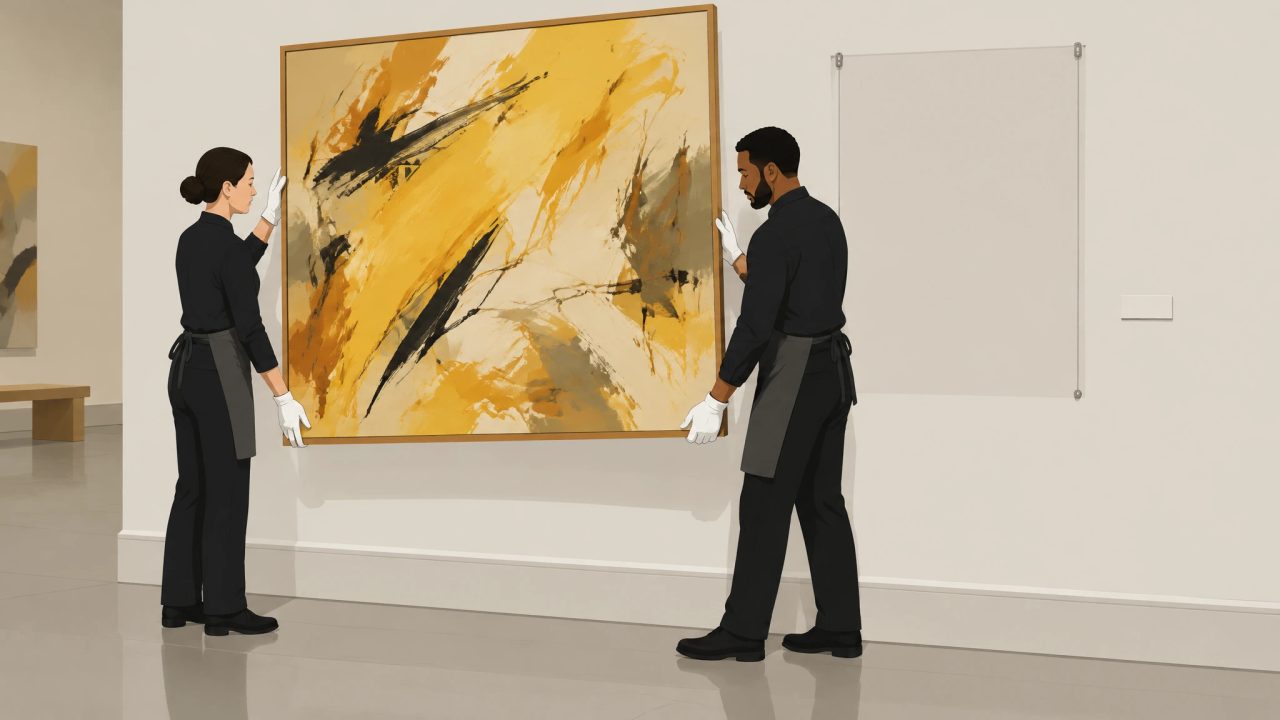
On 17 November 2026, Willem de Kooning's Yellow River (1958) crosses the block at Christie's in New York with an estimate of $12 million to $18 million, consigned by the Whitney Museum of American Art. It is the latest case of museum deaccessioning, the formal process by which a museum removes a work from its permanent collection and, in many cases, sells it. For a collector, museum deaccessioning raises three practical questions: which rules allowed the sale, what the money may pay for, and how much weight a museum provenance carries once the work is back on the market. The answers differ sharply between New York, Paris and London, and they shape what a bidder reads in a catalogue entry whose provenance ends with a museum's name.
Key takeaways:
- Yellow River (1958) by Willem de Kooning is offered at Christie's New York on 17 November 2026 at $12 million to $18 million, three years after it entered the Whitney as a gift.
- Since 30 September 2022, members of the Association of Art Museum Directors may spend deaccession proceeds only on acquisitions or on direct care, defined as the direct costs of storing and preserving works of art; staff salaries and exhibition costs are excluded.
- In France, works held by a musée de France owned by a public person are inalienable under article L451-5 of the Code du patrimoine, and works received by gift or bequest can never be declassified (article L451-7).
- In the United Kingdom, the Museums Association Code of Ethics asks museums to refuse disposal principally for financial reasons except in exceptional circumstances.
- In 2026, 23% of 3,100 high net worth collectors surveyed across ten markets planned to donate works to museums within twelve months.
Yellow River and the Whitney: the museum deaccessioning sale of 17 November 2026
The Whitney Museum of American Art consigned Yellow River to Christie's 20th century evening sale in New York on 17 November 2026, and designated the proceeds to benefit its collection. The painting belongs to the abstract landscapes de Kooning painted after long drives out of New York; it hung in his third exhibition at Sidney Janis Gallery in 1959, where visitors queued from 8:15 in the morning and 19 of the 22 paintings on offer had sold by noon. The estimate of $12 million to $18 million sits well below the artist's auction record of $68.9 million, set in 2018 at Christie's New York by Woman as Landscape (1954 to 1955), and above the $12.9 million paid at Sotheby's London in October 2026 for an untitled canvas of 1977, the highest price for de Kooning at a European auction.
The provenance of the work explains why this museum deaccessioning drew attention within hours of its announcement. Yellow River belonged to David M. Solinger, a lawyer and collector who in 1966 became the first president of the Whitney from outside its founding family. After the death of his widow, Betty Ann Besch Solinger, in 2022, Sotheby's sold 23 works from the couple's collection that autumn. Yellow River arrived at the Whitney in 2023, twelve years after it was promised to the museum, and it leaves the collection three years later.
The museum framed the decision as routine collection management. A Whitney representative stated: "Deaccessioning is an established practice in responsible collections stewardship and a component of the Whitney's collections strategic plan, allowing the museum to thoughtfully evaluate and refine its holdings in support of its long-term collection priorities." The Whitney keeps six large oil paintings by de Kooning, including a Woman of the early 1950s and a return to the subject from the mid 1960s; only Door to the River (1960), from the same period as Yellow River, is currently on view.
The sale is the Whitney's second visible museum deaccessioning round in three years. In May 2023 the museum sent four works by Edward Hopper to Sotheby's New York, led by Cobb's Barns, South Truro (1930 to 1933), estimated at $8 million to $12 million, alongside works by John Marin and Maurice Prendergast. That earlier round, its first in five years, was described by the museum as a sale of works "duplicative within the collection", and it reopened a debate about the Hopper bequest that dates back to 1971.
For a reader of the market, the Yellow River consignment illustrates the three variables that every museum deaccessioning case turns on: the reason the institution gives, the rule that governs the use of the money, and the way the market prices a work whose label once read "Collection of the Whitney Museum of American Art". The sections below take each in turn, starting with the reasons.
Own a work by Andy Warhol?
Send a photo. Lyna Brahami replies within 48 working hours, free and without commitment.
Drop your photos here
or
Prefer WhatsApp?
Send the photos on WhatsAppWrite to +352 661 225 970. The reply comes in the conversation.
What is deaccessioning, and why do museums sell art?
Deaccessioning is the permanent removal of an object from a museum's accessioned collection by a decision of its governing body, followed by disposal, the physical transfer of the object by sale, exchange, gift to another institution or, for damaged material, destruction. The two steps are distinct: a museum can deaccession a work and transfer it to another museum without any sale at all. The auction is only the most visible form of disposal, and the one that brings a museum deaccessioning case into the market.
Museums give a small number of recurring reasons. The professional practices of the Association of Art Museum Directors (AAMD, the professional association of art museum directors in North America) ask staff to document four elements before a board votes: the prior ownership history of the work, any intent the donor expressed, current scholarly evaluation, and the relevance of the work to the existing collection. In practice the stated reasons fall into a short list:
- Duplication. The museum holds several comparable works by the same artist, from the same period, in the same medium, and judges one of them surplus.
- Fit with the mission. The work falls outside the collecting policy the museum has adopted, for example a European picture in a museum refocused on American art.
- Quality and attribution. Research has downgraded the work, or a better example has entered the collection.
- Condition. The object is damaged beyond reasonable conservation, or cannot be stored safely.
- Title. The work was stolen or unlawfully removed, and restitution to a claimant ends the museum's ownership.
- Funding for the collection. The sale raises money for new acquisitions or, since 2022 in the United States, for the direct care of the remaining works.
The sixth reason is the one that turns museum deaccessioning into a market event and a public controversy. A museum that sells a minor duplicate to buy a missing work by another artist is reshaping its collection. A museum that sells a major painting to pay salaries is converting its collection into operating income, a use that the professional codes of the United States, the United Kingdom and France all refuse, each in its own legal language.
Museum deaccessioning also differs from the sale of a private collection in one structural respect: the seller is a public trust. A museum's collection is held for the public, often built from gifts that donors made in the expectation that the works would stay. Every museum deaccessioning decision therefore answers to three audiences at once: the donors and their heirs, the professional associations that grant loans and accreditation, and the public that funds the museum through tax exemptions and grants.
The American rulebook: AAMD, AAM and the direct care definition
American museums sell more works than their European peers because American law treats most museum collections as the private property of nonprofit corporations, and the binding limits come from professional codes and accounting standards. Two associations write those codes. The AAMD governs the directors of art museums; the American Alliance of Museums (AAM, the association that accredits museums of all disciplines in the United States) governs accredited institutions more broadly. A museum deaccessioning sale that breaches either code exposes the institution to professional sanctions.
The current AAMD rule dates from 30 September 2022. Section 25 of its Professional Practices in Art Museums states that funds received from the disposal of a deaccessioned work, "including any earnings and appreciation thereon, may be used only for the acquisition of works of art in a manner consistent with the museum's policy on the use of restricted acquisition funds or for direct care of works of art." Direct care means "the direct costs associated with the storage or preservation of works of art": conservation and restoration treatments, including packing and transport for that work, and storage materials such as acid-free paper, folders, matboard, frames, mounts and digital media migration. The same section excludes "salaries of staff" and "costs incurred for the sole purpose of temporary exhibition display."
The 2022 wording closed a two year experiment. In April 2020, at the start of the pandemic, the AAMD passed temporary resolutions that allowed museums to spend deaccession proceeds on direct care without defining the term, which opened the door to wider uses. Those resolutions expired in April 2022, and the September 2022 vote replaced them with the narrow, permanent definition above. Rod Bigelow, chair of the AAMD deaccessioning task force and director of the Crystal Bridges Museum of American Art, summarised the intent in 2022: "this change is the ceiling, not the floor."
The AAM reached a similar position by a different path. The phrase "direct care of collections" has appeared in the AAM Code of Ethics for Museums since 1993, and the Alliance published a white paper on its meaning in 2016, updated in 2019 after the Financial Accounting Standards Board (FASB, the body that sets accounting standards for American nonprofits) revised its rules. The FASB standard now requires a collection-holding nonprofit to disclose its policy on the use of deaccession proceeds, and its definition of direct care when it allows that use. The accounting disclosure gives a bidder or a journalist a document to check against any museum deaccessioning announcement.
Sanctions give the codes their force. An AAMD member who breaches the deaccessioning policy faces reprimand, suspension or expulsion from the association, and the museum itself is exposed to censure or sanctions. The AAMD also recommends that deaccession proceeds, with their earnings, be tracked separately from other acquisition funds, so that their use can be accounted for year after year.
Baltimore 2020: the sale that was stopped hours before the auction
The clearest test of the American rules came in October 2020, and it remains the reference case for museum deaccessioning in the United States. The Baltimore Museum of Art announced that it would sell three works through Sotheby's to raise $65 million: Andy Warhol's The Last Supper (1986), offered privately at around $40 million; Brice Marden's 3 (1987 to 1988), estimated at $10 million to $15 million; and Clyfford Still's 1957-G (1957), estimated at $12 million to $18 million. About $54.5 million was to fund an endowment for the care of the collection, staff pay and longer opening hours, and about $10 million was to go to acquisitions.
The plan relied on the April 2020 pandemic resolutions, and it collapsed on the day of the sale. More than 200 supporters of the museum, former trustees among them, wrote to the Maryland attorney general to block it; two former board chairmen said they were rescinding $50 million in pledged gifts; fifteen former AAMD presidents urged the board to reconsider. Critics pointed out that the Still had come to the museum in 1969 as a gift from the artist and was his only canvas there, and that the Marden was likewise the only painting by its artist in the collection. On 28 October 2020, hours before the Still and the Marden were due to be offered at Sotheby's in New York, the museum withdrew all three works.
Brent Benjamin, then president of the AAMD, drew the line in a statement the same evening: "art collections should not be monetised except in very narrow and limited circumstances." The Baltimore case shows a collector where the limit sits in practice. Selling a work to buy another is accepted; selling a work to fund salaries, programmes or an endowment for general purposes triggers a reaction from donors, peers and regulators strong enough to stop a sale already catalogued.
France and the United Kingdom: inalienability against disposal
European rules start from the opposite principle. Where American codes regulate how museums sell, French law forbids public museums to sell at all, and British guidance treats a sale for money as an exception that has to be justified case by case. For a collector based in Luxembourg, Belgium or France, these rules explain why a deaccessioned work from a European public museum reaches the market so rarely, and why each American museum deaccessioning sale draws European comment.
Museum deaccessioning in France: why public collections cannot be sold
French public collections are protected by the principle of inalienability, the rule that property belonging to the public domain cannot be sold. Article L451-5 of the Code du patrimoine (the French Heritage Code) states that the works forming the collections of the musées de France (the label given to museums whose collections are recognised by the State) that belong to a public person "font partie de leur domaine public et sont, à ce titre, inaliénables": they form part of the public domain and are, for that reason, inalienable. A public museum can sell a work only after it has been declassified (removed from the public domain), and since 9 December 2020 any declassification requires the binding opinion of the Haut Conseil des musées de France, under the version of the article amended by Law no. 2020-1525 of 7 December 2020.
Two further provisions close most of the remaining doors. Article L451-7 states that works incorporated into public collections by gift or bequest, and works acquired with State aid for collections that do not belong to the State, cannot be declassified at all. Article L451-6 adds a right of first refusal: when the owner of a musée de France collection other than the State sells a declassified work, it notifies the administrative authority of its asking price, and the State has two months to decide whether to buy it. In practice, a work given to a French public museum stays there, and museum deaccessioning by sale remains a rare event in France.
French law also reaches beyond museums. In October 2026, commentators in the art press questioned a proposed bill that would increase the State's powers over privately owned works designated as national treasures, cultural property of major heritage interest whose export the State can refuse. The debate concerns private owners and leaves public collections untouched. For collectors, it shows that the French discussion turns on how far the State's hold over heritage objects should reach.
The United Kingdom: financially motivated disposal as an exception
The United Kingdom sits between the two models. Most British museums can legally dispose of works, subject to their founding statutes and trust deeds, and the professional limits come from the Museums Association (MA, the professional body for museums and their staff in the United Kingdom). Paragraph 6.13 of its Code of Ethics, reproduced in the MA Disposal Toolkit of 2014, asks museums to "refuse to undertake disposal principally for financial reasons, except in exceptional circumstances as defined in 6.14", because financially motivated disposal "risks damaging public confidence in museums and the principle that collections should not normally be regarded as financially-negotiable assets."
The toolkit defines financially motivated disposal as a "sale of collections where a primary reason for disposal is to raise funds." A museum deaccessioning proposal of this kind requires a report showing how the sale meets the Code of Ethics and the requirements of museum accreditation, and paragraph 6.14 allows it only in exceptional circumstances. The report goes to the MA and to the body that assesses museum accreditation, which ties the decision to the museum's accredited status. The money raised must benefit the collection.
The table below sets the three regimes side by side for the questions a collector asks.
| Question | United States (AAMD and AAM) | France (Code du patrimoine) | United Kingdom (Museums Association) |
|---|---|---|---|
| May a museum sell a work? | Yes, by board decision under its own policy | Only after declassification, with the binding opinion of the Haut Conseil des musées de France | Yes, subject to statutes, trust deeds and the Code of Ethics |
| Works received by gift or bequest | Saleable, subject to any restriction in the deed of gift | Never declassified (article L451-7) | Saleable, subject to the terms of the gift |
| Permitted use of proceeds | Acquisitions or direct care since 30 September 2022 | Not applicable in practice | For the benefit of the collection |
| Sale principally to raise funds | Accepted for acquisitions and direct care | Not permitted for public collections | Exceptional circumstances only (paragraphs 6.13 and 6.14) |
| Control of the decision | AAMD and AAM codes: censure or sanctions, reprimand, suspension or expulsion of the director | Binding opinion of the Haut Conseil des musées de France; State right of first refusal (article L451-6) | Report to the MA and the accreditation body |
Reading a museum deaccessioning lot as a bidder
A museum deaccessioning lot arrives with the strongest provenance line a work can carry, and that line still has to be read with care. Decades of institutional ownership mean a documented exhibition history, a conservation file, published scholarship and a credit line that every catalogue repeats. None of these elements settles authenticity or condition on its own, and none fixes a price. A collector who sets a ceiling on a deaccessioned work checks the same points as for any other lot, with seven additions specific to museum sales:
- The stated reason. Read the museum's announcement and its collection management policy. "Duplicative within the collection", "outside the collecting mission" and "to benefit the acquisitions fund" describe three different situations, and the first invites the question of which comparable works the museum chose to keep.
- The credit line. Read how the catalogue words the museum's credit line and the stated use of the proceeds, then compare it with the museum's published policy on proceeds. The museum line stays in the provenance of the work in every later sale.
- The deed of gift. When the work entered as a gift, check whether the deed restricted its sale. A breached restriction gives heirs grounds to contest the sale, and the Baltimore case shows how quickly opposition to a museum sale reaches a state attorney general.
- The exhibition and loan history. Museum ownership usually means loans, catalogues and published references. List them, because they support the attribution and they explain part of the price a work achieves.
- The condition and conservation file. Ask whether the museum's conservation record is available through the auction house. A work kept in museum storage for decades can still carry old restorations that the condition report has to describe.
- Title and restitution. A museum provenance does not erase an earlier gap. A work that entered a collection in the 1950s can still carry an ownership history from the 1930s and 1940s that needs research, as any work with a European history of that period does.
- The price signal. Museum deaccessioning brings works to market that collectors have seen on museum walls, which draws bidders, and it also tells the market that a leading institution judged the work surplus. The estimate reflects both.
Worked reading: two Whitney consignments ten years apart
The Whitney's own history with the Hopper bequest shows that a museum provenance does not guarantee a sale. Josephine Hopper left more than 3,000 works by her husband to the Whitney on her death in 1968, the largest holding of Edward Hopper's work in the world; Hoppers account for around 10% of all the works the museum holds. In 1971 the critic Hilton Kramer described what the museum itself called "the most important bequest of an American artist's work to a museum" as "a kind of fundraising project."
In 2013 the Whitney consigned Hopper's watercolour Church in Eastham (1948) to Sotheby's with an estimate of $2 million to $3 million. It failed to sell. Offered again in 2016 with an estimate of $600,000 to $800,000, it failed a second time and was bought in. The work carried the same museum provenance on both occasions; what changed was the estimate, and the market declined both times.
Ten years later, the 2023 round gave a different reading. The museum offered Cobb's Barns, South Truro, an oil of 1930 to 1933 that had hung in the Oval Office during the presidency of Barack Obama, with three Hopper watercolours estimated at $500,000 to $700,000 each. Kayla Carlsen, head of American Art at Sotheby's, said of the oil: "Cobb's Barn is from his prime period. It will certainly raise attention in the market." Its exhibition history included the White House and a survey of Hopper's landscapes at the Fondation Beyeler in Basel. The lesson for a bidder in a museum deaccessioning sale is practical: the museum provenance raises interest, and the quality, period and exhibition history of the individual work set the price.
Giving a work to a museum: what a donor can secure
The donor's side of museum deaccessioning matters to more collectors than the bidder's. In 2026, 23% of 3,100 high net worth collectors surveyed across ten markets planned to donate works to museums in the coming year; the share planning gifts to museums or charities reached 30% in the United States and 27% in France. Family remains a common route into collecting: 28% of collectors named it as their main entry point, and 40% of Gen Z collectors did. Almost 90% of Gen Z collectors who inherited works kept them, which means many of those works will one day face the same choice between keeping, selling and giving.
The legal outcome of a gift, and the risk of a later museum deaccessioning, depend first on the country of the museum. A work given to a French public museum that holds the musée de France label falls under article L451-7 and can never be declassified, which gives the donor the strongest guarantee available in Europe. A work given to an American museum belongs to a private nonprofit that can deaccession it under its own policy, unless the deed of gift says otherwise. A work given to a British museum falls between the two, governed by the terms of the gift, the museum's statutes and the Museums Association Code of Ethics.
A donor who wants a gift to stay can negotiate four points before signing, and each one belongs in the written deed:
- A restriction on sale. The deed states that the work may not be sold, or may not be sold during the donor's lifetime or for a fixed number of years.
- A right of return. If the museum decides to deaccession, the work returns to the donor or the heirs, or passes to a named institution.
- A credit line. If the work is sold, the proceeds fund acquisitions credited to the donor's name.
- Notification. The museum undertakes to inform the donor or the heirs before any museum deaccessioning vote concerning the work.
The Art Institute of Chicago, for example, states in its deaccession policy that it will abide by a restriction in a gift agreement or will "to the extent it is reasonably able to do so consistent with applicable law." The Yellow River case shows why the point matters: the Solinger family promised the painting in 2011, the museum received it in 2023, and the work is offered at auction in 2026. For an owner weighing a bequest, the deed of gift is the document that decides whether a work stays on a museum wall or returns to the saleroom.
FAQ: museum deaccessioning
What does museum deaccessioning mean?
Museum deaccessioning is the formal removal of a work from a museum's permanent collection by decision of its governing body, followed by disposal through sale, exchange, transfer to another institution or, for damaged objects, destruction. In the United States, AAMD members document the ownership history, donor intent, scholarly evaluation and relevance of the work before the board votes. A sale at auction is the most visible form of disposal and the one collectors meet in catalogues.
Why do museums sell art at auction?
Museums sell works they judge duplicative, outside their collecting mission, downgraded by research or too damaged to keep, and they sell to fund the collection. Since 30 September 2022, AAMD members may spend the proceeds only on acquisitions or on direct care, meaning the direct costs of storing and preserving works of art. The Whitney's consignment of Yellow River to Christie's on 17 November 2026 is designated to benefit its collection.
Can a French public museum sell a work from its collection?
Only in narrow cases. Article L451-5 of the Code du patrimoine makes the collections of musées de France owned by a public person inalienable, and a sale requires prior declassification with the binding opinion of the Haut Conseil des musées de France. Article L451-7 bars the declassification of any work received by gift or bequest. The American practice of selling to fund acquisitions has no equivalent in French public museums.
Does a museum provenance guarantee the authenticity or value of a lot?
A museum provenance documents ownership, exhibitions and scholarship, and it supports an attribution; it does not replace the condition report, the provenance research for earlier periods, or the buyer's own checks. Its effect on price varies: the Whitney's Hopper watercolour Church in Eastham (1948) failed to sell at Sotheby's in 2013 at $2 million to $3 million and again in 2016 at $600,000 to $800,000.
What happens to the money from a museum deaccessioning sale?
In the United States, AAMD members must restrict the proceeds, and any earnings on them, to acquisitions or to direct care, and must not use them for operations, staff salaries or temporary exhibitions. Under FASB standards, a collection-holding nonprofit discloses its policy on proceeds. In the United Kingdom, the Museums Association asks that the money benefit the collection and accepts sales principally for funds only in exceptional circumstances.
Can a donor stop a museum from selling a gift?
A donor can restrict the sale in the deed of gift, add a right of return to the donor or heirs, or require notification before any vote. American museums such as the Art Institute of Chicago state in their policies that they abide by restrictions in a gift agreement or will to the extent the law allows. In France, gifts and bequests to public museums can never be declassified under article L451-7.
How LLB Auction supports collectors and owners
LLB Auction is a full service auction house for fine art and collectibles at 29 rue du Fort Elisabeth in Luxembourg, selling online on llb-auction.com with sales listed on Interenchères. Collectors who follow museum deaccessioning sales in New York and owners who weigh a gift, a bequest or a sale meet the same questions at the house: what the work is, what its history shows, and what it is likely to fetch.
Free valuation from photographs. Lyna Brahami, Associate Specialist, answers each valuation request within 48 working hours. The valuation is free, confidential and without commitment, and every category of fine art and collectibles is accepted, from modern and contemporary paintings and works on paper to sculpture, prints, design, jewellery, silver and pop culture.
Examination before every sale. The specialist examines every object in person before it goes to sale, and the house handles photography, research and cataloguing. For an owner deciding between a museum gift and a consignment, this examination sets out what the work carries: signature, provenance, condition and comparable results.
A published record. Each sale of the house has a public results page, gathered on the LLB Auction results page, which lists each lot offered and the hammer price of each lot sold. Owners can request a free valuation, and sellers reach the house on WhatsApp and by phone at +352 661 225 970.
Conclusion
The sale of Yellow River on 17 November 2026 brings into one evening the questions that every museum deaccessioning case raises. In the United States, a museum may sell a work given only three years earlier, provided the proceeds go to acquisitions or to direct care as defined by the AAMD in September 2022. In France, the same gift to a public museum would have been inalienable and could never have been declassified. In the United Kingdom, the sale would have needed a reason beyond raising funds.
For a collector, the practical reading stays constant across all three regimes. A museum provenance documents history; it does not fix authenticity, condition or price, as the Hopper watercolour bought in twice at Sotheby's shows. Read the museum's stated reason, the deed of gift, the credit line, the conservation file and the ownership history before the 1950s, then set a ceiling on the merits of the individual work. For an owner thinking of a gift, the deed decides whether a work stays on the wall, which is the lasting lesson of museum deaccessioning for donors and bidders alike.
Also worth reading:
- Museum funding crisis art market: what the Louvre's squeeze tells a collector
- Single-owner collection auction: what a collector is really paying for
- Museum retrospective effect on art prices
- Reading art market data: telling price from value
- How to consign art, step by step
Sources:
- The Whitney Is Sending a $18M de Kooning to Auction : Artnet News, Vittoria Benzine, 12 November 2026
- Following controversial sales, US museums association revises its deaccessioning policy : The Art Newspaper, Justin Kamp, 30 September 2022
- Professional Practices in Art Museums, 2011 edition revised 2022 : Association of Art Museum Directors, 2022
- Baltimore Museum of Art calls off sale of Warhol, Still and Marden after outcry : The Art Newspaper, Nancy Kenney, 28 October 2020
- Duplicative or discarded? Whitney's sale of more Hopper works from historic bequest comes under scrutiny : The Art Newspaper, Kabir Jhala, 27 April 2023
- Code du patrimoine, articles L451-5 to L451-9, Collections publiques : Légifrance, version in force on 14 November 2026
- Disposal Toolkit: Guidelines for Museums : Museums Association, 2014
- The Art Basel and UBS Survey of Global Collecting 2026 reveals Gen Z as the highest-spending generation : UBS, 8 October 2026
- The survey reveals Gen Z's growing influence and collectors' use of AI : Art Basel, Arts Economics, October 2026
- Direct Care of Collections : American Alliance of Museums, white paper 2016, updated 2019
- Deaccession Policy : Art Institute of Chicago, consulted 14 November 2026
- The Art Newspaper, Could proposed bill give the French state too much control over privately owned art?, Kaisse Sokrane, October 2026
The artists of this article at LLB Auction
- Andy Warhol19 lots offered, 5 sold
Sell or buy with the house
Lyna Brahami values a work from your photos, free, within 48 working hours. The house then catalogues it, offers it in an online sale and settles you with a statement once the buyer has paid.

Associate Specialist